Kirti Mandir, meaning "Temple of Fame," is a magnificent heritage monument located in the heart of Vadodara (formerly Baroda), Gujarat. Commissioned by Maharaja Sayajirao Gaekwad III in 1936 during his silver jubilee celebrations, this memorial was constructed to honor and perpetuate the legacy of his illustrious ancestors from the royal Gaekwad dynasty. Over the decades, Kirti Mandir has become one of Vadodara’s most celebrated landmarks, showcasing a rich blend of historical significance, architectural grandeur, and cultural depth.
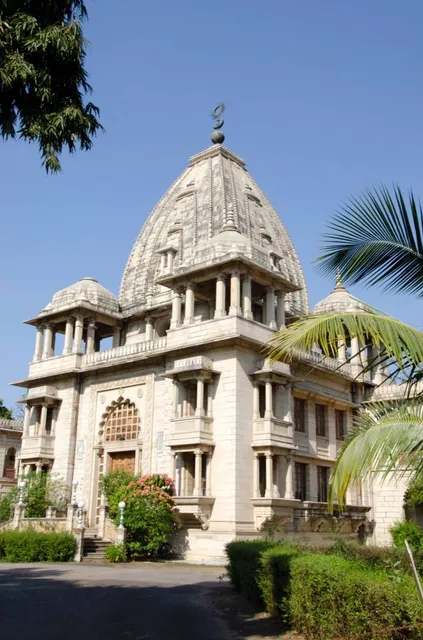
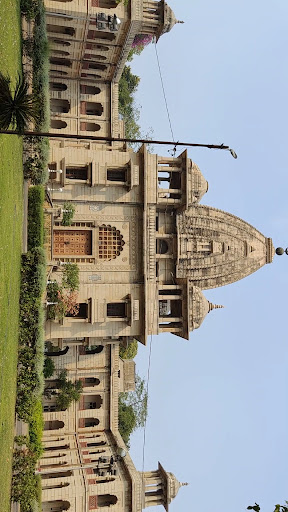
The architectural design of Kirti Mandir is a striking example of Indo-Saracenic style fused with traditional Hindu temple motifs. The main structure is shaped like the letter "E" and features exquisite elements such as balconies, terraces, domes, and an impressive central shikhara that rises to about 35 meters. The shikhara is uniquely adorned with bronze representations of the sun, moon, and Earth, symbolizing cosmic harmony, complete with an undivided map of India—a poignant reminder of unity and continuity. The building was designed by architect Talwalkar, who apprenticed under British architect Sir Edward Lutyens, blending European and Indian architectural sensibilities in a harmonious manner.
Beyond its architectural appeal, the interiors of Kirti Mandir reveal artistic treasures of remarkable caliber. The marble-finished halls are adorned with intricate murals painted by the renowned Bengali artist Nandalal Bose. These murals depict classical themes from Indian epics and mythology, including scenes from the Mahabharata’s great battle, the life of the devotional poet Meera Bai, the Gangavataran (descent of the river Ganges), and the famous dance drama Natir Pooja. These artworks contribute to the spiritual and cultural aura of the monument, inviting visitors to embark on a visual journey through India’s ancient narratives and royal heritage.
Kirti Mandir also serves as a cenotaph for the Gaekwad family, housing statues and precious photographs of deceased members of the royal lineage. Adjacent to the main building lies the cremation ground known as Kardeshwar Ghat, adding a poignant sense of reverence to the site. The memorial remains an active space for prayer meetings, ceremonies, and cultural events, deeply connecting the present community with Vadodara’s regal past.
Visitors to Kirti Mandir often describe it as a soul-stirring experience where history, art, and architecture converge beautifully. The monument stands surrounded by tall trees and landscaped gardens, offering a peaceful retreat within the bustling city. It is particularly popular during festivals like Diwali, when the site is beautifully illuminated and cultural programs, including rangoli competitions, enliven...
Read moreKIRTI MANDIR : ANCIENT HERITAGE TEMPLE OF FAME THE CENOTAPH OF THE GAEKWADS
The outstanding stone building is constructed in the shape of a letter "E" with terraces, balconies, domes and a central shikhara that rises to approximately 35 metres.
The interiors of the Kirti Mandir are marble treated and brilliantly decorated with intricately carved murals.
The walls of the central hall are adorned with many impressive murals such as the Gangavataran, Life of Meera, battle of Mahabharat and Natir Poojan which are all very well preserved works from the renowned Bengali artist Nandalal Bose.
Statues as well as precious photographs of eminent members of the Gaekwad family are also displayed for public viewing.
According to annals of history, the golden era in the Maratha rule of Baroda commenced when Sayajirao Maharaja came into power in 1875.
The Kirti Mandir of Baroda was built at the cost of Rs.50,000, it preserves in its various rooms the statues and photographs of the members of the royal family.
The interior of this elegant structure is marble finished and on the walls of the central hall are the murals Gangavataran, battle of Mahabharat, Life of Meera and Natir Pooja-executed by the famous Bengali artist Nandalal Bose.
The Kirti Mandir in Vadodara is actually a cluster of temples dedicated to Lord Shiva.
The temples were constructed by His Highness Maharaj Sayajirao Gaekwad in 1936, on the occasion of the Diamond Jubilee celebrations.
Also known as the Temple of Fame, it is situated near the picturesque Vishwamitra Bridge of the city, in the memory of deceased members of the royal Gaekwad family.
The marble treated interiors of the Kirti Mandir is wonderfully decorated with intricately carved murals.
The characteristic ‘shikhara’ of this statuesque monument represents the sun, the moon and the earth in bronze with the undivided...
Read moreKirti Mandir, also known as the Temple of Fame, is a historical and cultural landmark located in Vadodara, Gujarat, India. It is dedicated to the memory of the Gaekwad dynasty, which ruled the princely state of Baroda (now Vadodara) from the 18th century until India's independence in 1947.
Kirti Mandir was built in 1936 by Maharaja Sayajirao Gaekwad III, the visionary ruler of Baroda, to honor the members of the Gaekwad dynasty. The structure serves as a mausoleum and houses the cremated remains of the Gaekwad family members, including Maharaja Sayajirao Gaekwad III and other prominent personalities.
The architectural style of Kirti Mandir reflects a blend of various influences, including Hindu, Islamic, and European elements. The central dome of the structure resembles the central dome of the Gol Gumbaz in Bijapur, Karnataka. The temple is adorned with intricate carvings, beautiful murals, and stained glass windows, showcasing the rich craftsmanship of the artisans of that era.
Inside the Kirti Mandir, there are several memorials and portraits depicting the Gaekwad dynasty's history and notable figures. The museum within the temple complex showcases artifacts, photographs, and personal belongings of the Gaekwad rulers, providing visitors with insights into their lives and contributions to the region.
Kirti Mandir is not only a historical monument but also a significant cultural center. It attracts tourists, history enthusiasts, and devotees alike, who come to admire its architecture, pay their respects to the Gaekwad dynasty, and learn about the region's...
Read more