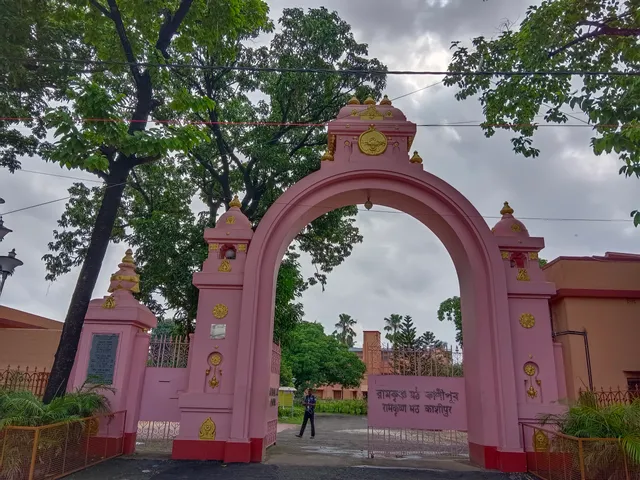
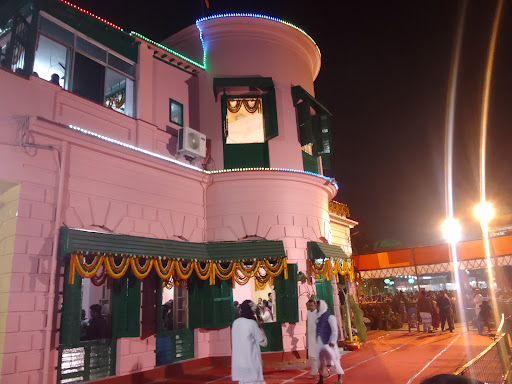
When Sri Ramakrishna was suffering from serious illness, he was removed for treatment from the Kali Temple of Dakshineswer to Shympukur in the month of October, 1885. A little more than three months after, when it was found that medicine and diet did not effect any improvement, the devotees at the suggestion of Dr. Mahendra Lal Sarkar, brought him in the afternoon of the 11th December, 1885 to the Cossipore Garden House which stood on the broad road that ran through the northern part of Calcutta and joined the Baghbazar area with Baranagar, three miles away from the city. This garden was free from stuffy and polluted atmosphere and the devotees were extremely happy when they saw that the master was pleased to find the fresh air and solitude of the place abounding in fruits and flowering plants.
The late Gopal Lal Ghosh, son-in-law of Rani Katyayani, was the owner of the garden. The devotees hired the house from him for the residence of Sri Ramakrishna on a monthly rent of Rs. 80/- (Eighty) for which an agreement was signed at first for six months and thereafter for three months more.
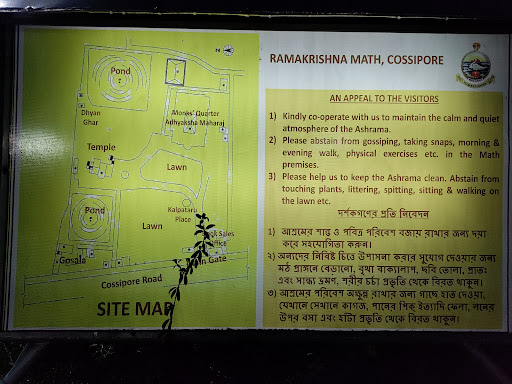
The site was a little more than eleven Bighas, four Kathas and two Chhataks in size. The place was surrounded on all sides by a high wall. There were side by side three or four small rooms used as kitchen and store about the middle of the northern part of the boundary wall. In front of these rooms, there stood, on the other side of the garden path, a two-storied residential building with four rooms below and two above. Of the ground floor rooms the central one was like a big hall. On the northern side of it, there were two small rooms contiguous to each other. Of these, the western room had a wooden staircase leading to the first floor while the eastern one was reserved for the Holy Mother.
The devotees used to sit in the aforesaid spacious rectangular hall lying east-west. The room on the southern side of the hall was used for the accommodation of the young devotees who attended on the Master. On the western side of the house, there was a path running north-south. At the southern end of this path, Sri Ramakrishna blessed many devotees in an ecstatic mood on the 1st of January in 1886.
There was a small verandah on the eastern side of the room which was meant for the attendants. Equal in dimension to the ground floor hall, there was above it a room on the upper floor, where Sri Ramakrishna used to live. On the southern side of it, there was an open walled terrace of a small size where Sri Ramakrishna sometimes walked and sat. The northern side of the roof above the room enclosing the staircase as well as the room of the same size as that of the one reserved of the holy mother on the ground floor, were used for the purpose of bathing of the master as well as for the accommodation of one or two...
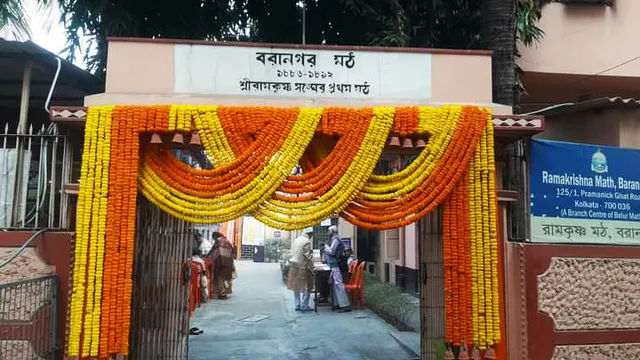
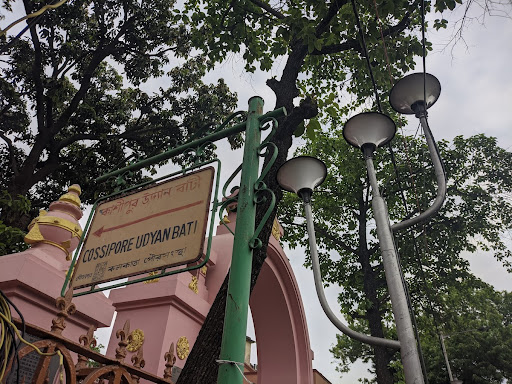
Read moreTucked away in a quiet, leafy lane of North Kolkata, far from the city’s traffic tantrums and chai-fuelled chaos, lies a place where time pauses respectfully — Ramakrishna Math, Cossipore Uddyanbati. This serene heritage home-turned-ashram isn’t just a structure of bricks and prayer — it’s a living chapter of spiritual India, humming gently with the legacy of Sri Ramakrishna Paramahamsa.
Once a garden house, the Uddyanbati became a spiritual crucible in 1885, when Ramakrishna, ailing with throat cancer, was brought here by his disciples for care. What unfolded over the next few months wasn’t merely a treatment of the body, but a profound transformation of minds — this was the very place where Narendranath Dutta truly blossomed into Swami Vivekananda. Yes, Cossipore Uddyanbati witnessed the genesis of one of India’s greatest spiritual movements.
What makes it truly iconic? Historic Significance: This is where Sri Ramakrishna spent his final days and continued to guide his disciples — even while battling terminal illness. His teachings during this phase were raw, intimate, and often peppered with humour and deep insight.
Vivekananda’s Moment of Realization: Here, young Narendra had his ultimate spiritual awakening, finally seeing his master not just as a teacher but as an incarnation of divinity. It was the birth of the Ramakrishna Order in spirit.
Unparalleled Serenity: The garden still retains its meditative calm. Sit under the mango trees or stroll past the blooming hibiscus, and you’ll know why they called it Uddyanbati — ‘The Garden House’.
Spiritual Reflection: This isn’t your average temple stop. It’s a quiet crucible of awakening, where echoes of chants from the past still seem to linger in the air. The shrine is simple, the museum poignant, and the aura? Absolutely soul-soothing.
Final Thought: Cossipore Uddyanbati isn’t just a monument — it’s a moment. One that transcends religion and whispers gently, “Be still, and know thyself.”
“The winds of grace are always blowing; it is for us to raise our sails.” –...
Read more'ṬHĀKURĒR ĀTMAPRAKĀŚĒ ABHAẎAPRADĀNA (in bengali- ঠাকুরের আত্মপ্রকাশে অভয়প্রদান: in english-The Bestowal of Freedom from Fear on All Devotees by Revealing Himself)' on 1 JANUARY 1886.
That was a relatively good day for Bhagwan Sri Ramakrishna Dev, and he took a walk in this garden-house. There, he asked one of his followers, Girish, a question, "Who do you say that I am?" Girish responded that he believed that Ramakrishna was "God incarnate, come to Earth out of mercy for humankind". Bhagwan Sri Ramakrishna Dev replied, "What more shall I say? MAY YOU BE AWAKENED." Ramakrishna then entered an "ecstatic state" and began touching all of his followers. Those he touched reported experiencing a variety of new states of consciousness, including vivid visions. One of these disciples was Saratchandra Chakravarty, later known as Swami Saradananda. Having witnessed the day's event from the rooftop of Ramakrishna's residence, Saradananda later commented that "Kalpataru Day" is a misnomer, since the mythological wish-fulfilling tree (Kalpataru) grants anything, GOOD OR BAD, and Ramakrishna gave only WHAT WAS SPIRITUALLY BENEFICIAL. Saradananda rather referred to the event as "the bestowal of freedom from fear on all devotees by revealing himself" (ĀTMAPRAKĀŚE ABHAYAPRADĀNA)
Visit this place on 1st January every year on the occasion of "Kalpataru Utsab". See the images here uploaded for 1st Jan 2016 celebration. Feel the serenity created by Bhagwan Sri Ramakrishna Dev. The top floor room where Bhagwan Sri Ramakrishna Dev stayed his last days, is a place right for meditation and one must find peace. Please stay for few minutes and meditate on God (Bhagwan Sri Ramakrishna Dev). U would remember his existence...
Read more