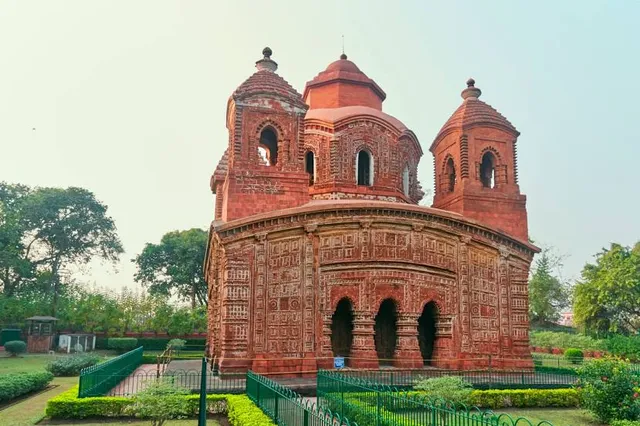
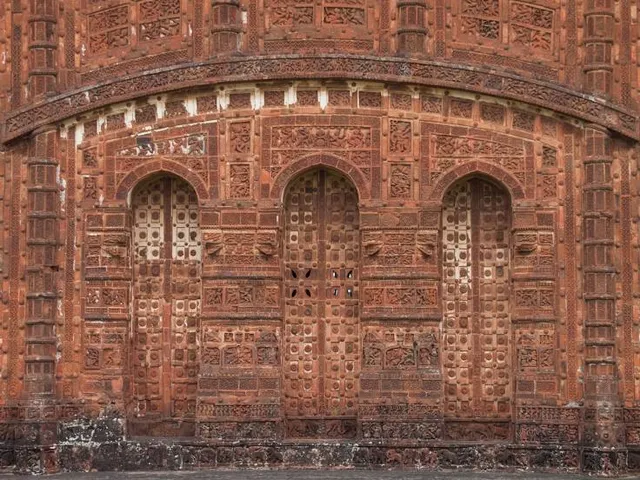
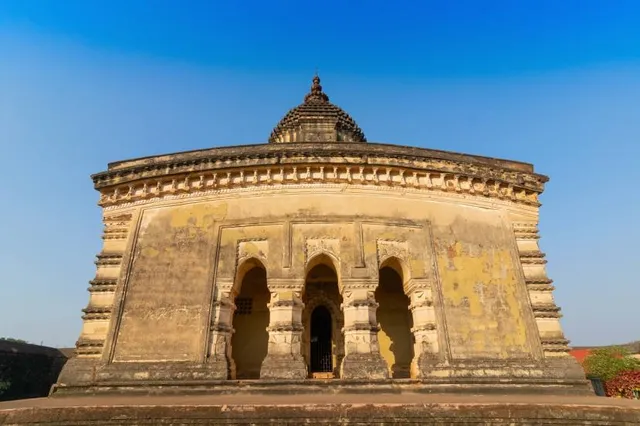
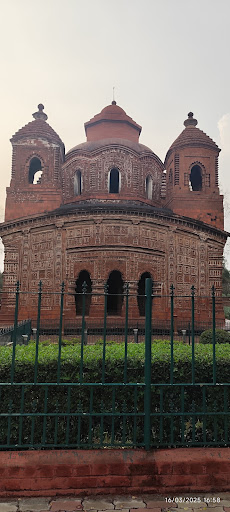
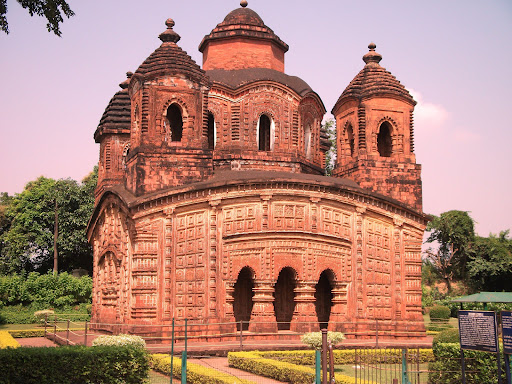
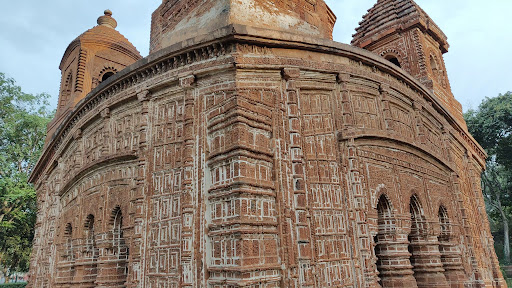
Bishnupur Pancharatna Temple also known as Shyam Rai Temple was built by King Raghunath Singha in 1643. Pancharatna Mandir stands on a low square plinth and consists of an ambulatory pathway with a porch opened by three arches on the four sides of the temple. The central shikhara is octagonal, while the rest four are square, walls are richly decorated with terracotta carvings featuring life aspects of Lord Krishna. The Pancharatna Temple honours Vishnu as Krishna, reflects the Pancharatna architectural style, and is perhaps West Bengal’s oldest surviving temple representative of this design. In Bengali Panchratna meaning five gem, hence it got the structures of five towers. Built entirely of brick, the only building material abundantly available in the region at the time, the Shyam Rai temple stands on a low square plinth with a char chala roof surmounted by ratnas or gems at each corner. While the towers in the corners are square-shaped, the central tower is octagonal in shape and they rest on a sloping roof in ‘Pida’ order. Each of the four sides of the temple greets us with triple multi cusped arched gateways, leading to the sanctum around which runs a well paved circumambulatory path. The curved cornice and eaves, derived from the thatched bamboo hut, so characteristic of Bengal, are special features of the temple, as of the others in Bishnupur. This style, directly descended from the bamboo framework of the huts, was originally bent into this shape to drain off rain water during frequent and intense downpours. The absence of stone or any other building material did not prove to be a deterrent to the architects and artisans of the times. Rather, they baked tales in clay tiles, narrating episodes from mythology and life, breathing life into bricks to give rise to a new form of temple architecture that lead to the construction of terracotta temples that were elaborately and intricately clad in high quality square panels of terracotta reliefs. The use of bricks in construction obviously meant that the routine column-beam style of building, characteristic of most early Islamic structures, could not be adopted. Hence, arches have been used to span spaces and support the weight above. Yet, a unique feature we observe about the Shyam Rai temple vis-à-vis most of Bishnupur’s temples is the influence of Islamic architecture in its curved ceiling. The Shyam Rai temple, with its superior figurines and floral motifs, was the first of its kind in Bengal. Its exterior and interior walls and ceiling are emblazoned with a profusion of stunning terracotta sculptures portraying Krishna Leela, episodes from the Ramayana and Mahabharata, and the socio-economic and political life of the people of the times. Particularly brilliant is the rasa mandala which embodies the convergence of artistic and structural knowledge. We also get to see a few specimens of the Gandhar style of sculpture on its walls. It is believed that the artisans of Uliwara and Panchmura villages close by were instrumental in carving high quality terracotta tiles with splendid...
Read moreBuilt in 1643 by King Raghunath, Shyam Rai temple has the most intricate sculptural details amongst all the Bishnupur temples. Shyam Rai Temple is an example of the Pancha Ratna (meaning five gems) architecture. The gems in this temple are the four small towers and one main tower that build the Temple. The architecture of this Temple is unique in its own way and is one of the highest prioritized monuments of the Archaeological Survey of India (ASI).
At a distance of 2 km from Bishnupur Bus Stand, Shyam Rai Temple is an ancient temple situated within the fort of Bishnupur. Located near Jor Bangla Temple, it is one of the popular temples in Bishnupur and among the must-see places to experience Bishnupur tourism.
It stands on a low square plinth and consists of an ambulatory pathway with a porch opened by three arches on the four sides of the temple. This brick-built temple consists of a square roof surmounted by five towers. The central tower itself is octagonal while the other four are square in shape. The walls are richly decorated with terracotta carvings featuring aspects of Lord Krishna's life. The curved ceiling of the temple is influenced by Islamic architecture which cannot be seen in any other temple.
Visitors can get the entry tickets for all the Bishnupur temples from Rasmancha including this one. Else, visitors are not allowed to enter inside the temple.
Timings: 6 AM - 6 PM
Entry Fee: Rs.10 for Indians & Rs.100 for Foreigners (to be taken...
Read moreThe Shyam Rai Temple at Bishnupur in Bengal’s Bankura district is massive in its scale and ornamentation. One of the most striking of these temples is the Shyam Rai Temple built by King Raghunatha Singh in 1643 – a structure that is massive in scale and in ornamentation. The temple, which honours Vishnu as Krishna, reflects the Pancharatna architectural style, and is perhaps West Bengal’s oldest surviving temple representative of this design. The edifice with its five towers, the central and tallest one surrounded by one each in the four corners, stands magnificent in the midst of well manicured, lush lawns.
Built entirely of brick, the only building material abundantly available in the region at the time, the Shyam Rai temple stands on a low square plinth with a char chala roof surmounted by ratnas or gems at each corner. While the towers in the corners are square-shaped, the central tower is octagonal in shape and they rest on a sloping roof in ‘Pida’ order. Each of the four sides of the temple greets us with triple multicusped arched gateways, leading to the sanctum around which runs a well paved circumambulatory path. The curved cornice and eaves, derived from the thatched bamboo hut, so characteristic of Bengal, are special features of the temple, as of the others in Bishnupur. This style, directly descended from the bamboo framework of the huts, was originally bent into this shape to drain off rain water during frequent and...
Read more