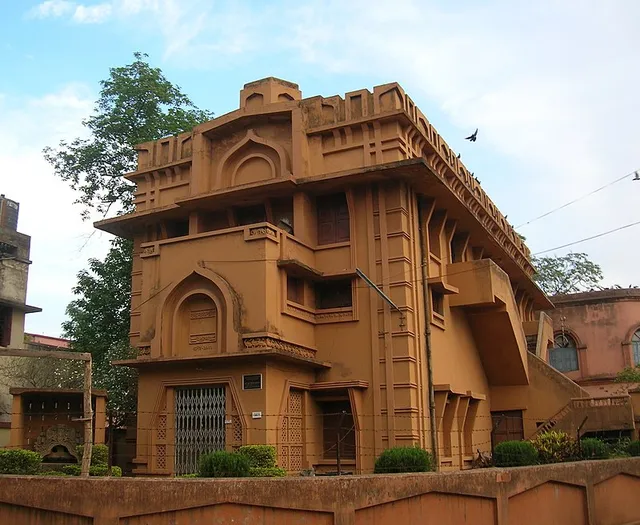
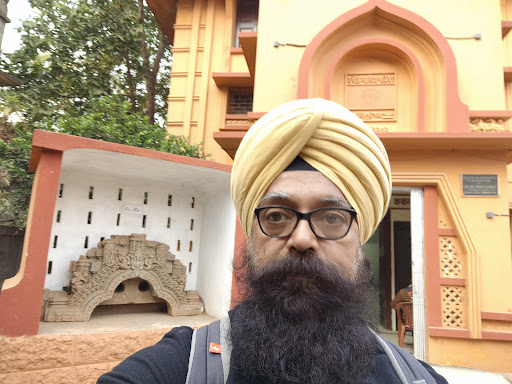
The Bankura District Museum or the Acharya Jagadish Chandra Purakriti Bhavan was inaugurated in 1951 and is now under the control of the Directorate of Archaeology and Museums, Ministry of Information and Culture, Government of West Bengal. It is important to mention at the outset that this museum differs from the contemporary understanding of museums. The museum was started by a group of people with limited knowledge of museum practices. Nevertheless it is to be seen as a significant attempt to preserve and archive the history and cultural heritage of Bishnupur and its surrounding areas.
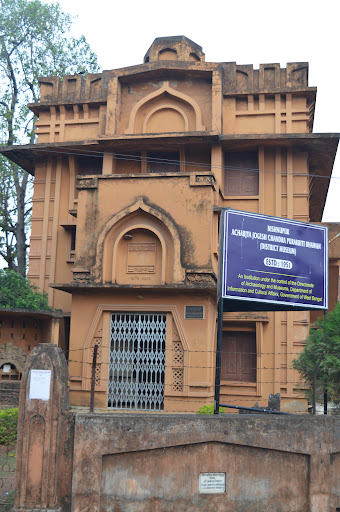
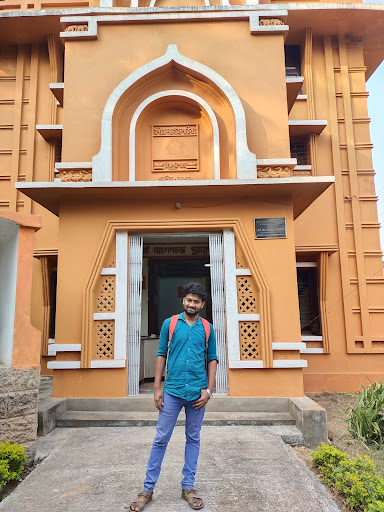
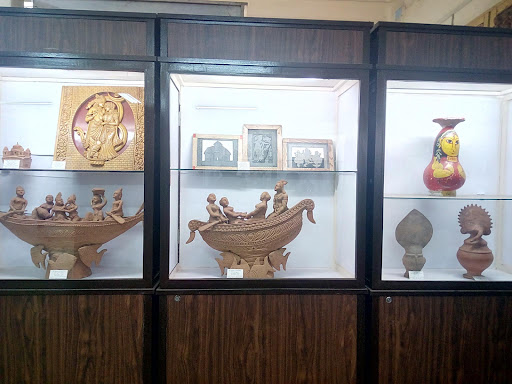
This museum preserves the traditions of terracotta and other indigenous art forms in Bankura. It is a double-storied, yellow building with three main galleries: on sculpture, music and terracotta. The first two galleries are spread over a large area on the ground floor while the terracotta gallery is on the first floor. In addition, as part of the terracotta gallery is a gallery showcasing rare photographs of Sree Sarada Devi, wife of Sri Rama Krishna Paramhansa[4] who was born in this district. A proposed anthropology gallery would make the fifth gallery. A decorative terracotta boat replica welcomes all visitors to the museum and also reminds one of how Bishnupur is synonymous with this art form. The museum is encircled by a small but well-manicured garden which further aestheticizes it.
Undoubtedly this museum is a great initiative by the people of Bishnupur. The fact that as early as 1955, realizing the necessity to preserve the art traditions of the place, they formed a group and started a museum needs to be appreciated. It is to be mentioned that around the same time museums all over the country were undergoing significant changes. Especially after the British rule, the desire to establish a museum to display one’s own heritage and culture was gaining prominence.[5] It became the rage. The present secretary of the museum, who also actively participated in its establishment, mentioned in an interview that Acharya Prafull Chandra Ray[6] always wanted to have a museum in the Bankura district. Mr Manik Chakraborty mentioned that Ray expressed his desire to build a museum in Bishnupur in an international journal. He strongly believed that the remarkable terracotta artefacts and temples with which Bishnupur is replete need to be preserved. A museum that not only displayed these fantastic objects from Bishnupur but also brought to light the history and culture of south-western Bengal was for him an immediate necessity. Unfortunately, due to some unknown constraints he was unable to...
Read moreTushar Sarkar, the current curator of Bishnupur Museum, says that when it was established in 1951, the museum was a private effort, led largely by such local luminaries as former Bishnupur High School teacher Maniklal Singha, and a few of his colleagues such as Chittaranjan Dasgupta. These founders sourced artefacts from various sources, including private collections, and the museum’s sizable collection was eventually taken over by the West Bengal government’s Directorate of Archaeology and Museums.
Today, the museum houses nearly 5,000 old manuscripts such as the ‘Chaitanya Charitamrita’, ‘Madanmohan Bandana’, and various ayurvedic texts, more than 100 sculptures dating primarily from the 10th-12th century AD, remnants of British history, and several priceless specimens of textiles, various photographs, and tribal art and craft. That apart, there are microliths from the Mesolithic and Chalcolithic eras, coins and artefacts from various historical eras such as the Pushana, Sunga, Gupta, and Pala, establishing a history of continuous human habitation in Bankura from prehistoric times.This museum preserves the traditions of terracotta and other indigenous art forms in Bankura. It is a double-storied, yellow building with three main galleries: on sculpture, music and terracotta. The first two galleries are spread over a large area on the ground floor while the terracotta gallery is on the first floor.A beautiful museum hosting several different artefacts. Bishnupar gharana, people who made name for themselves and Bishnupur, paintings, frescoes. Small but great collection. Do visit when you are there. Ticket price is 10 INR per personHistory of the area preserved with archeological evidence collected from old temples, kingdom and people. Identified Sorted and displayed chronologically with brief description by...
Read moreEstablished in 1951, Bishnupur Museum is the only museum in the entire district of Bankura related to art and archaeology. The museum is now under the control of the Directorate of Archaeology and Museums, Ministry of Information and Culture, Government of West Bengal. The museum has nearly 5000 manuscripts, 100 sculptures of the 10th-12th century CE, British history and several invaluable specimens of textiles, various photographs, and folk arts and crafts.
From microliths of the Mesolithic era to sculptures of the 12th century, the museum has an invaluable collection. This Museum accounts for the coins and artifacts from the very ancient days of rulers in Bishnupur, starting from the Gupta kings to the Pal kingdom. Also, there are contemporary art and paintings, manuscripts and rare photographs. The museum also contains a music gallery and a tribal art gallery which is often overlooked.
At a distance of 1 km from Jor Bangla Temple and 2 km from Bishnupur Bus Station, Bishnupur Museum is a museum located at Dalmadal Para in Bishnupur town of West Bengal. Officially known as Acharya Jogesh Chandra Purakriti Bhawan, it is one of the prime places to visit in Bishnupur.
Timings: 11 AM - 6.30 PM
Entry: Rs....
Read more