About Corporation of Chennai Brief Note on Corporation Of Chennai The Corporation of Chennai (previously Madras) is the Oldest Municipal Institution in India established on the 29th September 1688. A charter was issued on the 30th December, 1607 by East Indian Company constituting the "Town of Fort St. George" and all the territories thereunto belonging, not exceeding the distance of ten miles from the Fort, into a Corporation. The Parliamentary Act of 1792 gave the Corporation power to levy Municipal Taxes in the City. The Municipal administration properly commenced from the Parliamentary Act, 1792 making provision for the good order and administration of the city. The Municipal Act has been amended introducing from time to time major changes in the constitution and powers of the Corporation. The Madras Municipal Corporation Act, 1919 (as amended) provides the basic Statutory authority for the administration now. HISTORY Sir Josiah Child, one of the directors of the East India Company was responsible for the formation of the Corporation of Chennai, on the model of Dutch Government in the East Indies. On 29th September 1688, the corporation was inaugurated with power to decide petty cases, levy rates upon the inhabitants for building of schools, a town hall and a jail. Mr. Nathaniel Higginson was nominated as First mayor with 12 aldermen and 60 burgesses. ADMINISTRATIVE SET UP The Council of 200 councilors is headed by the Honorable Mayor and Council meets ordinarily once in a month. The executive wing is headed by the Commissioner. There are Deputy Commissioners and various Heads of Departments and 15 Zonal Officers at present. AREA & POPULATION Chennai is located on the Coromandel Coast on the Northern end of the State of Tamil Nadu. The city stretches along the Coromandel Coast much of its superb sandy beach and extends inland. Its irregular shape covers about 426 Sq. Km. The estimated present population of Chennai is 6.5 Million. SALIENT FEATURES OF CHENNAI CORPORATION Chennai Corporation is Maintaining 1160 roads to a length of 370 Km and storm water drain to a length of 962 Km. Total numbers of street lights in Chennai city under the maintenance of Chennai Corporation is 2, 13, 045 and using 19 megawatts per day, and spending 2 lakhs for electric consumption per day. Chennai Corporation having 260 parks and constructed 113 community halls for public purpose. Chennai Corporation is removing 5000-5200 MT of solid waste per day through 966 conservancy vehicles and maintaining Kodungaiyur and Perungudi dumping grounds for dumping the solid waste. The total birth reported in Chennai city is 400 per day and death is 180 per day. Currently 23,538 staffs are working in it. The Annual Budgetary estimate of Chennai Corporation in 2012-13 revenue is 1326.11 crores and expenditure is 1232.97 crores. Surplus income is 93.14 crores. INDUSTRIES Over the years, the City has developed in trade, commerce and industry. Chennai City is the biggest industrial and commercial centre of South India. There are about 15,000 industries and factories licensed in the Chennai City. CLIMATE Chennai climate varies from humid to hot humid with 24° C mean...
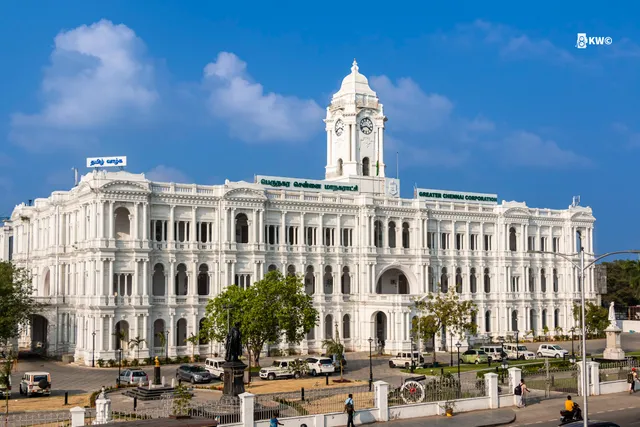
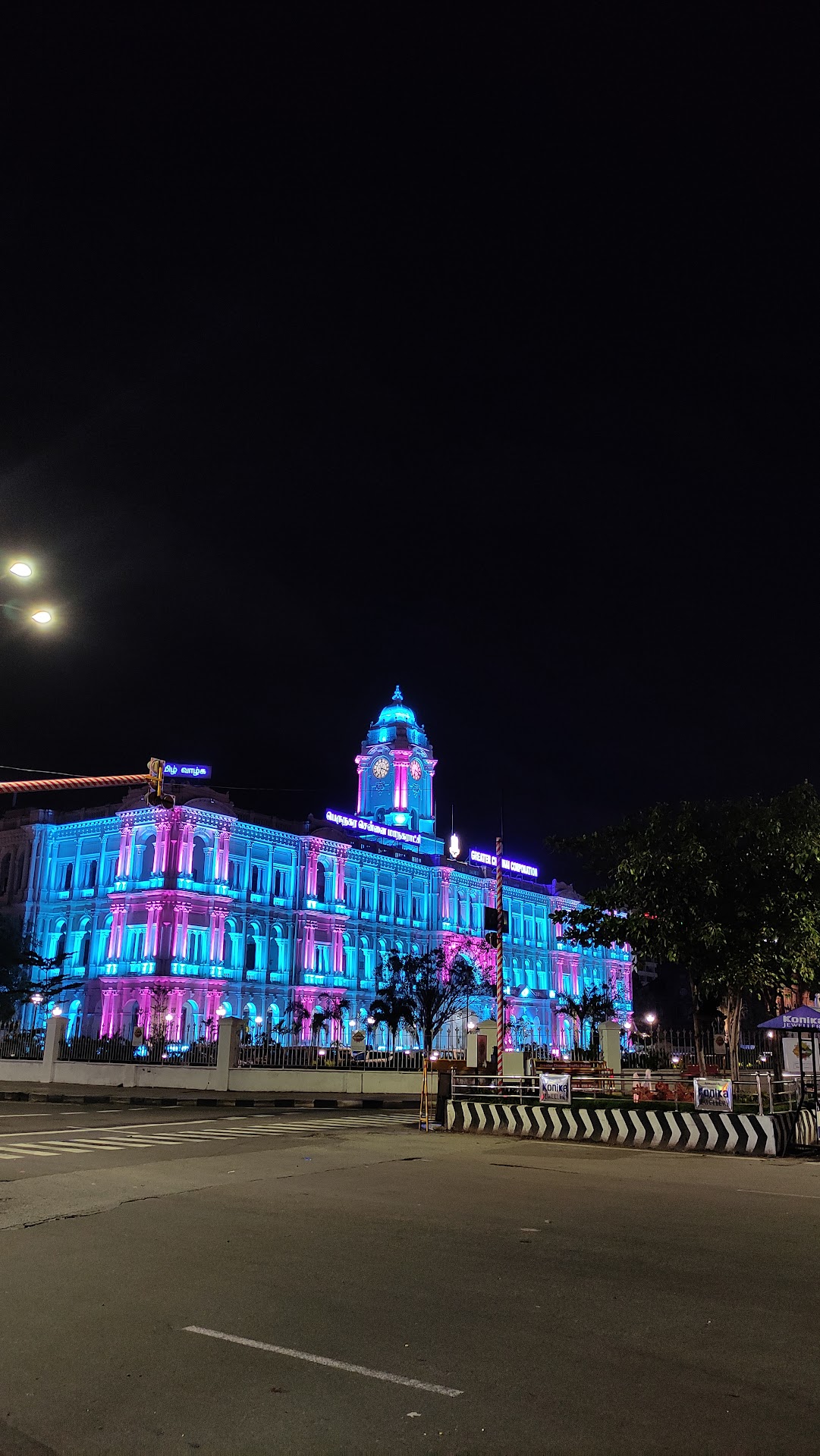
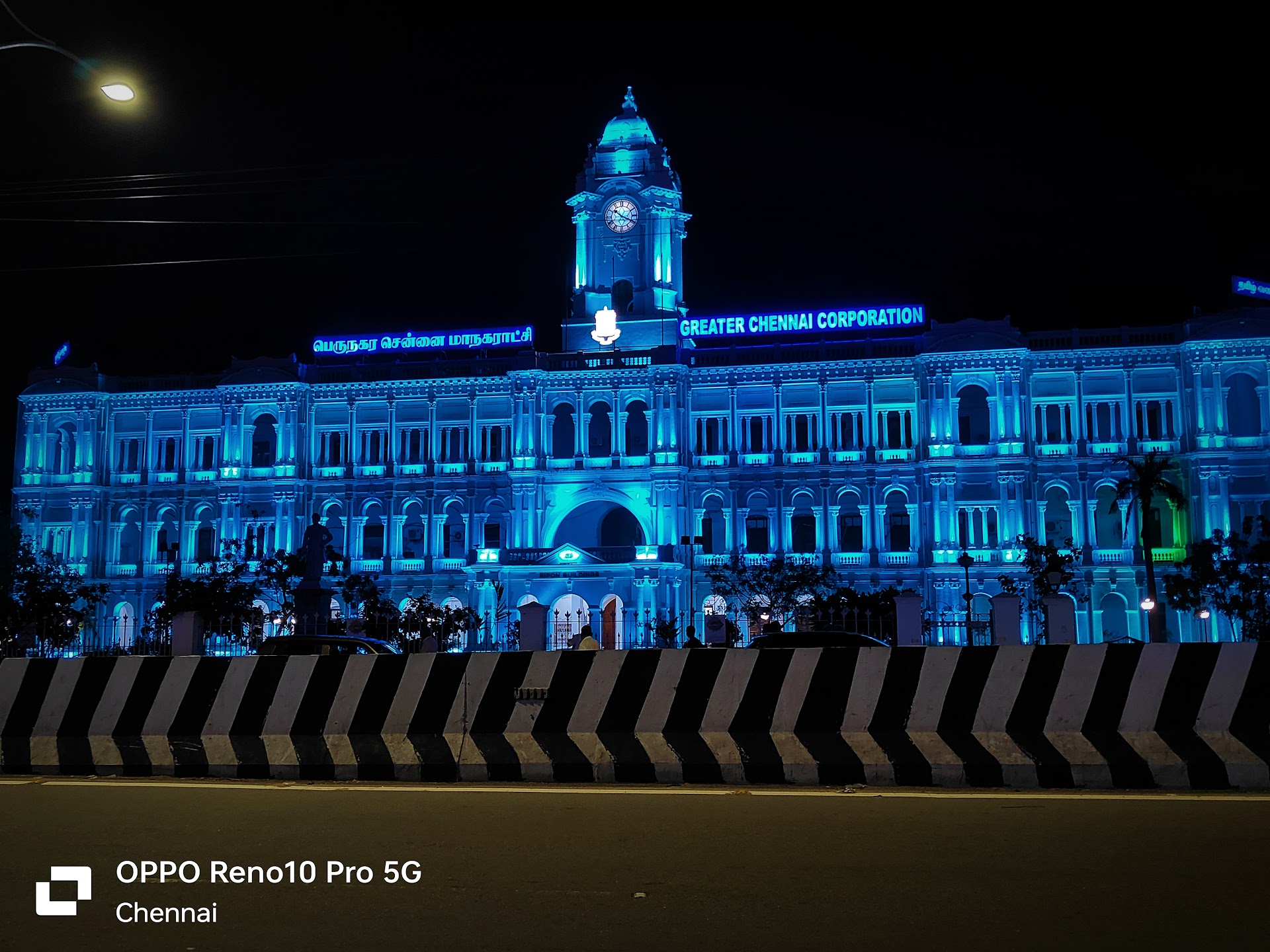
Read moreThe Greater Chennai Corporation, commonly referred to as the Chennai Municipal Corporation or the Chennai Corporation, is the governing body responsible for the administration and management of the city of Chennai, Tamil Nadu, India. The corporation has its headquarters located in the Ripon Building, a historic landmark in the heart of the city.
The Ripon Building, constructed in 1913, serves as the corporate office of the Greater Chennai Corporation. It is named after Lord Ripon, who was the Governor-General of India and played a significant role in implementing local self-government in Chennai during the colonial era.
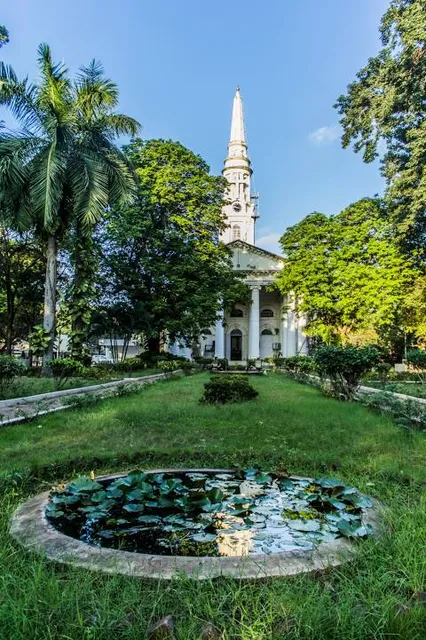
The building itself is an architectural marvel, designed in the Neoclassical style, and stands as a symbol of Chennai's colonial past. Its imposing façade, grand columns, and intricate detailing make it an iconic structure that represents the heritage and history of the city.
Inside the Ripon Building, the Greater Chennai Corporation carries out its administrative functions. It houses various departments and offices responsible for urban planning, public works, health, sanitation, revenue, and other essential municipal services. The building's interior features spacious halls, offices, and meeting rooms, creating a conducive environment for the corporation's day-to-day operations.
As the headquarters of the Greater Chennai Corporation, the Ripon Building plays a vital role in the governance and development of the city. It serves as a hub for decision-making, policy formulation, and coordination of various municipal activities. The corporation works towards ensuring the smooth functioning of the city's infrastructure, public services, and welfare programs.
The location of the Ripon Building in the central part of Chennai makes it easily accessible for citizens, officials, and visitors. Its historical significance and architectural beauty also attract tourists and those interested in the...
Read moreThe Ripon Building is the seat and headquarters of the Greater Chennai Corporation in Chennai, Tamil Nadu. It is an example of neoclassical architecture, a combination of Ionic and Corinthian styles. The Ripon Building is an all-white structure and is located near the Chennai Central railway station. Commissioned in 1909, the Ripon Building was designed by G.T.S. Harris. The foundation stone was laid by Lord Minto, Viceroy of India, on 11 December 1909. It was built by Loganatha Mudaliar, and took four years to build at a cost of ₹750,000, including a sum of ₹550,000 paid to Mudaliar.The Ripon building was named after Lord Ripon, Governor-General of British India and the Father of local self-government. Earl of Minto, the then Viceroy and Governor General of India laid the foundation on 12 December 1909.
The Municipal Corporation of Madras, after functioning from several other places including Errabalu Chetty Street, settled at Ripon building in 1913, with P. L. Moore as the President of the Municipal Corporation at the time of the inauguration. The inaugural function was attended by over 3,000 of the city's elites. The building is rectangular, 85 metres (279 ft) long and 32 metres (105 ft) wide, with a 43 metres (141 ft) high central tower containing a clock 2.5 m (8.2 ft) in diameter. The first of its three floors has approximately 2,800 m2 (30,139 sq ft) of space.The walls were constructed with stock bricks, set and plastered with lime mortar and the roof is supported with teak wood joists. The original flooring of the ground floor was Cuddapah Slate that has been replaced with marble. In 1913, one of the building's main attractions, the Westminster Quarter chiming clock, was installed by Oakes and Co. The clock has a mechanical key system, which must be wound daily. There are four bells, which were cast by Gillet and...
Read more