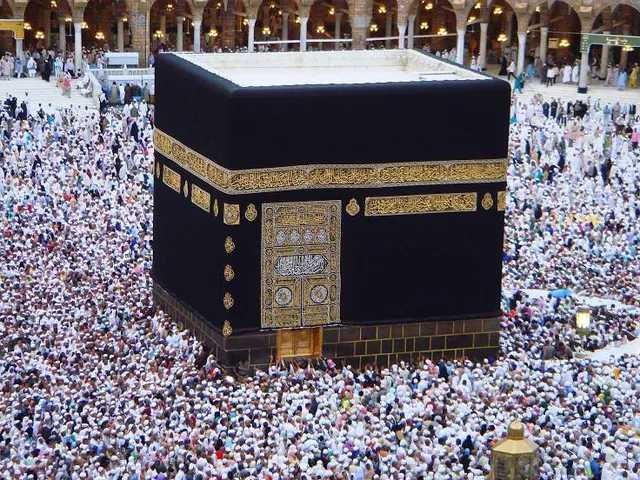
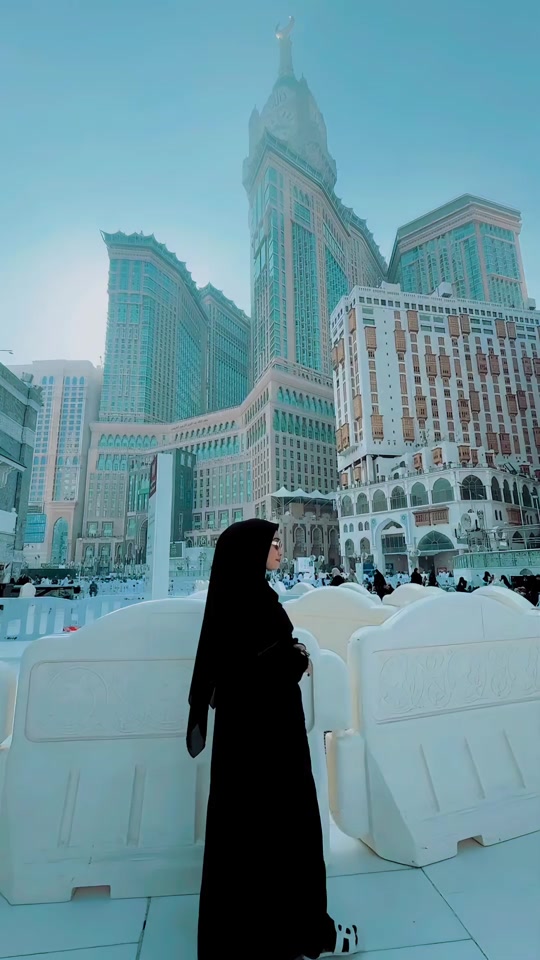
Best place on the planet, but watch out- it's crowded beyond any crowd you've ever seen. The majority of people are gross, rough, and completely ignorant of the Islamic concepts of decency and respect to others. Funny enough, a single Muslim is worth more to Allah than the land and even the Kaaba, yet majority of the pilgrams here are giving over-respect to the Kaaba and disrespectful of all others. I'm just sharing this to get your expectations in line. It's not going to be you alone in front of the Kaaba. In fact, they do so much construction that at times the ground floor is almost always full and the upper levels are either closed or somewhat restricted.
They're also only allowing those in ihram to get to the bottom floor. They don't care about your intentions, just your clothing. It's a quick and dirty way to crowd control. I don't know why they don't do turn style entrances and once the limit is hit they don't allow anymore people in.
Wheelchairs and strollers are only allowed on the upper floors. But be aware, the circumference is much bigger so you'll be walking a lot more per tawaf circuit.
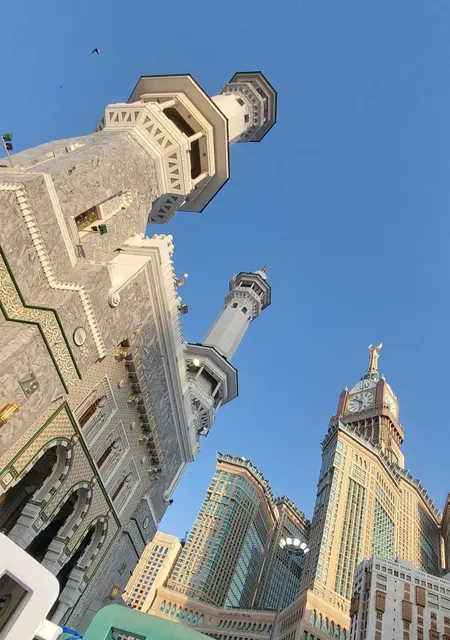
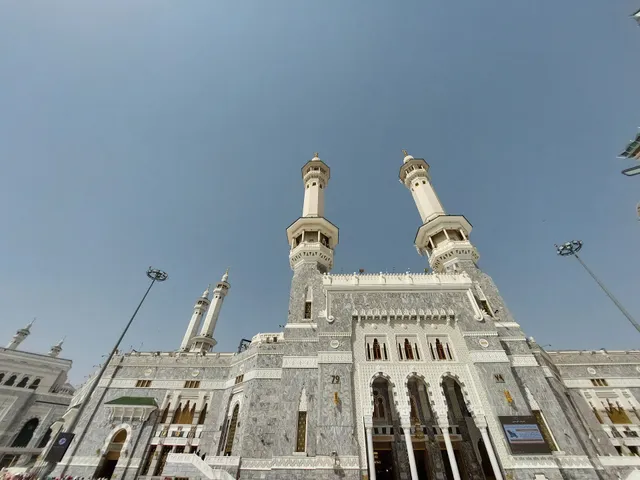
It's easy to get lost so use the clock tower as a landmark.
Try to use the bathroom before coming because the bathrooms here aren't great and there's usually a line.
The guards separate the men and women during prayer times, although there's no Islamic law to back up that claim. Don't fight them. They're difficult people but they're just doing what they're commanded to do. Take it up with the salmon prince boy 👑 🐟 if you're upset, but I'm sure he'll tell you to come back during 2030, because that's all he cares about.
Take breaks and drink plenty of Zamzam. Look up a Birdseye map of the location and familiarize yourself with the gates and their locations relative to the clock tower, plus do the same with your hotel.
They don't check the nusuk app because it's too crowded, so don't bother reserving a spot. But definitely do so for the rawdha at the masjid nabawi, because they're super strict about it there.
Also, I recommend using Uber because the private taxis are crazy expensive. 40SAR vs $80USD...
If you forget or run out of anything, bin dawood should have your back. Try to avoid al baik chicken because it's too crowded and the order is almost always wrong. Also it'll make you feel gross while doing your ibada.
Do yourself a favor and get a close hotel, but also an expensive one. It'll be worth it for you and your family. You don't want to go from a crowded masjid to a crammed room.
For jumah, you'll want to get there about 6 hours early for any spot inside. I kid you not. The entire city pretty much shows up. For normal prayers, expect to be there about 2 hours early for a decent spot.
Get comfy slippers and don't carry any bag bigger than a cinch backpack. They'll rarily let a normal backpack in, even if you offer to show them the contents. They have some leeway for mothers. But if you have a stroller, just pack things into it and go to the upper levels.
When you sit to pray, you'll be surprised that those near you are usually very nice. Weird because when doing tawaf, they could be really rude. Allahu musta'aan.
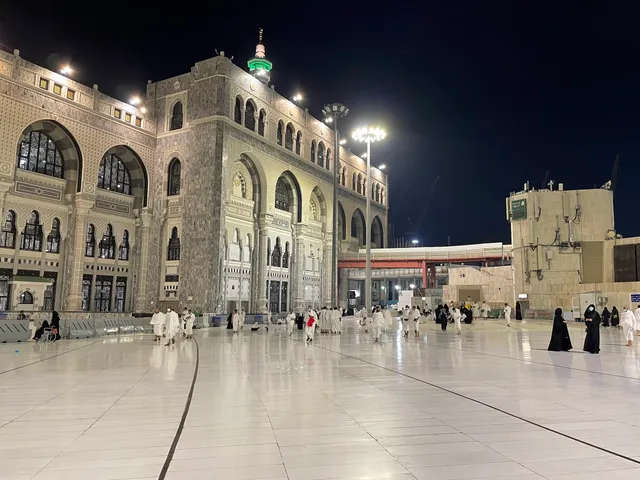
In the pics you can see the crowd during jumah about 3 or 4 hours prior. You can also see the pics of when I was leaving during the same time to get to my hotel for an emergency. You can see how crowded the incoming horde is. Let me tell you, they didn't make it past the walls. All those people had to pray outside. Yup. 4 hours prior, that's how crowded it gets... Zoom in if you don't think it's crowded.
Go with pure and patient intentions and you'll be surprised at how Allah will widen the place for you and give you the One on one you're looking for. May Allah accept your Hajj, umrah, and prayers and please keep me...
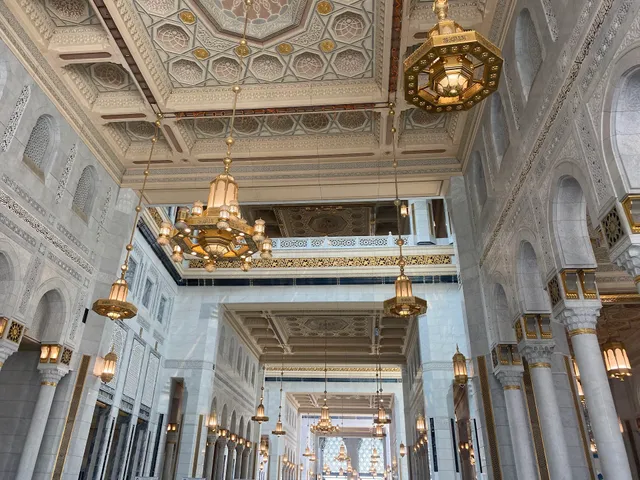
Read moreMasjid Al-Haram, located in the heart of Makkah, Saudi Arabia, is not only the largest mosque in the world but also the most sacred site in Islam. This majestic and spiritually significant mosque surrounds the Holy Kaaba, which is the Qibla—the direction Muslims around the globe face during their prayers. Visiting Masjid Al-Haram is a deeply emotional and life-changing experience for Muslims, as it is the focal point of their faith and religious rituals. The centerpiece of Masjid Al-Haram is the Kaaba, a cube-shaped structure draped in a black silk and gold curtain (Kiswah). According to Islamic tradition, the Kaaba was originally built by Prophet Ibrahim (Abraham) and his son Ismail (Ishmael) as a house of monotheistic worship. Pilgrims from every corner of the world gather here to perform Hajj and Umrah, fulfilling one of the pillars of Islam. Watching millions of believers circumambulate the Kaaba during Tawaf is a breathtaking sight that brings tears to the eyes and peace to the heart. Masjid Al-Haram is not just a mosque—it is a spiritual universe where every corner radiates tranquility and divinity. The sound of the Adhan (call to prayer) echoing through the minarets is profoundly moving. The grand mosque is open 24/7 and provides facilities that accommodate millions of worshippers. With its magnificent white marble floors, cool under the feet even in scorching heat, the mosque is meticulously designed to preserve both comfort and holiness. One of the most emotional and spiritually enriching spots within Masjid Al-Haram is the Maqam Ibrahim—a small, glass structure housing the footprint of Prophet Ibrahim (AS), left while building the Kaaba. Nearby is the Zamzam Well, a miraculous water source that has never run dry for centuries, believed to have been gifted by Allah to Hagar and baby Ismail. Another significant element tied to the sacredness of Masjid Al-Haram is the city of Makkah itself, which is the birthplace of Prophet Muhammad (peace be upon him). The Prophet was born here in the year 570 CE, and his early life, prophethood, and struggles for the message of Islam all unfolded in this blessed land. Being in Makkah brings believers a deep connection to the history and heritage of Islam. Masjid Al-Haram has undergone incredible expansions over the years to serve the growing number of pilgrims, yet it has maintained its spiritual charm and grandeur. The mosque is exceptionally clean, well-managed, and equipped with services like escalators, prayer areas for women, wheelchairs for elderly pilgrims, and guided information in multiple languages. The atmosphere inside the Haram is filled with humility, devotion, and peace. People of every nationality, color, and background unite here under one faith, standing shoulder to shoulder in prayer, reflecting the true spirit of Islamic brotherhood. In conclusion, Masjid Al-Haram is not only a place of worship; it is the soul of Islam. The Kaaba, the birthplace of Prophet Muhammad (PBUH), and the presence of historical Islamic landmarks make this place a once-in-a-lifetime destination for every Muslim. The feeling of standing in front of the Kaaba, praying in submission to the Almighty, is indescribable and stays with...
Read moreSubhanallah..
Masjidil Haram: The Grand Mosque of Mecca
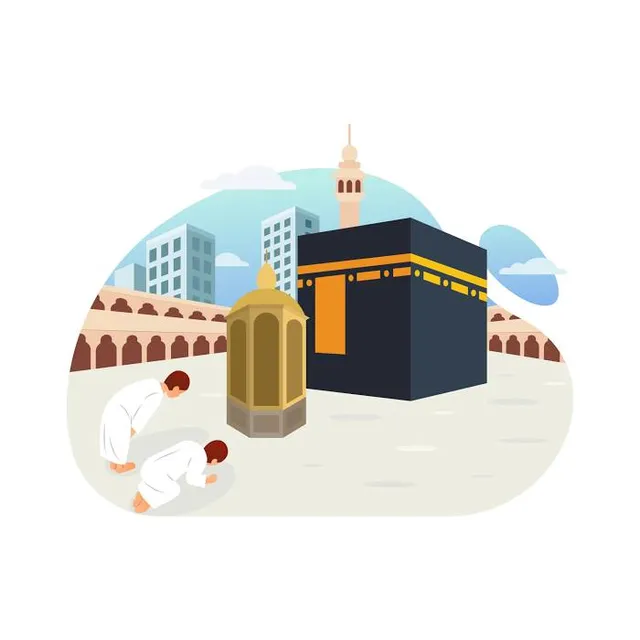
Masjidil Haram (المسجد الحرام) is the holiest mosque in Islam, located in Mecca, Saudi Arabia. It surrounds the Kaaba, the most sacred site in Islam, which Muslims face during their daily prayers (Qibla).
Key Features of Masjidil Haram The Kaaba The cube-shaped structure at the center of Masjidil Haram. Built by Prophet Ibrahim (AS) and Ismail (AS) as a house of worship. Covered in the Kiswah, a black silk and gold-embroidered cloth.
The Black Stone (Hajar al-Aswad) A revered stone from paradise, set in the eastern corner of the Kaaba. Muslims try to touch or kiss it during Tawaf (circumambulation). It is believed to have descended from Jannah
Maqam Ibrahim A stone where Prophet Ibrahim (AS) stood while building the Kaaba. Enclosed in a golden cage near the Kaaba.
Zamzam Well A miraculous non stop water source that sprung for Hajar (AS) and baby Ismail (AS). Located within the mosque, pilgrims drink from it during Hajj and Umrah.
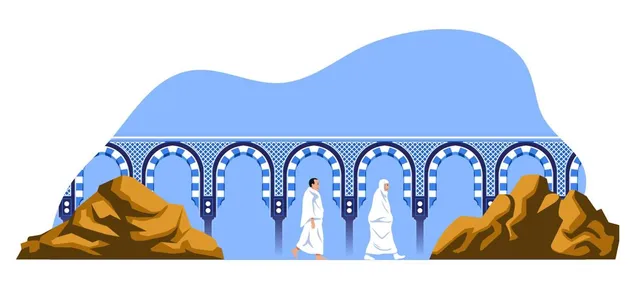
Safa and Marwah Two small hills inside Masjidil Haram. The site where Hajar (AS) ran in search of water for her son Ismail (AS). Pilgrims perform Sa'i (ritual walking) between these hills.
The Expansion Projects Masjidil Haram has undergone multiple expansions under Ottoman, Saudi, and modern administrations. Currently, it can accommodate over 2.5 million worshippers.
Hadith About Masjidil Haram & The Kaaba Prayers in Masjidil Haram Abu Hurairah (RA) reported that the Prophet (SAW) said: "One prayer in my mosque (Masjid Nabawi) is better than a thousand prayers in any other mosque except for Masjid al-Haram, and one prayer in Masjid al-Haram is better than a hundred thousand prayers in any other mosque." (Ibn Majah 1406, Musnad Ahmad 14694)
The First House of Worship Allah says in the Quran: "Indeed, the first House [of worship] established for mankind was that at Makkah – blessed and a guidance for the worlds." (Surah Aal-e-Imran 3:96)
The Kaaba Will Be Destroyed Before the End of Time Abu Hurairah (RA) reported that the Prophet (SAW) said: "The Kaaba will be destroyed by an Abyssinian man with two small legs." (Sahih al-Bukhari 1595, Sahih Muslim 2909)
Tawaf Around the Kaaba Removes Sins Ibn Umar (RA) narrated that the Prophet (SAW) said: "Whoever circumambulates the House (Kaaba) seven times and prays two rak’ahs, it is as if he has freed a slave." (Ibn Majah 2955, Al-Tirmidhi 959)
Dua at the Multazam (Area Between the Kaaba Door & Black Stone) is Accepted Ibn Abbas (RA) said: "The area between the Black Stone and the door of the Kaaba is called the Multazam. No one makes dua there without it being accepted." (Musannaf Ibn Abi Shaybah 12375)
Virtues of Masjidil Haram & The Kaaba The first mosque ever built on earth. The only place where Tawaf (circumambulation) is allowed in worship. Angels constantly surround the Kaaba making Tawaf in the heavens (Al-Bayt Al-Ma'mur). One prayer there equals 100,000 prayers elsewhere.*l Hajj & Umrah performed there wipe away...
Read more