History of the Hajj
Four thousand years ago the valley of Mecca was a dry and uninhabited place.
Muslims believe the Prophet Ibrahim (Abraham) was instructed to bring his wife, Hajira (Hagar) and their child Is'mail to Arabia from Palestine to protect them from the jealousy of Ibrahim's first wife Sarah.
Allah told the Prophet Ibrahim to leave them on their own, and he did so, with some supplies of food and water. However the supplies quickly ran out and within a few days Hajira and Is'mail were suffering from hunger and dehydration.
In her desperation Hajira ran up and down two hills called Safa and Marwa trying to see if she could spot any help in the distance. Finally she collapsed beside Is'mail and prayed to Allah for deliverance.
Is'mail struck his foot on the ground and this caused a spring of water to gush forth from the earth. Hajira and Is'mail were saved. Now they had a secure water supply they were able to trade water with passing nomads for food and supplies.
After a while the Prophet Ibrahim returned from Palestine to check on his family and was amazed to see them running a profitable well.
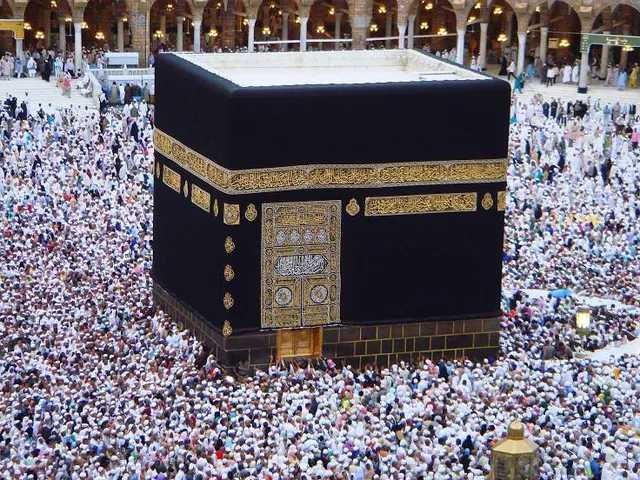
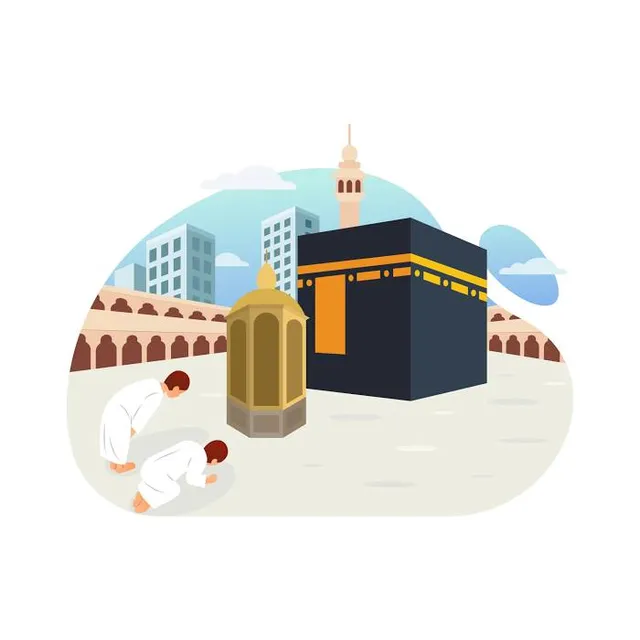
The Prophet Ibrahim was told by Allah to build a shrine dedicated to him. Ibrahim and Is'mail constructed a small stone structure - the Kaaba or Cube - which was to be the gathering place for all who wished to strengthen their faith in Allah.
As the years passed Is'mail was blessed with Prophethood and he gave the nomads of the desert the message of surrender to Allah.
After many centuries, Mecca became a thriving city thanks to its reliable water source, the well of Zam Zam.
Gradually, the people began to adopt polytheistic ideas, and worship spirits and many different gods. The shrine of the Prophet Ibrahim was used to store idols.
After many years, Allah told the Prophet Muhammed that he should restore the Kaaba to the worship of Allah only.
In the year 628 the Prophet Muhammed set out on a journey with 1400 of his followers. This was the first pilgrimage in Islam, and would re-establish the religious traditions of the Prophet Ibrahim.
Top Guide to going to Mecca
Guide to going to Mecca
Pilgrim with a handcart to carry his belongings Pilgrim with his belongings © It's best to travel light, so only take essentials.
Many pilgrims fly to Jeddah, and then travel to Mecca by bus.
Once you get to Mecca, there are two rituals which you can perform; the lesser pilgrimage or Umra, and the main pilgrimage or Hajj.
The Umra is an extra, optional pilgrimage and does not count as the once-in-a-lifetime Hajj. Although it includes some of the rituals of the Hajj, they are shortened and there are fewer of them.
Most pilgrims who come for the Hajj arrive a few days before it actually starts and perform Umra first. Combining the Hajj with the Umrah is called a Hajji-Tamattu.
Being pure
To carry out the pilgrimage rituals you need to be in a state of Ihram, which is a special state of ritual purity.
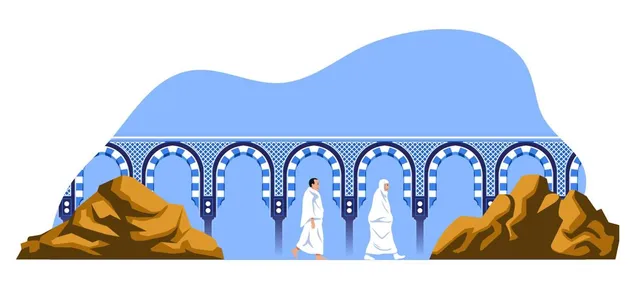
You do this by making a statement of intention, wearing special white clothes (which are also called ihram) and obeying the regulations below.
The person on the Hajj may not:
Engage in marital relations Shave or cut their nails Use cologne or scented oils Kill or hunt anything Fight or argue. Women must not cover their faces, even if they would do so in their home country. Men may not wear clothes with stitching. Bathing is allowed but scented soaps are frowned upon. Umra
The Hajj is a real pilgrimage - a journey, with rites and rituals to be done along the way.
You begin at a place just outside Mecca called the Miqat, or entry station to the Hajj.
There you bathe, put on the Ihram (the special white clothes), make the intention for Umra and begin reciting the Talbiya Du'a (prayer).
Here I am at Your service, O Allah,...
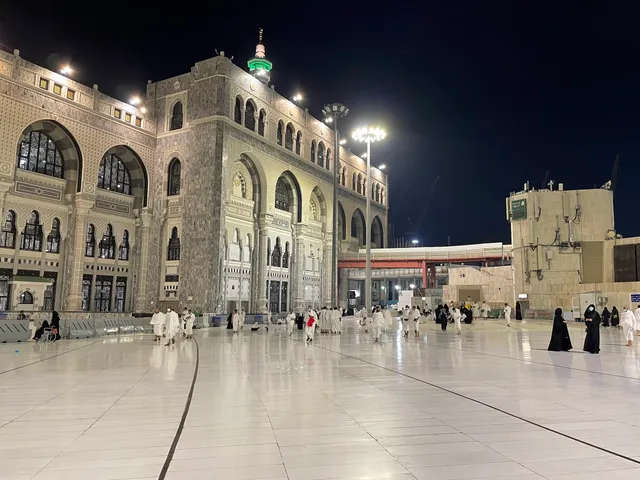
Read moreAl Salam Gate, situated in Jeddah, Saudi Arabia, is a mesmerizing architectural masterpiece that welcomes visitors with grandeur and cultural significance. This majestic gateway, with its intricate design and towering arches, serves as a testament to the rich heritage of the region.
The gate's name, "Al Salam," translates to "peace" in Arabic, and the structure exudes a sense of tranquility and harmony. Its impressive scale and meticulous detailing showcase the craftsmanship and artistic prowess inherent in Islamic architecture.
As a prominent landmark, Al Salam Gate holds historical importance, serving as a bridge between the city's past and present. The surrounding area, adorned with beautifully landscaped gardens, provides a serene space for locals and tourists alike to appreciate the beauty of the gate and its cultural context.
The night illumination of Al Salam Gate adds another layer of enchantment, casting a warm glow that enhances its aesthetic appeal. Beyond its visual allure, the gate serves as a symbol of hospitality, inviting all who pass through to experience the hospitality and cultural richness of Jeddah.
Al Salam Gate stands not only as a physical structure but also as a cultural emblem, embodying the essence of peace and welcoming those who encounter it to immerse themselves in the historical and architectural splendor...
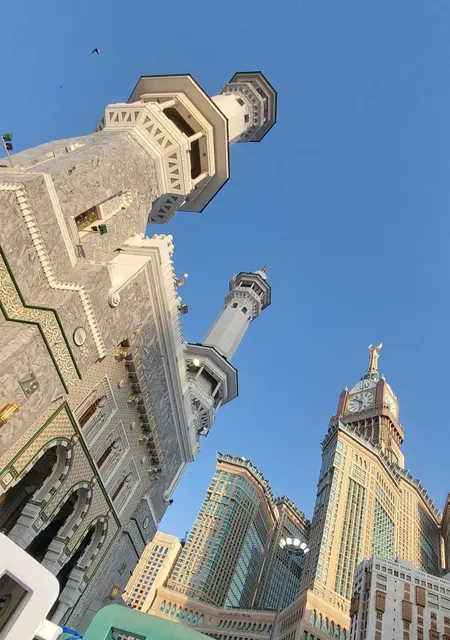
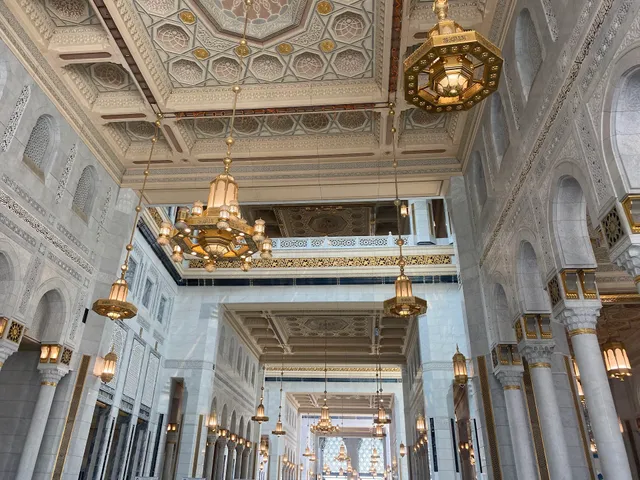
Read moreThe main and holy Gate of Masjid Al haram Brief points of Masid Al haram
Masjid al-Haram (The Sacred Mosque) is the holiest and largest mosque in Islam, located in Mecca, Saudi Arabia. Its most sacred feature is the Kaaba, the cube-shaped structure draped in black silk at its center, believed by Muslims to have been built by Abraham and his son Ishmael.
Key Points:
Direction of Prayer (Qibla): Muslims worldwide face the Kaaba during their five daily prayers. Pilgrimage Site: It is the focal point of the Hajj (annual pilgrimage), one of Islam's Five Pillars, which every able Muslim must undertake at least once. It's also central to the Umrah (lesser pilgrimage). Expansive Structure: Continuously expanded over centuries, it's the largest mosque globally, capable of holding millions of worshippers. Other Key Features: Includes the Black Stone (Al-Hajar al-Aswad) embedded in the Kaaba's corner, the Station of Abraham (Maqam Ibrahim), and the hills of Safa and Marwa connected by a long gallery (Al-Mas'a) within its complex. Spiritual Significance: Represents the unity of the Muslim Ummah (community) and is the most revered site in Islam.
Masjid al-Haram stands as the spiritual heart of the Islamic faith, drawing millions of...
Read more