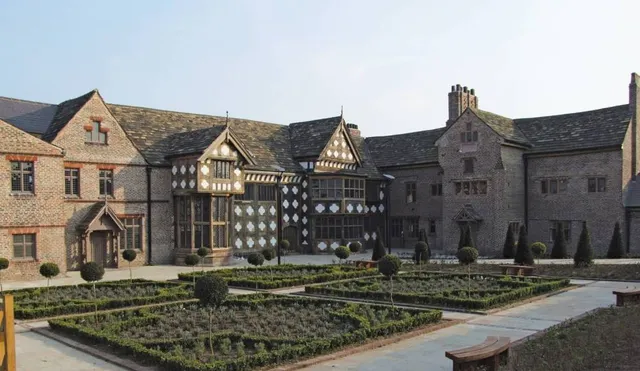
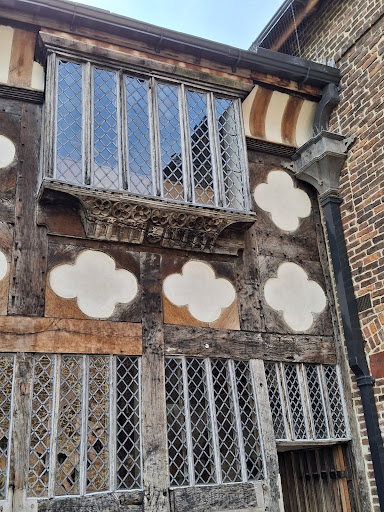
Ordsall Hall is a large former manor house in the historic parish of Ordsall, Lancashire, England, now part of the City of Salford, in Greater Manchester. It dates back more than 750 years, although the oldest surviving parts of the present hall were built in the 15th century. The most important period of Ordsall Hall's life was as the family seat of the Radclyffe family, who lived in the house for more than 300 years. The hall was the setting for William Harrison Ainsworth's 1842 novel Guy Fawkes, written around the plausible although unsubstantiated local story that the Gunpowder Plot of 1605 was planned in the house.
Since its sale by the Radclyffes in 1662 the hall has been put to many uses: a working men's club, a school for clergy, and a radio station among them. The house was bought by the old Salford Council in 1959 and opened to the public in 1972, as a period house and local history museum. The hall is a Grade I listed building, and entrance is free.
Ordsall Hall is a formerly moated Tudor mansion, the oldest parts of which were built during the 13th century, although there has been a house on the site for over 750 years. David de Hulton is recorded as the owner of the original hall, in 1251. The manor of Ordsall came into the possession of the Radclyffe family in about 1335, but it was not until 1354 that Sir John Radclyffe established his right of inheritance. The manor was described in 1351 as a messuage, 120 acres (48.6 ha) of land, 12 acres (4.9 ha) of meadow and 12 acres (4.9 ha) of wood.
During the 1340s Sir John Radclyffe campaigned with Edward III in France, distinguishing himself at the battles of Caen, Crècy and Calais. As a reward for his service, the king allowed Sir John to take some Flemish weavers back to his Ordsall estate, where he built cottages for them to live in. English weaving skills at that time were poor, and textiles from Manchester were considered to be of particularly poor quality, so the Flemish weavers were employed in instructing the local weavers. They also started up a silk weaving industry, the foundation for Manchester's later cotton industry.
At the time of the 1666 hearth tax survey, Ordsall Hall was the largest house in Salford, with 19 hearths. The Oldfield family of Leftwich, near Northwich, bought the estate at the end of the 17th century, and in 1704 it was sold again, to John Stock, a trustee of Cross Street Chapel. His family were probably the last owners to reside at the hall. The Stocks lived in the hall's central section, comprising "a large hall, lounge dining room, a chapel, six rooms on a floor, with brewhouse, large courts, stable, etc", while the two wings were leased tenants from about 1700. In 1756 the hall was sold to Samuel Hill of Shenstone, Staffordshire. Two years later, on Hill's death, the house passed to his nephew, Samuel...
Read moreAbsolute gem of a historic place in Salford with free entry. We came years ago when my daughter was little (she's 22 now) & I can't honestly say why we forgot about this place but so glad we remembered. A few of my family & friends visited yesterday & had a fantastic time. There's loads to do for children or all ages & the adults will find it very informative. Please note there are lots of stairs all over the Hall so it makes it awkward pushing prams, our friend opted to leave her pram at the space near the toilets but we saw some struggling up the few stairs to get into the star chamber (& before you say it yes we did help them & didn't leave them to struggle) Unfortunately the weather didn't cooperate as it was pouring down so our original plan of having a picnic went out the window but there is a small cafe inside but please note you can only eat & drink food purchased in the cafe. There are picnic benches in the grounds near the car park so on a nice time it would be good to have your lunch there. We found all the staff extremely friendly & helpful & have to give a big shout out to Cynthia, we met her in the star chamber & she was a wealth of information on the marriage bed (I didn't know beforehand the history of marriage beds & found it very interesting) & the history of the family who originally owned it. Throughout the Hall there are places where kids & even adults can dress up in period clothes, we had some little kids in our party & they loved it. The Opening Times are Mon - Thurs 10am - 4pm but please check their website to confirm before visiting. As a bargain hunter the free entry is fantastic (you can hardly go anywhere for free these days) although there is a suggested £3 donation. We visited the cafe & had hot drinks & ice-cream for the kids & even I found the cost very reasonable (I'm notorious for hating visiting cafes in musuems etc because of the high cost). I was surprised they were closed at the weekends but whilst sitting in the cafe & looking the photos I realized they host weddings at the Hall at the weekends to generate revenue. Because of the bad weather we didn't look around the gardens but we intend to visit when the weather is nice & explore the gardens in full & have our picnic. There is a small car park with 48 spaces, we didn't have any problem parking, not sure if that was the weather but the cost was £2.50 for up to 3 hours which I think is plenty of time to see the Hall, look around the gardens & even have a picnic or eat in the cafe (We only stayed 2 hours). All things considered it's a must-do to visit...
Read moreWhat a fantastic and surprising place to visit! This restored house and museum is a little known gem that is well worth the visit. The house is beautiful with lots of interesting things to see that spread across the centuries. What made the visit for us was the range of well thought out activities and points of interest for younger children as well as one of the museum guides who brought to life many of the exhibits, with fun, interesting and unusual facts about the house and the people who lived there. He was very knowledgeable and knew how to engage the children. We could have listened to him for hours! We visited with an 8 year old, a 2 year old and a 6 month old. The oldest children found lots of fun and educational points of interest in every room, from dressing up boxes, reading corners, drawing stations, brass rubbings and games. There was even a soft play area which our toddler spent time rolling around in, which bought us some time to look at the exhibits and read in peace the display information. There were excellent baby changing facilities and even a supply of emergency nappies for those who had run short, which is such a useful and thoughtful addition to any museum. Whoever has thought out how to make visits here easy and interesting for families deserves a round of applause! I would recommend a visit to this historic house to anyone. It's free ( but a voluntary donation is well deserved) , fascinating, has engaged staff and great facilities! I don't know why it's not...
Read more