Amazing, Interesting and Informative! Review of The Museum of Computing
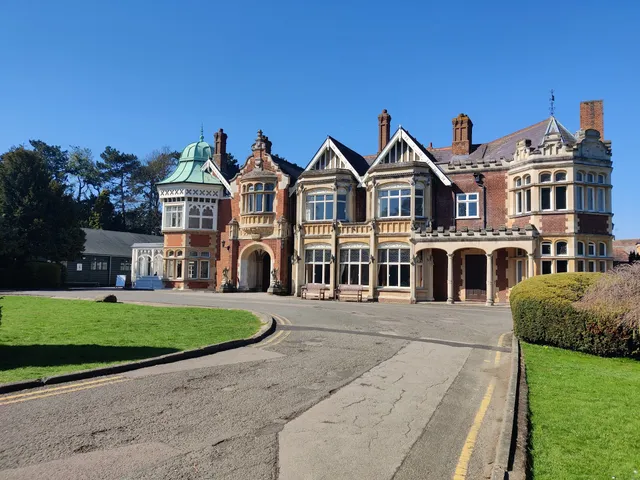
This hidden gem is next to / on the grounds of Bletchley Park but instead of hearing about the house and grounds concerns itself with the amazing work of the codebreakers and the invention of the first computer, designed to break the codes.
The museum is small enough to feel friendly and staff are enthusiast and knowledgable (almost geeky - which is good in this scenario) which means no matter your level or question you get an appropriate answer that leaves you feeling enriched for visiting (every other museum in the world could learn from this - I'm not a fan of glass cases and pseudo exhibits that actually patronise you!)
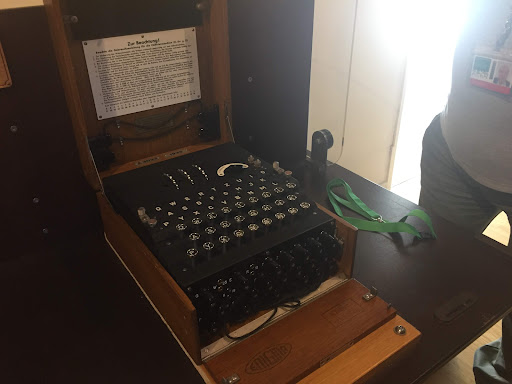
The museum is well laid out and superbly curated (not full of duplicated tatt like so many of our UK heritage centres are) You start with fully a demonstrated, working Enigma machine (used by the Germans in WW2 to code their communications) and you can see how it works see how its taken to bits and put together and see how the lever that is pressed actually routes the signal through to the light letter at the other end. When you understand the problem and the information available to the problem solvers then you can really get into how and why the problem could be solved.
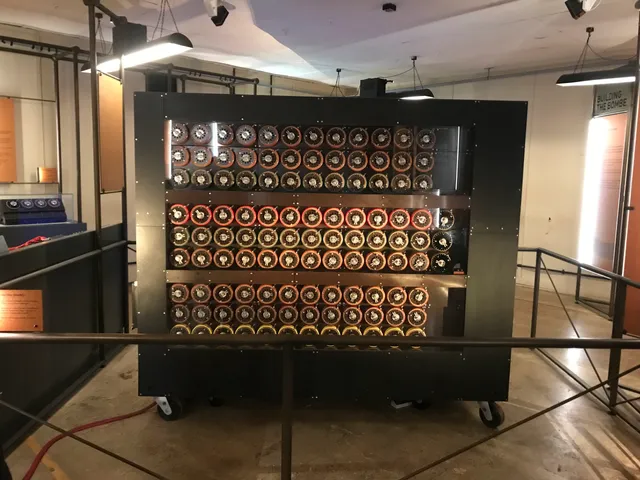
To then be shown a working rebuilt (by the volunteers) replica of the very machine (called the Bombe) that solves the problem and how the information was used to check it - its spine-tinglingly good. (What is more you can see inside the machine and how it is built and works)
How amazing to then get into a conversation with the incredibly knowledgable staff about what information could/would/or should be used and how etc etc. A whole world of le Carré-esque intrigue befalls you!
In the next room(s) you can see how the successor to Enigma (Lorenz / Tunny) was cracked and how it was cracked by the development of the very first computer (Colossus) invented and put together largely using Telephone Exchange components. Again you can see it working - you can see how it works, and knowledgable staff are on hand to tell you how it was decrypted.
As you go through each room and gallery you move onward from the earliest computers and their uses through each generation of technology; a real 'blast-from-the-past' and remarkable experience. Key is the way you are able relate the ancestry of each to the previous generation.
Beware & Watch out! The National Museum of Computing is not supported by the Bletchley Park Museum and there is real anamosity between the institutions, even down to the car park staff who tell you that one is worth visiting and one is not worth bothering with since they are paid by one not the other!
If you want to see the Hollywood version of the Bletchley Park Story complete with pretty house and grounds then 'Bletchley Park' park is for you. If you want to find out how, why, who, where, and when and to understand our place in the world as well as to get a sense the intrigue of the screw-ball thinking that makes our intelligence service the best in the world - you MUST visit the National Museum of Computing at Bletchley Park (you don't have to pay for Bletchley Park or Visa Versa) to get in.
Final thought! Please trustees (of both museums) knock your heads together and realise the people are missing out here because of your separate visions. It is important to recognise the work of Welchman, Tutte, Flowers, et al (countless others) as well as Turing and its vital to give your visitors access to all of the story as well has how and why. Working closely together you have the opportunity to be a much greater good than separately; be a far better...
Read moreSince visiting the museum last year for the first time himself, my dad has told me many times how much he thought I'd love it here. He wasn't wrong! With a bit of last minute date wrangling to avoid the second Covid19 lockdown, my 'surprise' day out for my birthday turned out to be a visit to Bletchley Park in the morning and the National Museum of Computing in the afternoon. Well, I honestly could have stayed in here for a whole day and will certainly go back! We started out with a live demonstration of the fully work replica Turing Bombe - Bletchley Park has a pretty decent automated demo but they weren't running guided tours due to Covid. Here, however, you've got access to a real human and not only is there a great talk and demonstration (I was finally able to make some sense of what the Bombe 'menus' actually meant) but you can geek out somewhat too! All of the demonstrators I met were very knowledgeable and passionate about the machines they were presenting. No question was too much.
Having left my poor dad sitting and waiting at all the (fully working) examples of the Bombe, then Colossus and then Edsac whilst I had long technical conversions with the staff and learnt a lot about some of these amazing early machines, he finally moved me on (after a brief game on Colossal Cave on an old ICL terminal) to the retro computing display.
For an 80s kid like me this was like walking through the gates of Heaven! There's several rooms with a vast array of machines from the zx80, Commodore Pet, BBC Micro model B, TRS-80, Spectrums and Amstrads, Ataris and Amigas, Acorn Archimedes and many others. Despite Covid19 (and with a bottle of hand sanitizer next to every keyboard) many of these machines are fully working and available for visitors to try out and explore. People's left over attempts at BASIC on these machines tended to consist of: 10 PRINT "HELLO" 20 GOTO 10 but there's nothing to stop you from exploring much further and there's a whole catalogue of retro games to blast you back into your childhood for a few moments. I was rather presently surprised to find that I was quickly able to remember the right keys to play JetPac on the ZX Spectrum and to breeze through level 1 for the first time in over 30 years, followed by a quick round of Chuckie Egg on the BBC Micro.
A friend has since told me that he went here many years ago and it was a disorganised collection of piles of machines with no obvious curation... My experience couldn't be further from that and I can only presume they've had a revolution there. It's now extremely well organised and is the most interactive museum I've ever visited. It's well worth a visit now. I was so long in the other exhibits that I missed the whole classroom of BBC micros set up to be a working demo of the school computer rooms of my childhood. A return visit will be necessary!
I have every intention of coming back here again and I hope to bring my children once they're old enough to appreciate it.
A truly wonderful day out for an old geek like me 🤓 (but you don't need to be quite as mad-passionate as me to really...
Read moreI was privileged to be able to return to TNMOC on its reopening day post COVID lockdown (Tuesday 8 September 2020). To one who “worked” in IT (originally Data Processing) for forty years from June 1976, this place is Shangri La. A major benefit of being the first to return was to have plenty of time to discuss with the superb volunteers the full story behind each of the exhibits. From Bombe to Colossus to Enigma via Witch and even ENIAC, all was laid bare. I was impressed by the volunteer who read paper tape by looking at the position of the holes. Even I couldn't do that back in the day when paper tape and punched cards were King. If you have any interest whatsoever in the history of computing (and if you don’t, then why not?!) then you need to get yourself to this place ASAP. The number of items in the display cases from early calculators to most recent games consoles where I said “I had that, I had that, I had that” made me wonder exactly how I managed to retire at 60 when I’d spent so much money as an early adopter back in the day ! For me personally, the icing on the cake was the final (and largest) exhibit of the ICL 2966 mainframe computer - the very machine that I programmed in COBOL back in the late 1970s using “the best operating system in the world” GEORGE 3. Proud to say I still speak COBOL and GEORGE 3 fluently ! A shame that it wasn’t booted up - I would have absolutely loved to load an exchangeable disk pack just one more time. - but with a 70kW power requirement, I simply didn’t have enough pound coins to put in the meter. Pound coins – or hopefully £50 notes – is what TNMOC now needs folks. Like many such institutions, their revenue has been hammered by the effect of COVID and resultant lack of visitors. This place is a National Treasure and as such MUST be saved. Visit if you can. Volunteer if you can. Join as a supporter if you can. Donate if you can. Your museum...
Read more