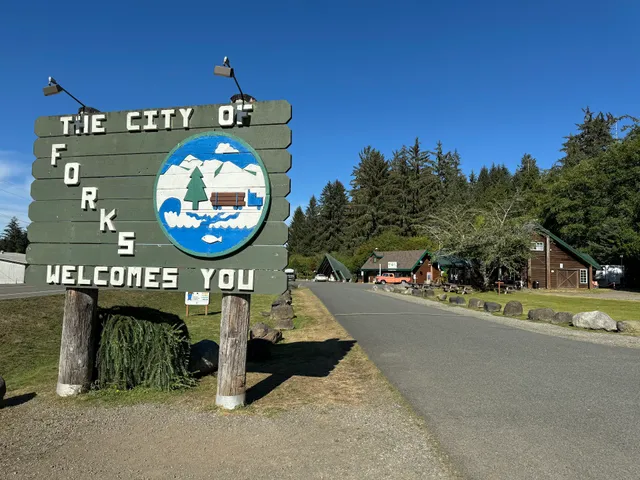
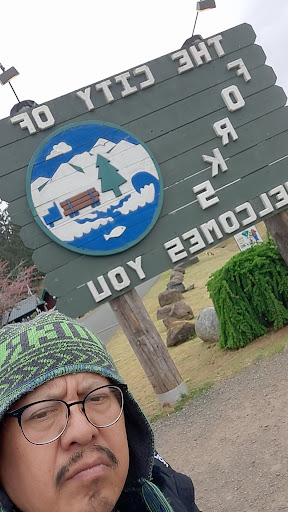
In the late 1870's, non-Indian settlers of Forks Prairie came by way of rivers and trails from the Pacific and the Strait of Juan de Fuca, as the overland route from the east was nearly impenetrable forest. Trails were the main means of travel for early settlers along the coast and in the interior Olympic Peninsula. The life of a settler was tedious. "Proving up" on their homestead claims was a primary goal since improvements were required within a specified number of years. Hunting and fishing were often pursued in fall and winter months to supplement the homesteaders' gardens and livestock. Hay, oats, grain, fruit and vegetables grew well on the prairie. The first dairy cows were brought in by schooner in 1870 via Neah Bay by Luther Ford.
Though it was a center of commerce, growth came slowly to Forks. A post office was established in 1884. A newspaper was started in 1890, and the town was laid out in 1912 on a homestead - remaining barely a block of buildings into the 1920s. Electricity came in 1923, and the first bank in 1930. And, the town did not incorporate until August 7, 1945.
Before 1900, timber in the West End was mostly cleared by settlers and small-time loggers using ox teams. Companies logged at Clallam Bay and Port Crescent on the strait in the 1870s. Timber baron Michael Earles, later developer of the first Soleduck hot springs resort, set up booming logging camps at the turn of the century at Crescent Bay and went along the strait - and many settlers from Forks worked in these camps. Merrill & Ring would begin to log in the Pysht River drainage northwest of Forks in 1916. World War 1 and its urgent demand for airplane spruce brought the West End into focus for its stands of Sitka spruce among the largest in the Hoko River drainage north of Forks. In 1918 the U.S. Army built 36 miles of railroad track from Port Angeles west to Lake Pleasant. This staged large-scale logging in the West End.
Disasters proved an unlikely road to Forks' boom years in the 1970s, when the town earned its reputation as "Logging Capital of the World" - through the '21 Blow, the Great Forks Fire in 1951 and the Columbus Day Storm of 1962. In the 1970's you could "make a couple of calls and have a good job" in the woods. The town's population doubled to over 3,000 that decade from a remote collection of farming homesteads into a booming timber town.
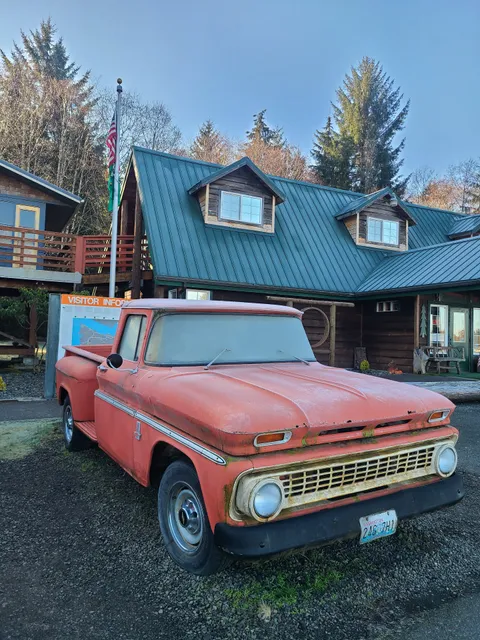
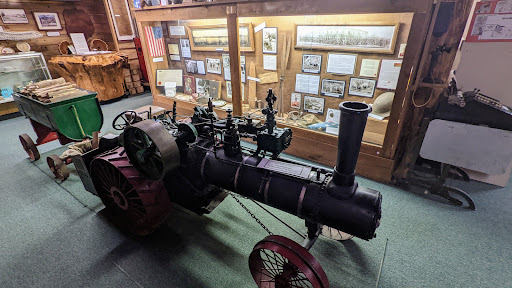
This museum offers a look into the rich history of homesteading, farming and logging in the Pacific Northwest, presented in a log cabin structure built by talented local volunteers and the High School Carpentry...
Read moreThe Timber Museum is a short, fun stop in town, but if you're hoping to glean knowledge of the intricacies of logging or critical discussion of the logging industry, look elsewhere. Unfortunately this museum attempts to justify clearcutting merely as a matter of convenience, and offers up now-green satellite photos of replanted cuts as evidence that the cuts are harmless, making no mention of the ecological devastation of mono-plantations and how replanted plots won't ever redevelop the biodiversity of that which has been so starkly destroyed. Logging is a complex issue and showing both sides of the coin is important.
The museum has a great mix of artifacts from many time periods. Some installations have nice writeups with context, while others are left almost bare, with no indication of how the items pertain to timber history, and few individual items anywhere are labeled.
The staff was very nice and there was a great scavenger hunt for our child. Other highlights were some impressive, century-old...
Read moreThe museum has many things. A couple parts that had too many words and did not have a consistent font or size of information that would have made it feel official. But the biggest thing i have to say is these days parents never teach their children how to properly act in museums. You have to be quiet! Whispering is allowed, and worse is how the museum people never ever tell museum goers to be quiet anymore. I thought that was a generalized known fact of museum-going. Instead I find myself extremely annoyed and irrated by these almost five kids stomping their feet jp and down and talking and yelling across rooms. The parents never tell them to be quiet, but rather even be loud themselves. Something must be done! Museums need to give a P.S.A or something to tell people to shut up! Because after visiting around 150 museums in this state. I no longer can tolerate this kind of behavior. Parents, TEACH...
Read more