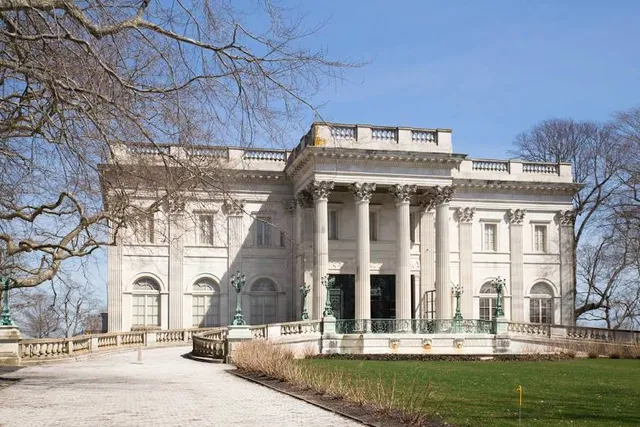
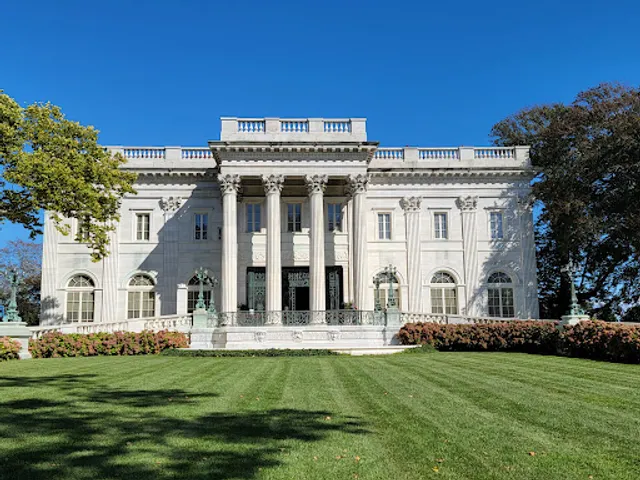
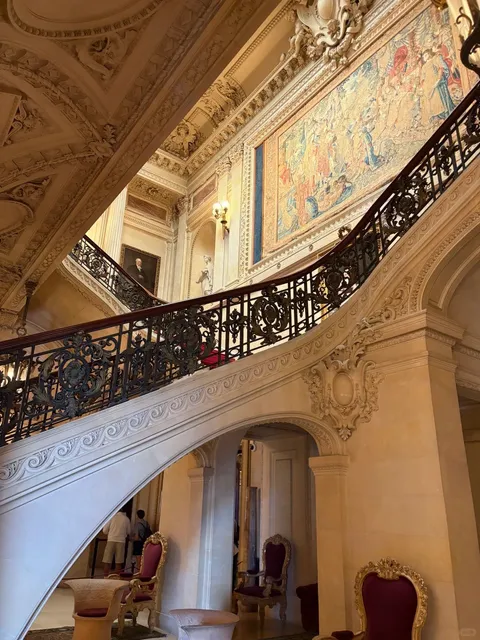
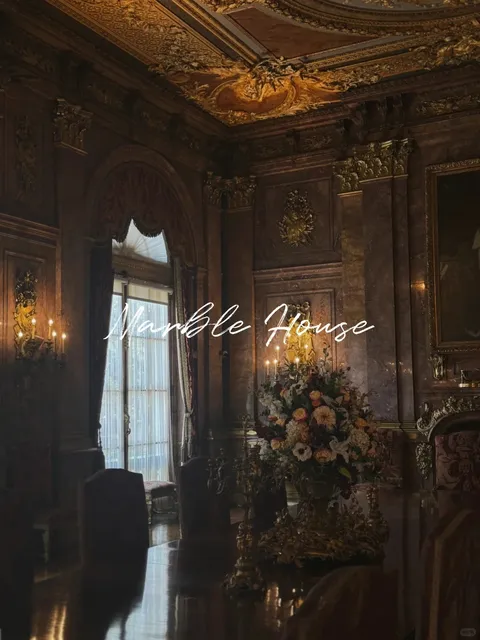
Marble House is a Gilded Age mansion in Newport, Rhode Island. Designed as a summer cottage for Alva and William Kissam Vanderbilt by the society architect Richard Morris Hunt, it was unparalleled in opulence for an American house when it was completed in 1892. Its temple-front portico, which also serves as a porte-cochère, resembles that of the White House. Located at 596 Bellevue Avenue, it is now open to the public as a museum run by the Preservation Society of Newport County.
The mansion was built as a summer "cottage" between 1888 and 1892 for Alva and William Kissam Vanderbilt. It was a social landmark that helped spark the transformation of Newport from a relatively relaxed summer colony of wooden houses to the now-legendary resort of opulent stone palaces. The fifty-room mansion required a staff of 36 servants, including butlers, maids, coachmen, and footmen. The mansion cost $11 million (equivalent to $307 million in 2018; $660 million in Gold-dollar equivalence (1890 $20 Double Eagle)) of which $7 million was spent on 500,000 cubic feet (14,000 m³) of marble. Vanderbilt's older brother Cornelius Vanderbilt II subsequently built the largest of the Newport cottages, The Breakers, between 1893 and 1895.
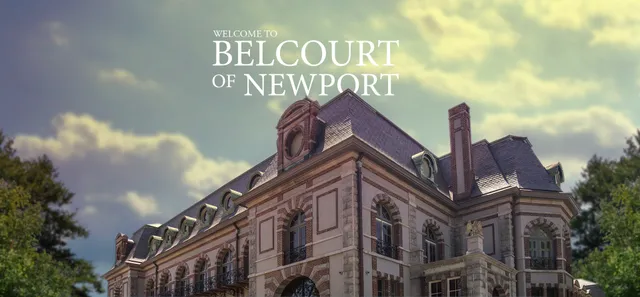
When Alva Vanderbilt divorced William in 1895, she already owned Marble House outright, having received it as her 39th birthday present. Upon her remarriage in 1896 to Oliver Hazard Perry Belmont, she relocated down the street to Belmont's mansion, Belcourt. After his death, she reopened Marble House and added the Chinese Tea House on the seaside cliff, where she hosted rallies for women's suffrage.
Alva Belmont closed the mansion permanently in 1919, when she relocated to France to be closer to her daughter, Consuelo Balsan. There she divided her time between a Paris townhouse, a villa on the Riviera, and the Château d'Augerville, which she restored. She sold the house to Frederick H. Prince in 1932, less than a year before her death. For more than 30 years, the Prince family carefully occupied the house during Newport's summer season, taking special efforts to leave the vast majority of the interior intact as the Vanderbilts had originally intended. One notable event that occurred in the Marble House during the Prince family's residency was the famed Tiffany Ball in July 1957, sponsored by Tiffany & Company and held to benefit the relatively new Preservation Society of Newport County. Continuing late into the early morning hours, the ball welcomed guests with long national and international pedigrees, such as then Senator John F. Kennedy and his wife, Jacqueline Bouvier Kennedy; Mr. and Mrs. E. Sheldon Whitehouse; the Astors; Count Anthony and Countess Sylvia Szapary of the Vanderbilt family; and hundreds of other luminaries. During their summer occupancies, to help preserve the integrity of Marble House's famed interiors, the Princes primarily resided in smaller quarters in the building's third floor, which had formerly been used for servant housing during the Vanderbilts' time. In 1963, the Preservation Society of Newport County purchased the house from the Prince Trust, with funding provided by Harold Stirling Vanderbilt, the Vanderbilt couple's youngest son. Through the Prince Trust, the Prince family donated virtually all original furniture for the house directly to the Preservation Society.
The mansion was added to the National Register of Historic Places on September 10, 1971. The Department of the Interior designated it as a National Historic Landmark on February 17, 2006. The Bellevue Avenue Historic District, which includes Marble House and many other historic Newport mansions, was added to the Register on December 8, 1972 and subsequently designated as a National Historic Landmark District on May 11, 1976. The mansion still stands in great visible condition and is used for many things such as guided and non-guided tours, as well as hosting various special events, parties,...
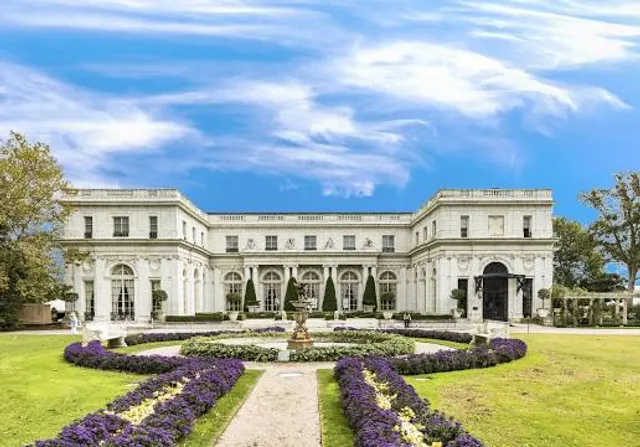
Read moreThe Rosecliff Mansion in Newport is a mesmerizing testament to the opulence of the Gilded Age. As you approach the estate, the grandeur of its architecture commands attention, with its striking white facade and meticulous landscaping. Originally commissioned by silver heiress Theresa Fair Oelrichs in 1899, the mansion exudes an air of sophistication and luxury from the moment you step onto its manicured grounds.
Upon entering Rosecliff, one is immediately transported to a bygone era of lavish social gatherings and extravagant parties. The interior design is a breathtaking fusion of French and Italian inspiration, evident in the ornate moldings, marble accents, and elaborate chandeliers that grace the halls. The ballroom, in particular, is a masterpiece, with its soaring ceilings and mirrored walls creating an illusion of endless space—a fitting setting for the extravagant soirées that were once hosted within its walls.
Exploring the various rooms of Rosecliff is like stepping into a time capsule. The meticulously preserved furnishings and decor provide a vivid glimpse into the lifestyle of the elite during the early 20th century. From the richly adorned drawing rooms to the cozy sitting areas, each space tells a story of the mansion's illustrious past. The attention to detail is remarkable, and visitors with an appreciation for history and design will find themselves enchanted by the authenticity of the experience.
One cannot discuss Rosecliff without mentioning its sprawling grounds. The manicured gardens and terraces overlooking the Atlantic Ocean add an additional layer of grandeur to the estate. The meticulously maintained pathways invite leisurely strolls, allowing visitors to soak in the serenity and natural beauty that surrounds the mansion. It's not difficult to imagine the elegant garden parties and summer gatherings that once animated these outdoor spaces.
The historical significance of Rosecliff is not limited to its architectural and aesthetic appeal. The mansion has played a role in various films and events, further cementing its place in popular culture. Movie enthusiasts may recognize Rosecliff as the backdrop for scenes from "The Great Gatsby" and other cinematic productions. This adds an extra layer of intrigue for those who appreciate the intersection of history, art, and entertainment.
The guided tours offered at Rosecliff provide invaluable insights into the mansion's history, detailing the lives of its original inhabitants and the cultural context of the Gilded Age. Knowledgeable guides enhance the visitor experience by weaving engaging narratives that bring the mansion to life. Whether you're a history buff or simply someone with an appreciation for architectural marvels, the tours offer a rich and informative journey through time.
In conclusion, a visit to the Rosecliff Mansion is a captivating journey into the past, where the elegance and excesses of the Gilded Age are meticulously preserved. The mansion stands as a living testament to a bygone era of American history, inviting visitors to immerse themselves in the splendor of a time when societal elites reveled in luxury and sophistication. For anyone seeking a taste of the extravagant lifestyle of Newport's high society at the turn of the 20th century, Rosecliff is an...
Read moreOf all the Preservation Society mansions in Newport, Marble House is my absolute favorite. It shines with elegance, history, and a kind of theatrical opulence that sets it apart—even from the more famous Breakers. Built by William K. Vanderbilt as a gift to his wife, Alva Vanderbilt, this home radiates the ambition and grandeur of the Gilded Age. What’s especially fascinating is that Alva kept Marble House after her divorce—a rare move for a woman of her time—and went on to build the Chinese Tea House on the property after her remarriage.
One unique feature is the elevator, installed by the family who purchased the home after the Vanderbilts. According to a knowledgeable staff member who kindly offered me a ride in it, the elevator originally came from the Ritz-Carlton Hotel. It still operates today and adds a delightful surprise to the tour. As the employee said, “Marble House makes The Breakers look dull and gray.” And honestly, I agree.
Walking through the home, I found most rooms to be bright and inspiring—except for Consuelo Vanderbilt’s bedroom, which has always struck me as surprisingly dark and somber. It made me wonder whether Consuelo had any say in its design, especially given her well-documented unhappiness during that period of her life.
My friend and I also noticed how starkly different the front and back of the house look. The front—with its grand columns and classical façade—is clearly meant to impress. The back, simpler and more utilitarian, likely wasn’t meant to be seen by society guests. It’s an interesting architectural contrast that tells its own story.
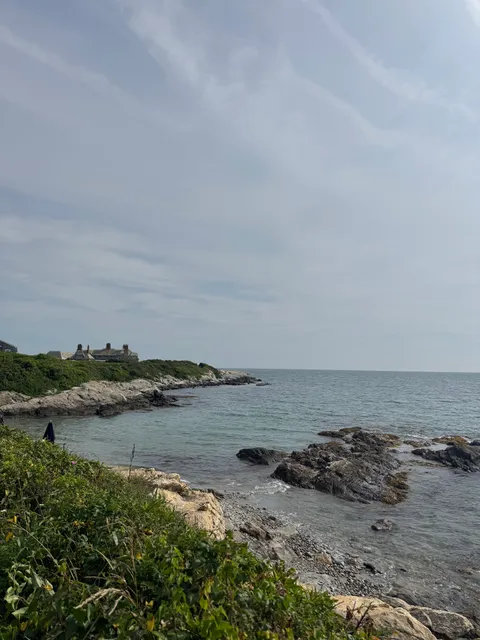
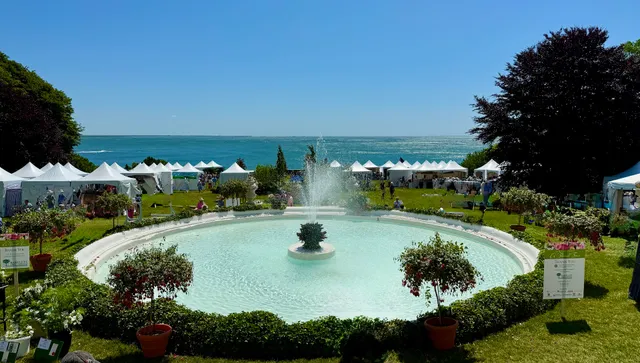
Out back, you’ll find the enchanting Chinese Tea House, where you can enjoy high tea (yes, that means with a savory entrée!). The view of the Atlantic from the Tea House is absolutely breathtaking. Five oceanfront chairs offer the perfect spot to relax after touring the mansion—comfortable, peaceful, and unforgettable.
There’s also a charming gift shop in the basement, where the restrooms are located. I appreciated that there was seating throughout the home for visitors with disabilities, which made the experience feel welcoming and accessible.
If you’re visiting Newport and only have time for one mansion, make it the Marble House. It’s more than just beautiful—it’s personal, powerful, and utterly unforgettable. If you want to be like everyone else, see the Breakers.
If you live locally and you think you’ll be visiting Newport Mansions at least twice a year, I recommend getting an...
Read more