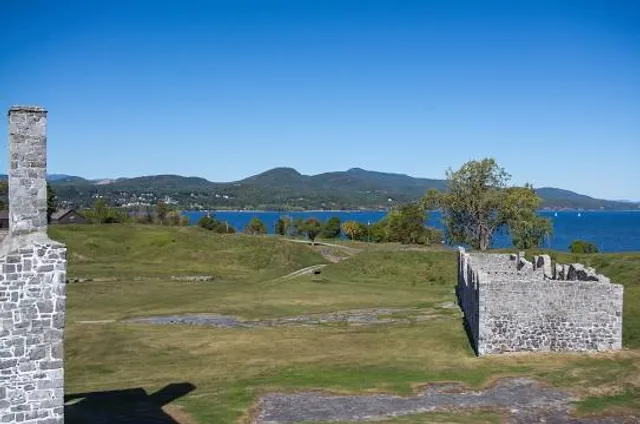
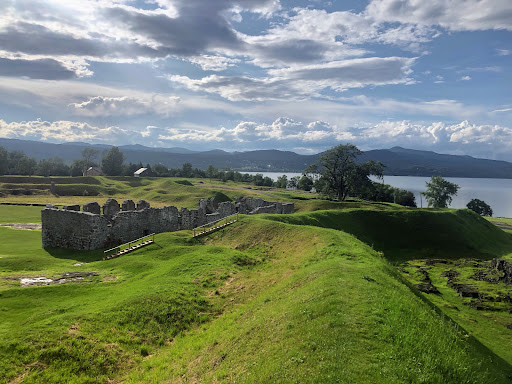
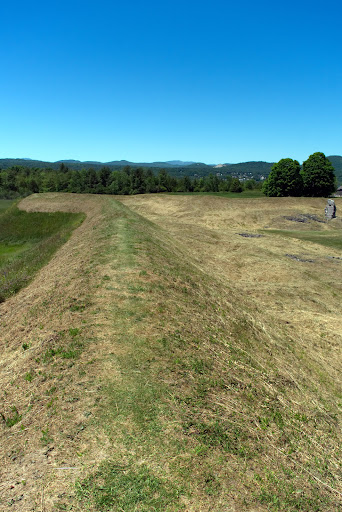
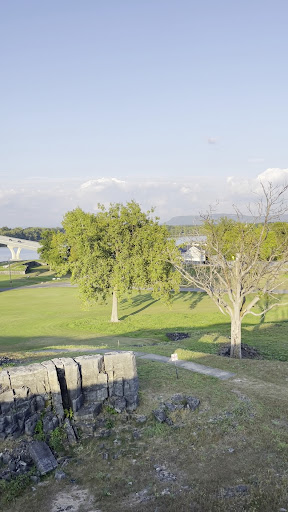
Fort Crown Point - (1759-1783) - First established in 1759 by British troops under General Jeffery Amherst on Lake Champlain near the site of the French Fort Saint-Frédéric following the capture of French Fort Carillon, later renamed Ticonderoga, in 1759.
Rather than rehabilitate the ruins of the French fort, General Amherst embarked on the construction of an enormous earthen fort. Amherst used the construction of the fort as a means of keeping his men working through the winter of 1759 after pushing the French into modern-day Canada. It is said that Israel Putnam, who would later become a major general in the American Revolution, supervised much of the construction. Fort Crown Point was at least one-third larger than Fort Saint-Frédéric had been, and it was intended to be the new center of British military power in the region. The renamed “His Majesty’s Fort of Crown Point” has been described as a large pentagon shaped fort with five bastions and over 100 cannons, three additional redoubts, a blockhouse, and redans.
The Fort was never directly assaulted, being built after the threat of French invasion had ended. After the Seven Years War, the British left a small garrison force at the fort and it was used largely as a staging area.
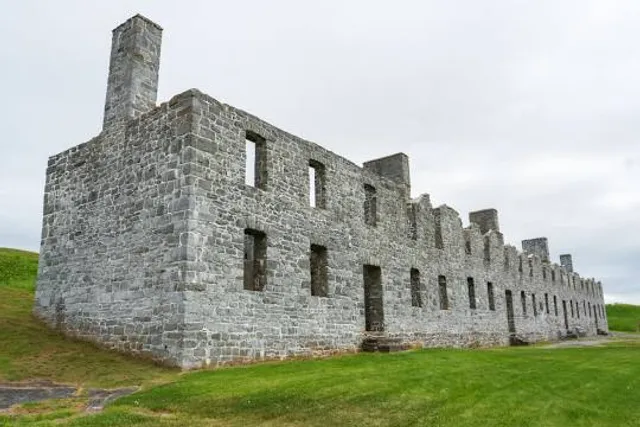
In April 1773, Fort Crown Point was destroyed. A chimney fire in a barracks building spread to a nearby powder magazine, leading to an explosion that reduced the mighty log and earthen fort to, in the words of engineer John Montresor, “an amazing useless mass of earth.” A court of inquiry was held to determine the cause of the fire, and testimony pointed the blame as Jane Ross, the wife of a soldier in the 26th Regiment of Foot, who had been boiling soap in the chimney where the fire started. Ross herself testified that such practices were common, and not prohibited by any orders. A tiny number of soldiers were to garrison the surviving buildings.
On May 12, 1775, after Ethan Allen and Benedict Arnold led the Green Mountain Boys to seize Fort Ticonderoga, they sent Captain Seth Warner and a force of about 100 men to capture Crown Point. The British soldiers at the ruined fort numbered less than a dozen men, and they were quickly overwhelmed and taken prisoner. While the stone barrack buildings of the fort were in ruins, it still housed a large number of military supplies, including artillery. The 111 cannons captured from the British at Crown Point proved valuable as part of the “noble train of artillery” that Henry Knox took to the Siege of Boston in March of 1776.
Crown Point was also the launching point for the ill-fated American Invasion of Quebec in December 1775. After the failure of the American invasion of Canada in the winter of 1775-1776, the weary and battered American army retreated to Crown Point, some badly wounded and others suffering from Smallpox. When General Horatio Gates decided to withdraw further south to Fort Ticonderoga, General George Washington wrote to Gates disapproving this move.
Crown Point remained abandoned, with the American army making Fort Ticonderoga the centerpiece of their defenses on Lake Champlain. In 1777, when British General John Burgoyne’s army advanced south from Canada, they once again occupied the abandoned fort without firing a shot and used it as a staging area for their siege of Fort Ticonderoga. A small British garrison would remain at Crown Point until after the Battles of Saratoga, when the British withdrew back into Canada once more with the surrender of Burgoyne’s Army. As the British strategy for the war shifted geographic focus from the Northern Theater to the Southern Theater, the British abandoned Crown Point for good in 1780 which had fallen into decay and disrepair. George Washington, traveling through the northern colonies while awaiting news of the peace treaty negotiations in Paris, visited Crown Point on July 21, 1783. This would be the furthest north that Washington...
Read moreI love learning about the history of the area I live in, so my trip to Crown Point was a real treat. This place is absolutely fascinating and the location, on Lake Champlain, is gorgeous. It was a stunning day, and we were there on a Monday, so the site was deserted. That was a real plus.
When you approach the site, you'll reach Fort St. Frederic first. This is a little confusing, because there are no placards explaining the ruins. Turns out, the museum is further into the site, so we visited everything out of order. Stupidly, we stopped at the first parking lot we saw, when we should've driven further in. I wish there were signs to indicate this, but if we'd just paid attention, we could've avoided confusion. The museum is definitely worth the visit, because it starts with a 12-minute video on the history of the site. Don't miss it. The video is quite entertaining and it'll help you appreciate the site. There is a small fee to enter, but the pass gets you into a local lighthouse, too.
I highly recommend Crown Point to history buffs, and to locals who don't think their neighborhood is very interesting. Absolutely...
Read moreThis place has been a little mecca for us for the last two decades, because we could walk our old, ailing, diabetic dog, down the fire road, very safely, because it was blocked off to traffic. Unfortunately, the new manager has opened up the fire road to traffic and my review must state how dissapointed I am in this. I give it until 2030 before it's completely trashed back there, as has happened in so very many other places. Indeed, on our last trip down to the ice fishing beach, we saw fishing line, sinkers, toilet paper, ciggarette buts and even discarded shrimp, (which, I'm sure, did NOT come out of the lake), all over the beach. We picked up some of it, but we really don't want to be in this position again. We started going all the way out there (a 20 minute drive for us), because this is the exact position we were put in, on the public trails behind our house. Very disappointed in the new managers decision. It isn't smart, it isn't safe, and it isn't in the best interest of the wildlife back there, either! Boo, NY, surely you...
Read more