
Comparing "Qushui Liushang" Pavilions Across Three East Asian Countrie
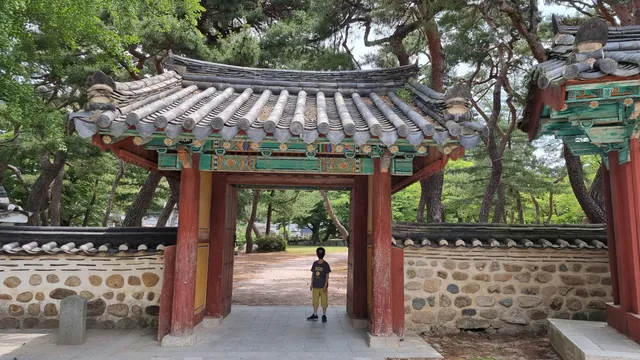
During my trip to Gyeongju, South Korea, I made a special trip to Poseokjeong Pavilion at the foot of Namsan Mountain in the ancient city. As South Korea’s first designated national treasure (No. 1 among all historical sites), this garden relic from the Unified Silla period (built before 885 AD) is also the earliest surviving relic of a "Qushui Liushang" (wine-flowing canal) pavilion known to date.🌿 ☘️ South Korea · Gyeongju Poseokjeong Pavilion Poseokjeong’s defining feature is its stone wine canal, shaped to mimic an abalone (hence its name, which translates to "Abalone Stone Pavilion"). The canal is constructed with 12 stone blocks on the inner side and 24 on the outer side. At the water inlet stands a stone turtle, from whose mouth water flows into the curved canal.🌿 Compared to the intricate, winding designs of Chinese Qushui canals, Poseokjeong’s layout is relatively simple. However, its stone craftsmanship is remarkably exquisite—each block is cut and fitted with precision, reflecting the advanced stone-working skills of the Silla Dynasty. Originally, a pavilion stood above the canal, but due to the passage of time, no historical records or remains exist to confirm its exact structure. ☘️ China · Dengfeng Fanshang Pavilion The Yingzao Fashi (Treatise on Architectural Methods), a classic Chinese architectural text, records the standard for building a "liubei stone canal" (wine-flowing stone canal): "It covers an area of 1.5 zhang (ancient Chinese unit, ~5 meters) square, using 25 stone blocks each 3 chi (~1 meter) square. Each stone is 1.2 chi (~0.4 meters) thick, with a carved canal 1 chi (~0.33 meters) wide and 9 cun (~0.3 meters) deep. The canal winds in patterns like the Chinese characters Dengfeng Fanshang Pavilion is noted by the renowned architect Liang Sicheng as the only surviving example of a Song Dynasty (960–1279) Qushui Liushang site and China’s earliest remaining relic of such a pavilion. Liang Sicheng wrote: "To date, the only known surviving example from the Song Dynasty is the liubei canal of Fanshang Pavilion at Song Dynasty Chongfu Palace in Dengfeng Regrettably, the pavilion has suffered from "restoration damage"—later renovation work failed to preserve its original ancient charm, leaving little trace of its historical authenticity. ☘️ Japan · Okayama Ruten Pavilion Behind the Iwayama Hill in Korakuen Garden (Okayama) stands the Ruten Pavilion, a structure inspired by the Qushui Liushang tradition. A narrow canal runs through the pavilion, with several rough, black volcanic rocks placed inside it. The design balances stark contrast: the neat, minimalist edges of the canal and pavilion contrast sharply with the random, unpolished volcanic rocks—creating an unexpected sense of modernity. This aesthetic echoes the "contemporary feel" of Kyoto’s Kinkaku-ji (Golden Pavilion), showing how traditional Japanese gardens anticipated modern design principles. 🌿Visiting here, one can finally understand why Frank Lloyd Wright, the legendary modernist architect, held ancient Japanese architecture in such high regard—its emphasis on simplicity, nature, and spatial harmony aligns perfectly with the core ideals of modernism.🌿 🍀 Reflection on "Qushui Liushang" The same "Qushui Liushang" theme (a traditional activity where guests sit by a curved canal, floating wine cups downstream; those whose cups stop before them drink and compose poetry) evolved into distinct forms across East Asia. These differences reflect each country’s unique cultural temperament—from China’s emphasis on ritual and intricate craftsmanship, to Korea’s focus on natural symbolism and refined stonework, to Japan’s fusion of simplicity and modern sensibilities. As the Japanese folklorist Yanagi Muneyoshi once said, traditional crafts and architecture are "the voice of a culture." In these three pavilions, we hear not just the echo of a shared East Asian tradition, but also the unique stories of each nation’s relationship with history and nature. #Architecture #LandscapeArchitecture #TraditionalGardens #AncientArchitecture