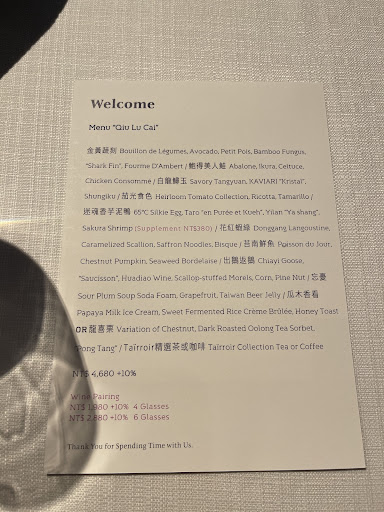
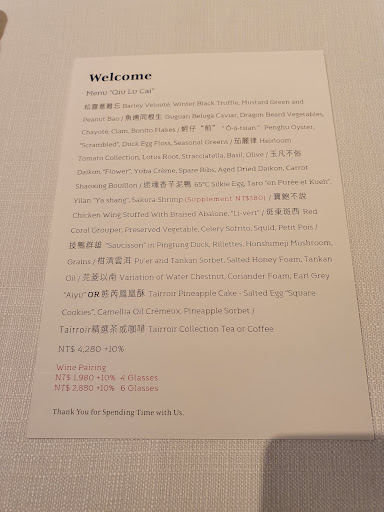
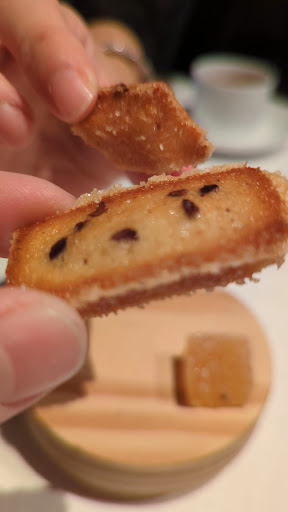
The restaurant is remarkable in 2 aspects: the appallingly mechanical service, and the confusion over the food. The service was an injustice to the food. The food isn’t bad but it could be a disappointment depending on your expectations. There is an appalling mismatch in how the restaurant “marketing” tries to define itself, from what is actually served, as if the two never communicated.
The marketing defines itself as Taiwanese-French fusion cuisine. “Taïrroir, a simple but meaningful compound word, is fused by ''Taiwan'' in English and ''Terroir'' in French. It expresses a new spirit about Taiwanese cuisine of this generation, ''Locally-Global”. Tairrior “fuses terrior and French cooking skill, transforms Taiwanese cuisine spirit with global taste, Taïrrior leads each global taster to experience the exclusive delicate of Taiwanese cuisine" (Tairrior website).
The bigger trouble is, the Taiwanese element in the presented food is MINIMAL at best. The food is simply pan-Chinese, NOT Taiwanese. The most Taiwanese thing about this is the occasional mention of local ingredients, like duck from Jiayi. We are served a rather Cantonese soup, Suzhou style noodle (蘇式煨麵, which, by the way, was the only dish clearly subpar), 紹興style sauced duck. The chef’s own interview describes a signature dish as Shanghainese and Cantonese duck (“經典招牌菜「迷魂香芋泥鴨」(65°C Silkie Egg, Taro “en Purée et Kueh”, Yilan “Ya shang”, Sakura Shrimp)就是把上海菜的八寶鴨與廣東菜的芋泥鴨解構” -Michelin website).
How exactly is this "Let the world see Taiwan" (“讓世界看見台灣”? How is this “讓台灣料理的聲音,被全球聽見” -Tairrior website)? There is nothing wrong with masterful Jiangzhe/Shanghainese cuisine, and nothing wrong with Cantonese cuisine--both my favorite. But the restaurant is apparently as confused about the difference between Taiwan and China as the rest of the world. It’s fine to serve Chinese food, just don’t fake it as Taiwanese.
The confusion can also be seen in the name of the set. The menu calls this “Qiu Lu Cai”, meaning chef’s special is incomprehensible to any Taiwanese, as it is the Mainland pinyin Romanization of the Mandarin pronunciation of the last 2 words and the mimic Mandarin pronunciation of the 1st word of the Taiwanese phrase “手路菜” (in proper Taiwanese Romanization: tshiú-lōo-tshài).
The biggest irony in this is that the chef, in an interview, denies this is even French-Taiwanese fusion cuisine. “外界雖然將他的菜色歸類為創意法式菜,然而他不認同被歸類,他就是他自己,「那不是法菜、中菜或台菜,那就是何順凱的菜”.
Looks like everyone is simply confused about the cuisine. This is my interpretation of Tairrior.
Running confused on philosophy, Tairrior's dishes simply appear to be a random combination of gimmicks. Our waitress’s introductions are purely a memorized list of ingredients which clarify none of the confusion. For serious creative dishes, they need to more properly explain what the dish is supposed to represent, and the thinkings being conveyed through the dish. Otherwise, since there is no menu to choose from, it’d feel like being served whatever gimmicks are in the kitchen. The food itself though, is mostly fine, except for the disastrous noodles “蘇式煨麵” which is nothing like 蘇式煨麵 and more like soggy instant noodles, but I can overlook a dish. My own impression of Tairrior is that they primarily serve gimmicky food, resorting to Mainland gimmicks as they have run out of ideas...
Read moreTaïrroir (態芮), Taipei: A Gastronomic Ode to Taiwan's Terroir Taïrroir (態芮), a distinguished three-Michelin-starred restaurant in Taipei, offers a truly unique and compelling dining experience. Its name, a clever fusion of "Taiwan" and the French "Terroir," perfectly encapsulates its philosophy: presenting the essence of Taiwan's land and culture through a global lens by bridging Taiwanese ingredients and flavors with refined French culinary techniques.
Culinary Philosophy and Highlights Helmed by Chef Kai Ho, Taïrroir's cuisine is a masterclass in reinterpreting familiar Taiwanese flavors with innovative flair. Each dish on the seasonal tasting menu is a thoughtful creation, designed to evoke memories and tell stories of Taiwan. Guests frequently praise the ingenious use of local ingredients, transformed into elegant culinary art.
While the menu evolves with the seasons, iconic dishes that embody their philosophy often include:
"Memories of a Rest Stop" (休息站的回憶): This signature dish brilliantly elevates the humble Taiwanese tea egg. It often features a tea-infused egg with a soft-boiled yolk, complemented by elements like fermented tofu, pickled vegetables, and a warm rice porridge, all presented with exquisite precision. It's a testament to how everyday Taiwanese snacks can be elevated to fine dining.
"I-Bi I-Bi Duck" (咿比咿比鴨): A playful yet sophisticated take on Peking duck, featuring succulent Pingtung duck breast with a rich, house-made sweet bean paste and delicate lotus leaf crisps, allowing diners to savor the flavors of roasted duck without the traditional assembly.
"Mesmerizing Taro Duck" (迷魂香芋泥鴨): This dish showcases another beloved Taiwanese ingredient, taro, often combined with smoked duck, crispy shallots, and a perfectly cooked onsen egg, creating a warm, comforting, and deeply flavorful experience.
The dishes are not just visually stunning but also engage multiple senses, with clever plays on texture, temperature, and aroma.
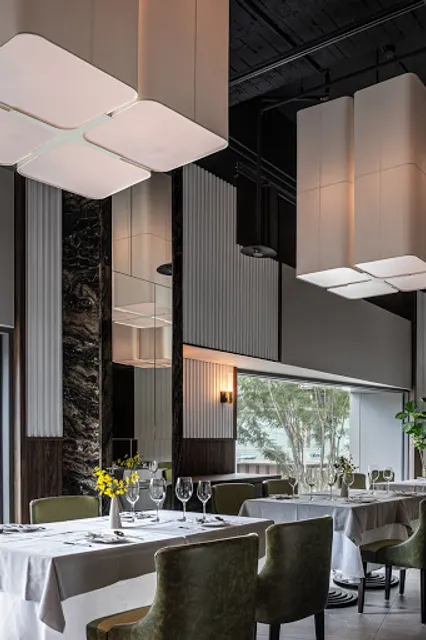
Refined Ambiance and Attentive Service Located in a stylish building in Taipei's Dazhi area, Taïrroir's dining room offers a sophisticated and intimate atmosphere. The design is modern and chic, with warm lighting and comfortable seating. A notable feature is the large glass panel allowing diners to peer into the bustling kitchen, providing a captivating "chef's table" feel and a direct connection to the culinary artistry unfolding.
The service at Taïrroir is widely lauded for being impeccable, attentive, and discreet. The team is highly knowledgeable about each dish's ingredients and inspiration, offering insightful explanations without being intrusive. Chef Ho himself is known for his keen observation, often making subtle adjustments to dishes based on a diner's apparent preferences or needs, a truly personalized touch. This seamless and thoughtful service further enhances the overall dining journey.
For anyone seeking a truly memorable gastronomic experience that celebrates Taiwan's rich culinary identity with innovation and elegance, Taïrroir is an absolute must-visit. It's not just a meal; it's a culinary narrative that captivates...
Read more-quick comment: Three-star dining didn't justify the price; flavor upgrade needed; sommelier's pricing lapse disappointing; high expectations unmet.
-long comment: Dining at a Michelin three-star restaurant is an experience reserved for those who can afford it, and such discerning patrons are unlikely to be deterred by mere Google reviews. My recent visit to this establishment, which had previously held two stars, left me with mixed feelings.
First and foremost, the quality of the food was, unfortunately, not significantly better than when the restaurant held two stars. While the dishes were undoubtedly expertly crafted and presented with precision, the flavors did not elevate to the level one would expect from a three-star establishment. It left me questioning whether the substantial increase in the dining bill was truly justified.
We all understand that the difference between Michelin two stars and three stars may not simply be about an incremental improvement in food flavor. After all, Michelin two-star restaurants already achieve a very high standard of cuisine, arguably reaching a level of culinary excellence that may be considered saturated. Therefore, the elevation to three stars must encompass not only outstanding dishes but also an exceptional overall dining experience that justifies the premium price. It should involve a seamless fusion of flavors, ambiance, service, and innovation that transcends the already high expectations set by the Michelin guide. Ultimately, diners should leave a Michelin three-star restaurant not just satisfied but utterly captivated by an unforgettable journey through the world of gastronomy.
While the restaurant met expectations in various aspects, there was one glaring issue that marred the overall impression. The sommelier failed to confirm the price of a selected wine at the time of ordering. Instead, the revelation of an exorbitant price tag came after we had already enjoyed a considerable portion of the bottle. This practice is far from the standard one would anticipate at a Michelin-starred...
Read more