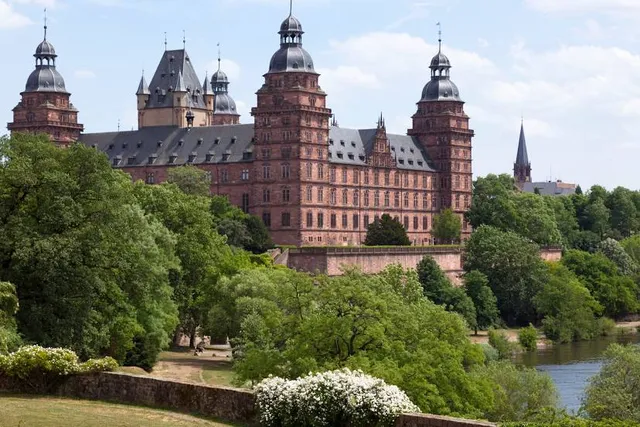
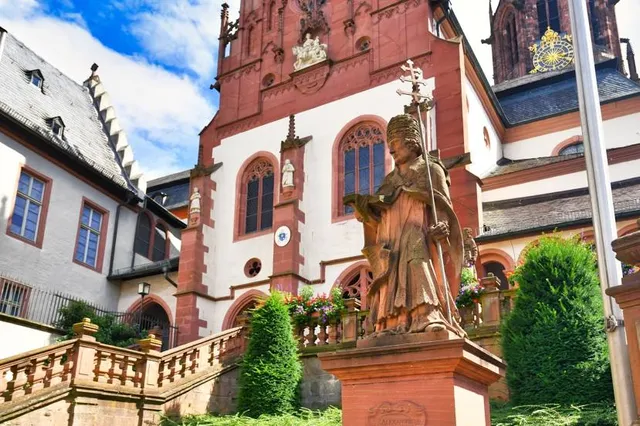
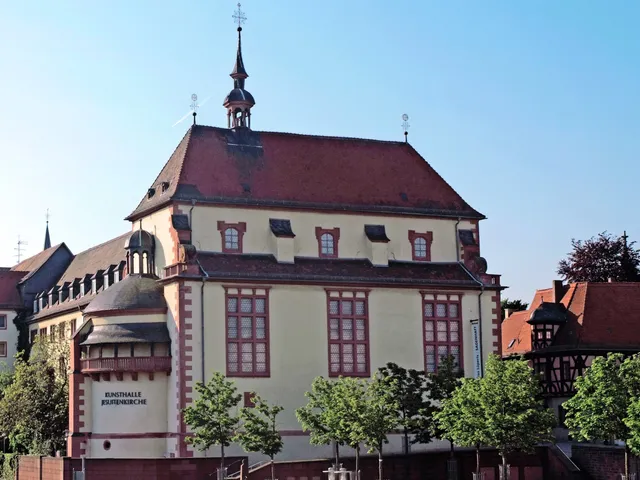
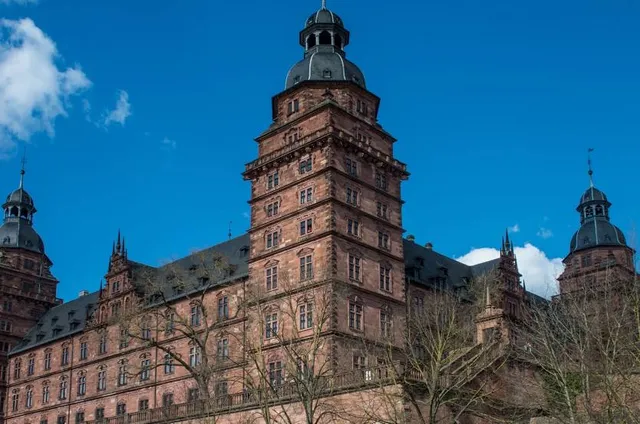
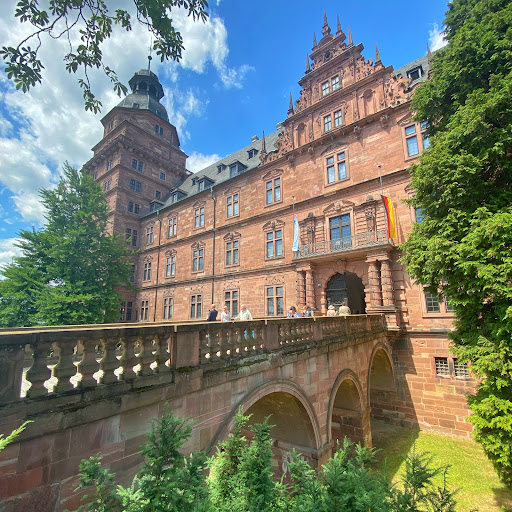
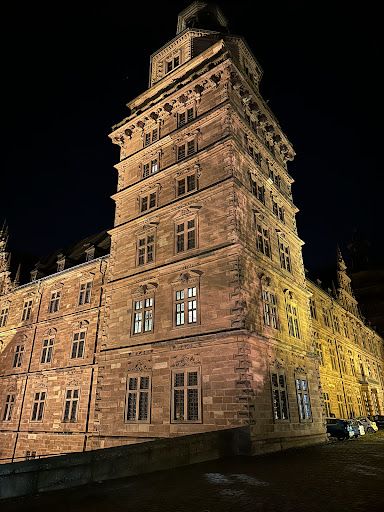
The castle Johannisburg, formerly Castle Johannisburg, in Aschaffenburg served until 1803 as the second residence of the Mainz archbishops and electors. It was built in the period from 1605 to 1614 by Strasbourg master builder Georg Ridinger from Rotsandsteing. The complex consists of four large wings, each with three floors. At each corner there is a tower, in the four corners of the courtyard are also smaller stair towers. From 1814 until the end of the monarchy in 1918, the castle belonged to the Bavarian crown. Today, the Free State of Bavaria is the owner, and the facility is managed by the Bavarian Administration of State Palaces, Gardens and Lakes. The castle also houses the castle museum and the administration of the museums of the city of Aschaffenburg. The castle dominates the image of the city of Aschaffenburg and is considered her biggest attraction. A native of Aschaffenburg said once: "The city is her castle." Little is known about the architectural history of the medieval castle built on the same site. In 1284, a new chapel was dedicated to John the Baptist. There are reports of the development of the castle from the 14th century, especially the keep, which towered over the magnificent castle complex to a drawing by Veit Hirsvogel the Younger far. Already this castle was the second seat of the Mainz archbishops, who presided over the largest ecclesiastical province of the Holy Roman Empire and at the same time acted as Archbchancers of the Reich. Aschaffenburg was in the 13th to 15th century place of various princely assemblies and synods. Outstanding guests were about 1317 King Ludwig the Bavarian or 1383 King Wenceslas of Luxembourg.
The location received particular importance when Albrecht of Brandenburg, archbishop of Mainz and Magdeburg, withdrew from Halle to Aschaffenburg in 1539 because of the Reformation. The medieval complex was plundered and destroyed in the Markgräflerkrieg in 1552, whereby many art treasures, which Albrecht had brought to Aschaffenburg, were lost. Above all, works by Lucas Cranach the Elder and his school, which today are part of the Staatsgalerie Aschaffenburg in the castle, have been preserved. In 1604, the new Elector Johann Schweikhard von Kronberg commissioned the construction of the castle. The execution was entrusted to Strasbourg architect and master builder Georg Ridinger. Ridinger had the remains of the old castle torn down; only the large Gothic keep was included as the fifth tower in the new building in the middle of the northwest wing. In the central axis of the castle in this wall the coat of arms of the Elector Johann Schweikhard, designed by the sculptor Hans Junker, embedded. The name of the castle thus has a double reference, on the one hand to the patron saint John the Baptist, on the other to his client. The entire structure is strictly symmetrical and has external dimensions of 87.5 m by 86 m. The three-storey side wings have a depth of about 13.50 m. The eight-story corner towers are 52 meters high. Above are three floors, which correspond to the roof height of the side wings. Around the seventh floor above, there is a balustrade around each tower. The eighth floor is finally octagonal with a tapered diameter and forms the basis for the likewise octagonal dome hoods. The four inner towers have four floors, of which the lower ones are square, the ones above are octagonal. Finally, the three-storey gables in the central axes of the intermediate buildings, which receive the corresponding storey heights of the towers, and an elaborate ornamentation in the style of the Italian Renaissance architecture with obelisks, offer a visual highlight. On the occasion of the inauguration of the palace on 17 February 1614, the 10th anniversary of his election as Elector, Johannes Schweikhard von Kronberg had coins minted on one side of the castle, on the other side his coat of arms or his portrait. From now on he carried out his affairs of state of the Mainz state from...
Read moreBeautiful red sandstone palace that is must see while in Aschaffenburg!
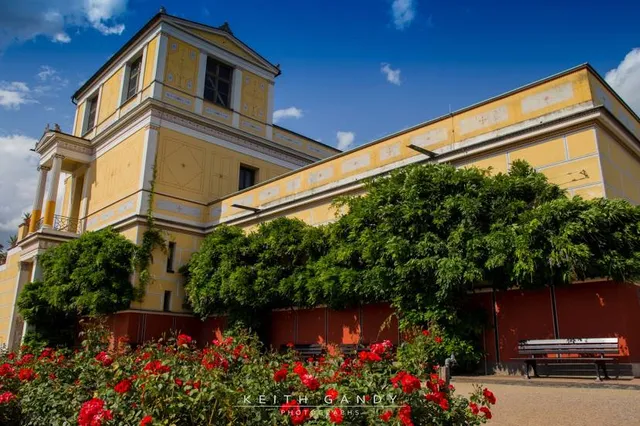
I visited on a Saturday with only a handful of other tourists, it was not busy at all. I bought a 3.5 EUR ticket at the cashier desk (you can purchase a combined ticket with Pompejanum which is around 5 minutes walking distance) and had to lock my backpack in a locker room before entering the museum. Only cash payments were possible and the staff did not really speak English.
Approximately only a quarter of the palace's surface is accessible for visitors, yet there is plenty to see. In the rooms above the museum lobby I explored and learnt about the history of the palace and how it is used now, along with miniature models representing different architectural styles through history (e.i. one model shows how the palace looked when it was destroyed during WWII). Explanations at this section of the museum were bilingual (German-English) however throughout the rest of the visit everything was in German only.
The most interesting part was visiting the world's largest collection of architectural models made from cork! I had no clue such a thing existed, therefore I was naturally surprised and amazed. There were at least 40 models of the ancient ruins and monuments in Rome. The eye for the detail was breathtaking, absolutely stunning and the size of the Colosseum model was simply colossal! The rest of the museum offers paintings, art, some furniture and porcelain artefacts. The last place I visited on my tour was a beautifully decorated chapel with an alabaster altar. The courtyard was vast, however completely empty. Toilets were available in the lobby of the museum.
Visited...
Read moreSchloss Johannisburg in Aschaffenburg, a historical gem, offers a captivating experience as night falls. Its rich history, architectural beauty, and enchanting illumination make it a must-visit.
History: Built in the 17th century, this Renaissance and Baroque castle has served various noble families. Damaged during World War II, it was meticulously restored and stands as a testament to the region's historical significance.
Nighttime Lighting: As night descends, the castle comes alive with tasteful illumination. Soft, warm lighting highlights its architectural details, casting intricate shadows and revealing hidden nuances, creating a timeless and mystique atmosphere.
Vibe: Schloss Johannisburg exudes quiet sophistication and cultural grandeur. The nighttime lighting adds intimacy and mystery, drawing visitors into the castle's rich history. It's an unforgettable journey into Bavaria's heritage, perfect for history enthusiasts, architecture lovers, and those seeking a romantic,...
Read more