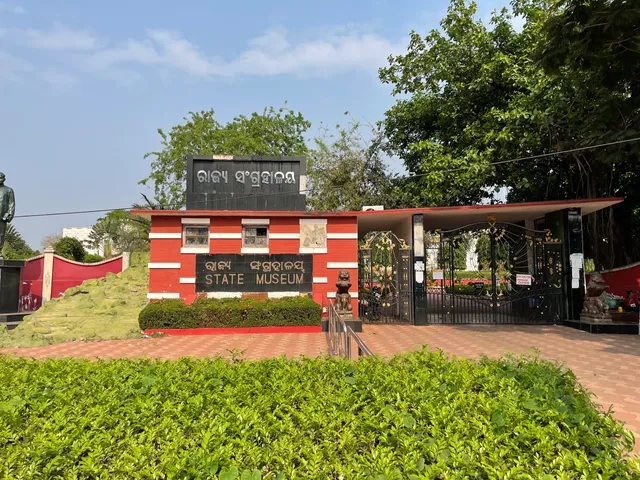
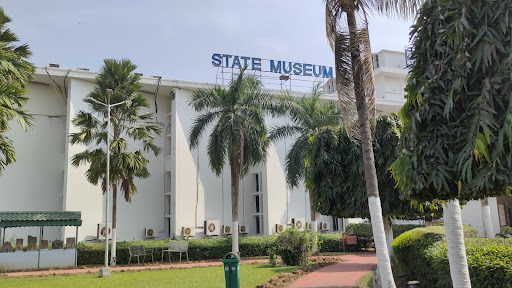
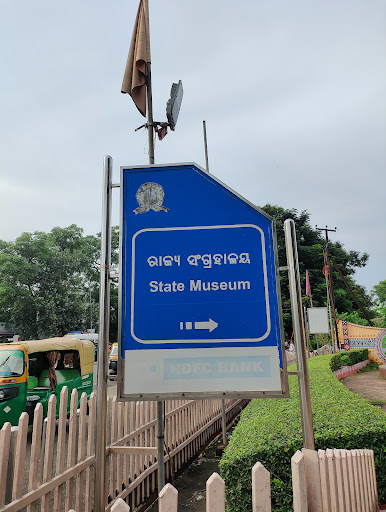
This state Museum is situated at 1.5 km away from Railway station and it is one of the most attracted tourist destination in Bhubaneshwar City
History of the Museum: Prof. N.C. Banerjee and Prof. Ghanshyam Dash of Ravenshaw College started this Museum in the year 1932 in Cuttack and later renovated and moved to present building in 1960. The foundation stone of the new building (Present building) was laid on 29th December 1957, by Dr. Rajendra Prasad, The first president of India.
I was little confused when I entered inside the Museum from Main Entrance as there are two options to go one is Main Entrance to enter into the main building and other is open area curved stones display. First I covered open area visit and then entered into Main Building which is having display in two stairs and divided the same into eleven sections. To avoid confusion where to and how to Finish please note down those eleven sections names and cover all the sections without fail as every section has its own uniqueness.
Different Sections of Museum: Archaeology Gallery: This section is famous for rare sculptures of Buddhist, Jain, Shaiva, Vaishnava and Sakta Pantheons. The Exhibits spread over three halls, in the Ground floor. Epigraphy Section: This gallery displaying coins of the ancient and medieval age of Odisha. Who all are interested in knowing about history of Coins can spend more time here. Numismatics Section: Systematic arrangement has been made here to showcase the coins from the crude and uninscribed punch marked pieces to the interesting variety of artistic Gupta coins and the issues of several local and align rulers. The time span of all these coins stretches from 6th Century BC to 20th Century AD. These coins show case the culture, religion, economy, and Social life of Indians through ages. Armory Section: Armory section depicting variety of Ancient weapons of Odisha Military which all were used in olden days. Mining & Geology Section: This is one of the most interesting section of this Museum as this Gallery show cases semi-precious stones of which temples and sculptures are built. Some minerals and there extraction process details are also displayed. Natural History: This Gallery show cases specimens of rare mammals and birds through evaluation of the species. This is in general section and not specific related to Odisha. I was not spend much time here Art & Craft Section: In this gallery variety of Odisha handicrafts showcased. Contemporary Art Section:Contemparary art gallery has been organized by the Lalita Kala Academy of Odisha. Here in this gallery attempts have been made to represent all the branches of art in different media like water paints, oil, graphics and Sculptures. Patta Painting Section: Patta Painting Gallery with depiction of Ravan Anugraha, Buddha Charitra, Jagannath triad scenes along with contemporary paintings and sculptures Anthropology Section: Tribal cottage assemblage presented in this gallery with every details of an original tribal household items and there ornaments Manuscripts Section: This Museum has a rich collection of ancient manuscripts. These are the one of finest collections in the country. Palm leaf Gallery is the most attractive one with a vast collection of rear palm leaf manuscripts
Museum Timings Morning 10:00 am to Evening 05:00 pm all weekdays Except Monday and public holidays
Museum Entry Ticket: 20...
Β Β Β Read moreOdisha State Museum is an institute of inestimable international efflorescence. It is situated amidst the kaleidoscopic garden ambience at the junction of ancient temple city and the new capital metropolis of Bhubaneswar spreading on the lap of a mediaeval fortification near Kalpana Square. Being the repository of the Cultural Heritage of the State, it epitomizes the excellent Odishan Civilization through ages.Its magnificent majestic manifestation is marvellous like that of its humble germination. As the prolific product of the global trend of museum movement of modern period, it was the brain child of a host of historians and connoisseurs like Jone Beams, Dr. Duke, Dr. Horrel, Sir William Jones, Prof. Ghanashyam Das, Prof. N. C. Benerjee, Dr. H. K. Mahatab, KederanathMohapatra, Dr. N. K. Sahoo, Dr. K. C. Panigrahi and Padmashree P. Acharya. Jone Beams was known to have established the first museum in British Odisha near Taladanda Canal adjacent to Ravenshaw College during Seventies of 19th Century when he was the Collector-cum-Commissioner of Cuttack. Subsequently, it was shifted to Patna, the then capital of Bihar and Odisha Province. The intellectual mass of Odisha reacted to the shifting of antiquities of Odisha to Patna Museum. They opined that establishment of a museum in Odisha is a must. The Ravenshaw College was found to be the most ideal institution for nurturing a maiden Museum in Odisha. The Principals of the College Dr. Duke & Dr. Horrel took initiative to establish the museum in the Kanika Library hall of the College. Under the provision of Treasure Trove Act a number of ancient coins were collected along with stone sculptures and manuscripts. Later on, it was shifted to Mohammedan Hostel when the museum collections proliferated. In 1932 this organisation originated .in the premises of Ravenshaw College, Cuttack. By Government notification, it was renamed State Museum and was shifted to Brahmananda building in old Bhubaneswar in 1945-46. From there, it came to Patel hall in 1950 and then to the building near High School of Unit-1. In December 27th, 1957 DrRajendra Prasad, the first President of India laid the foundation of the present Museum building under the leadership of Dr. H. K. Mahatab. In 1960, the great Institution was finally shifted to the present building. Initially it was part of education department. In 1958 it was handed over to the Cultural Affairs...
Β Β Β Read moreπState Museum, Bhubaneswar, Odisha
At a distance of 2 km from Bhubaneswar Railway Station, Odisha State Museum is a popular museum in Bhubaneswar. Renowned for its huge collection of manuscripts on palm leaves, this is one of the famous places to visit in Bhubaneswar.
Odisha State Museum was established in 1932 by Prof. N. C Banerjee & Prof. Ghanshyam Das. The museum started with a small display of archaeological treasures from several places. The small museum was then housed within the premises of the College. In 1938, by a suitable order, the Government of Odisha transformed this nucleus into the Provincial museum of Odisha. Today, it houses has an extensive collection of arts and artifacts. It is now maintained by the state government in collaboration with the Archaeological Department of India.
The museum is divided into eleven sections such as Archaeology, Epigraphy, Numismatics, Armoury, Mining & Geology, Natural History, Art & Craft, Contemporary Art, Patta Painting, Anthropology and Palm leaf Manuscripts. The four storey Odisha State Museum houses rich and invaluable collection of Buddhist and Jain sculptures, archeological findings, coins, copper plates, stone inscriptions from ancient and medieval Kalinga, armors, bronze age tools, ancient and medieval tools and weapons, enormous traditional dresses, stuffed animals, natural history, geological objects, paintings, anthropological specimens, traditional folk and musical instruments etc.
The palm leaf gallery is the most attractive one with a vast collection of rare Palm leaf Manuscripts including the 12th century manuscript of devotional poem Gita Govinda. It also has an impressive armour and weapon collection including the personal gun of Late Utkal Gaurava Madhusudan Das, a famous Oriya social reformer.
π2 Km From Bhubaneswar...
Β Β Β Read more