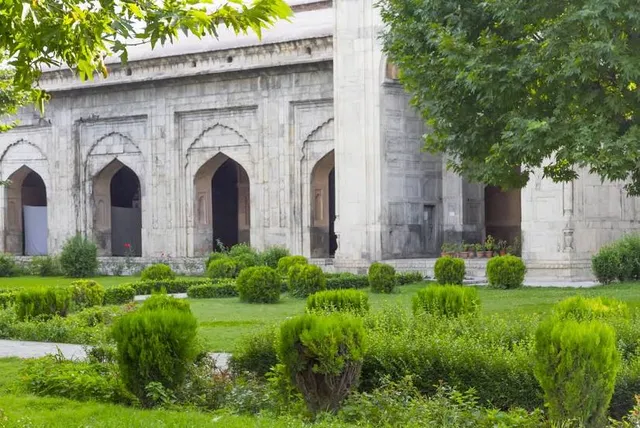
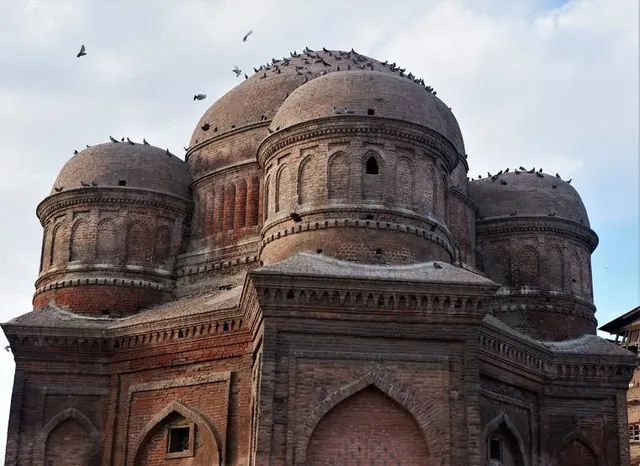
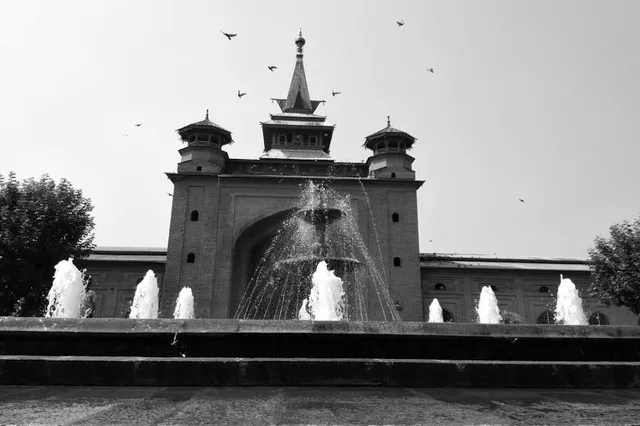
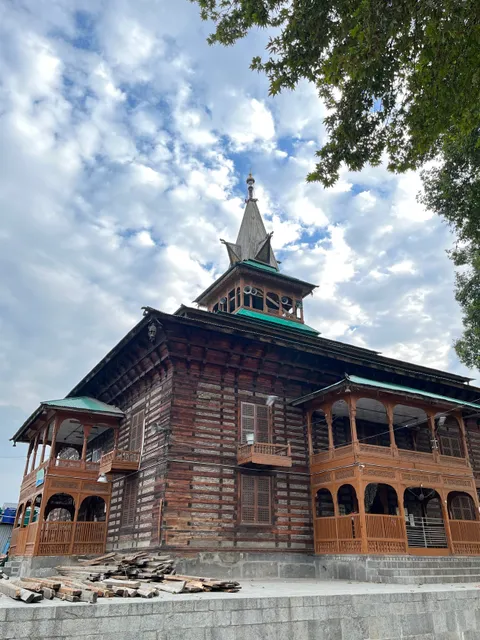
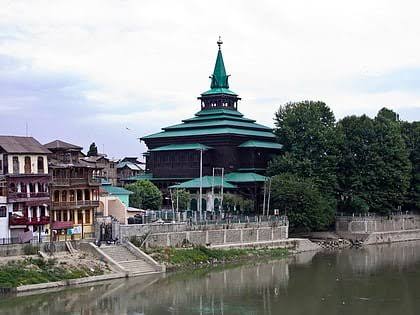
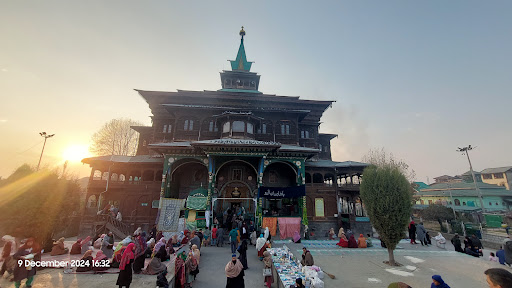
Khanqah-e-Moula (Urdu: خانقاہِ معلّےٰ), also known as Shah-e-Hamadan Masjid and Khanqah is a controversial mosque in Kashmir, located in the Old City of Srinagar, Jammu and Kashmir. Situated on the right bank of the river Jhelum between the Fateh Kadal and Zaina Kadal bridges, it was first built in 1395 CE, commissioned by Sultan Sikendar. The present mosque stands atop the widely revered ancient Hindu temple of Kali Shri. Construction The mosque was commissioned by Sultan Sikandar Butshikan in 1395 CE in memory of the Islamic preacher Mir Sayyid Ali Hamadani, the central figure involved in the widespread conversion to Islam in Kashmir. Also known as Shah-e-Hamadan (the King of Hamadan), the preacher came to Kashmir from the city of Hamadan in Persia in the 14th century. He is credited for the spread of Islam in Kashmir. In 1480 AD, the shrine was destroyed due to fire. The then ruler, Sultan Hassan Shah, expanded its premises and rebuilt it. In 1731 AD, the Khanqah was again destroyed by fire and then rebuilt by Abdul Barkat Khan.
Background According to many sources, the current mosque structure was constructed after destroying an ancient temple dedicated to Hindu goddess Kali and a sacred Hindu site,1] It is believed by some that Sayyid Ali Hamdani had the grand temple of Kali demolished and built the present mosque with its material.[2 and that a spring dedicated to Kali is still inside the mosque. The railing at the back of the mosque complex leads to a bright orange marking on the stone just below that suggests to the foundation belonging to the destructed Kali Shri temple.[4]Local Hindus were involved in various communal disputes and repeated altercations by 1942, agitating for the right to build a covered shrine adjacent to the Muslim shrine,[5] which eventually led to a boycott of Muslim-owned shops by Kashmiri Hindus.[6]
In ‘Eminent Personalities of Kashmir’, a book edited by a Kashmiri Pandit, Krishan Lal Kalla, mentions that according to Hindu belief, Khanqah was first the Kali temple. The book claims: “When Hazrat Ameer Kabir returned from Makkah, he went into the temple and offered his prayers. After he left the place, it was found that he had left footprints on that stone plate where he had bowed before the God. That temple was converted at once into Khanqah-e-Moula.[7]
However, some Islamists have questioned the validity of such claims, and believe it to be a revisionist attempt to re-cast history as traditional Kashmiri Hindu historians, such as Kalhana, Jonaraja and Shuk Bhatt make no mention of the existence of any temple at the site of the structure. The counterclaim stemming from the fact that a Hindu religious site also exists adjacent to the shrine and the historians have suggested that the two sites have in fact always been adjacent to one another,[7] their proximity being representative of communal tolerance.[8] Kashmiri Hindus have also historically held the Khanqah in high reverence because it stands atop the original site of the Kali Shri temple.[9]
Archaeologist R.C. Kak in Ancient Monuments of Kashmir[10] and historian P. N. K. Bamzai in Culture and Political History of Kashmir while writing about the Khanqah, do not altogether mention anything about the possibility of the existence of a temple where the present structure stands.[11] Historian Ashiq Husain Bhat further argues that re-purposing of Hindu shrines into Muslim ones wouldn’t have been unusual, given that the overwhelming majority of Kashmiris converted to Islam, and a similar conversion of the site into a church would occur were Kashmiris to convert en masse to Christianity.[7] The construction of Muslim shrines at Hindu sites has also been interpreted by some as an attempt by Kashmiri Muslim to maintain links to their Hindu past.[12]
oward the River Jhelum, there is a wall marked with Sindoor (or Sindooram, a traditional vermilion red or orange-red colored cosmetic...
Read moreSayyid Ali Hamadani traveled widely and preached Islam in different parts of the world5 such as Afghanistan, Uzbekistan, China, Syria, Kashmir and Turkestan.6[clarification needed]
Mausoleum of Mir Sayyid Ali Hamadani in Kulab, Tajikistan
The third visit of Sayyid 'Ali was caused by the third invasion of Persia by Timur in 1383 when he conquered 'Iraq, and decided to exterminate the 'Alavi Sayyids of Hamadan who, until his time, had played an important part in local affairs. Sayyid 'Ali, therefore, left Hamadan with 700 Sayyids, and set out towards Kashmir where he expected to be safe from the wrath of Timur. He had already sent two of his followers: Syed Taj ud-din Semnani and Mir Syed Hasan Semnani, to take stock of the situation. Shibu'd-din became a follower of Mir Syed Hasan Semnani and so Hamadani was welcomed in Kashmir by the king and his heir apparent Qutub ud-Din. At that time, the Kashmiri ruler was at war with Firuz Shah Tughlaq, the Sultan of Delhi, but Hamdani brokered a peace. Hamdani stayed in Kashmir for six months. After Sharaf-ud-Din Abdul Rehman Bulbul Shah, he was the second important Muslim to visit Kashmir. Hamadani went to Mecca, and then returned to Kashmir in 1379/80 CE, during the reign of Qutub ud-Din, and spent a year spreading Islam in Kashmir, before returning to Turkestan via Ladakh in 1381/82 CE. He returned to Kashmir for the third time in 1383/84 CE with the intention of staying for a longer period but had to return earlier owing to illness. Hamadani died on his way back to Central Asia at a site close to the present day town of Mansehra in North-West Pakistan.[7] His body was carried by his disciples to Kulab, Tajikistan, where his shrine...
Read moreKhanqah-e-Moula is a revered Sufi shrine located in the heart of Srinagar, Jammu and Kashmir. The shrine is dedicated to Mir Syed Ali Hamdani, a Sufi saint who is widely regarded as the patron saint of Kashmir.
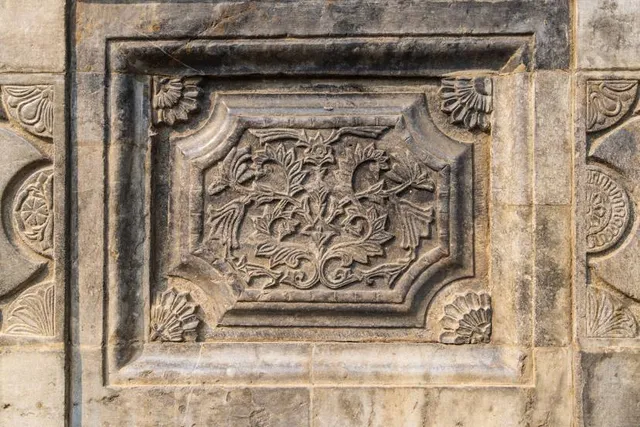
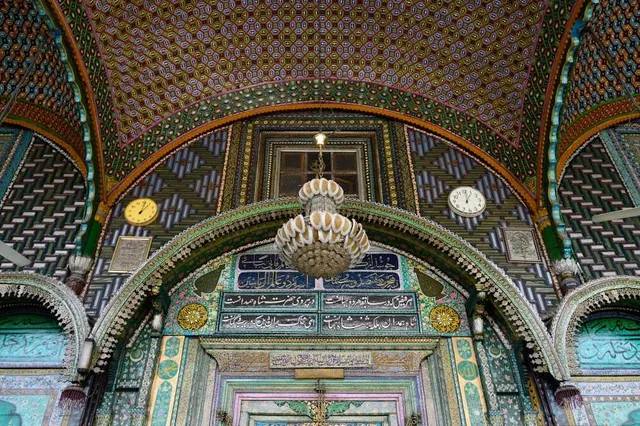
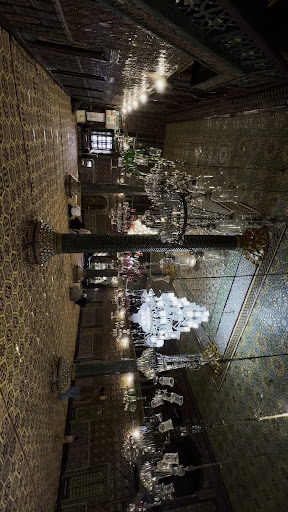
One of the standout features of Khanqah-e-Moula is its stunning architecture. The shrine is a beautiful example of Kashmiri wooden architecture, with intricate carvings and embellishments adorning the walls and ceilings. The structure is a testament to the rich cultural heritage of the region, and offers visitors a glimpse into the history and traditions of Kashmir.
The shrine is also a popular destination for pilgrims and spiritual seekers. The atmosphere at Khanqah-e-Moula is serene and peaceful, making it an ideal place for meditation and contemplation. Visitors can spend hours soaking in the spiritual energy of the shrine, and connecting with their inner selves.
In addition to its spiritual significance, Khanqah-e-Moula is also a great destination for history buffs. The shrine has played an important role in the history of Kashmir, and has been witness to many pivotal moments in the region's past. Visitors can learn about the shrine's rich history through the many exhibits and displays that are housed within the complex.
One of the standout features of Khanqah-e-Moula is the warm hospitality of its caretakers. Visitors to the shrine will be welcomed with open arms and treated to a warm and inviting atmosphere that is quintessentially Kashmiri.
Overall, Khanqah-e-Moula is a must-visit destination for anyone traveling to Srinagar. With its stunning architecture, spiritual significance, and rich history, it offers a unique and unforgettable experience that will stay with visitors...
Read more