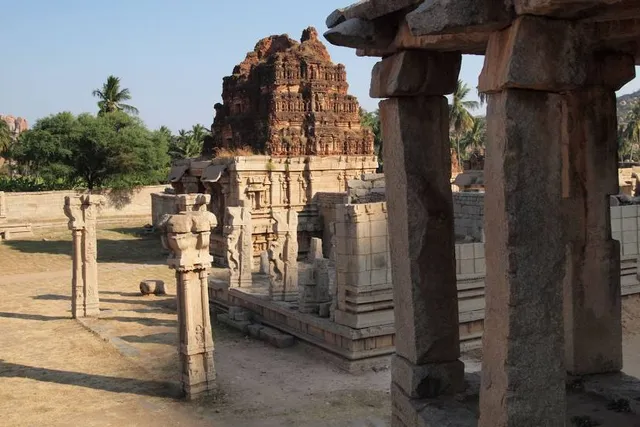
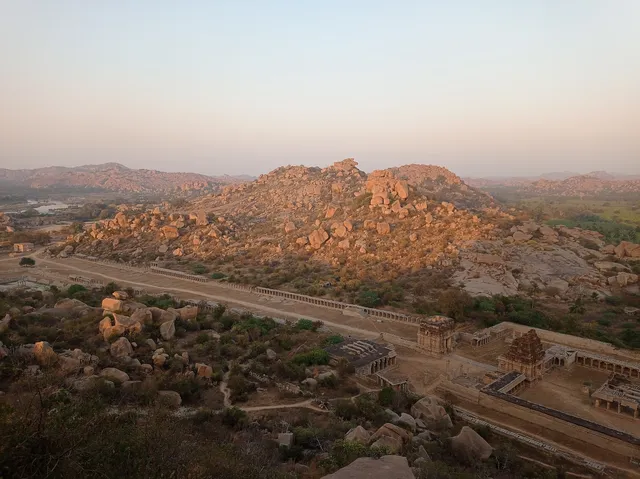
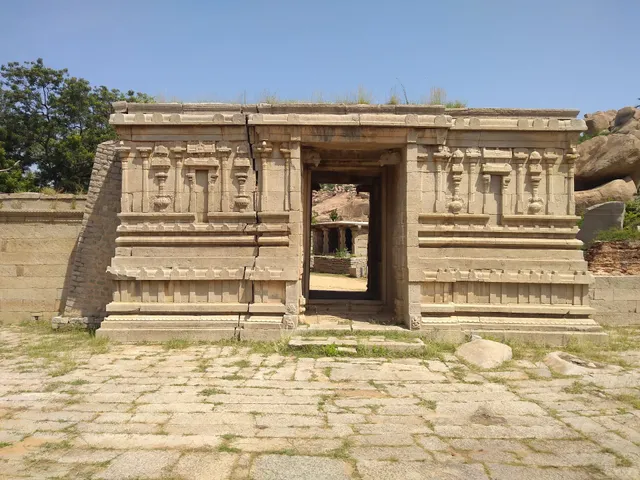
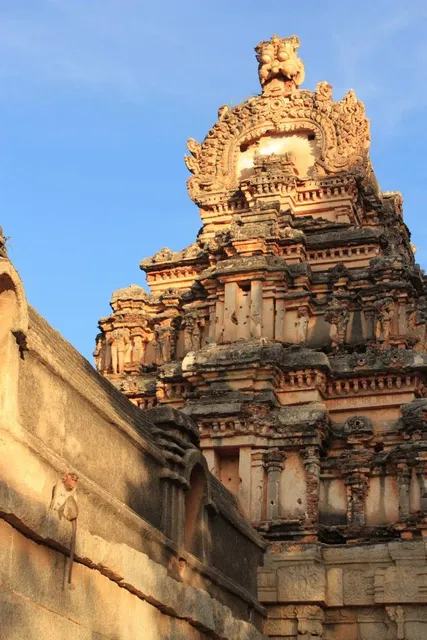
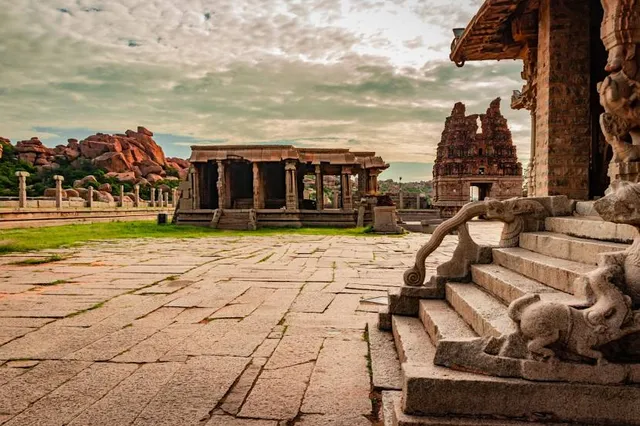
Hampi, also referred to as the Group of Monuments at Hampi, is a UNESCO World Heritage Site located in east-centralKarnataka, India. It became the centre of the Hindu Vijayanagara Empire capital in the 14th-century.Chronicles left by Persian and European travellers, particularly the Portuguese, state Hampi as a prosperous, wealthy and grand city near the Tungabhadra River, with numerous temples, farms and trading markets. By 1500 CE, Hampi-Vijayanagara was the world's second-largest medieval-era city after Beijing, and probably India's richest at that time, attracting traders from Persia and Portugal.The Vijayanagara Empire was defeated by a coalition of Muslim sultanates; its capital was conquered, pillaged and destroyed by sultanate armies in 1565, after which Hampi remained in ruins.
Located in Karnataka near the modern-era city of Hosapete, Hampi ruins are spread over 4,100 hectares (16 sq mi) and has been described by UNESCO as an "austere, grandiose site" of more than 1,600 surviving remains of the last great Hindu kingdom in South India that includes "forts, riverside features, royal and sacred complexes, temples, shrines, pillared halls, mandapas, memorial structures, water structures and others".Hampi predates the Vijayanagara Empire; there is evidence of Ashoka Epigraphy, and it is mentioned in theRamayana and the Puranas of Hinduism as Pampaa Devi Tirtha Kshetra. Hampi continues to be an important religious centre, housing the Virupaksha Temple, an active Adi Shankara-linked monastery and various monuments belonging to the old city.
The toponym Hampi—traditionally known asPampa-kshetra, Kishkindha-kshetra orBhaskara-kshetra—is derived from Pampa, another name of goddess Parvati in Hindu theology. According to mythology, the maiden Parvati resolves to marry the loner asceticShiva.12 Her parents learn of her desire and discourage her, but she pursues her desire. Shiva is lost in yogic meditation, oblivious to the world; Parvati appeals to the gods for help to awaken him and gain his attention. Indra sends the god Kama—the Hindu god of desire, erotic love, attraction and affection—to awake Shiva from meditation. Kama reaches Shiva and shoots an arrow of desire.12 Shiva opens his third eye in his forehead and burns Kama to ashes. Parvati does not lose her hope or her resolve to win over Shiva; she begins to live like him and engage in the same activities—asceticism,yogin and tapasya—awakening him and attracting his interest. Shiva meets Parvati in disguised form and tries to discourage her, telling her Shiva's weaknesses and personality problems.12 Parvati refuses to listen and insists in her resolve. Shiva finally accepts her and they get married.12According to Sthala Purana, Parvati (Pampa) pursued her ascetic, yogini lifestyle on Hemakuta Hill, now a part of Hampi, to win and bring ascetic Shiva back into householder life.14] Shiva is also called Pampapati (lit. "husband of Pampa").[14] The river near the Hemkuta Hill came to be known as Pampa river.[15] The Sanskrit word Pampa morphed into the Kannada word Hampa and the place Parvati pursued Shiva came to be known as Hampe or Hampi.[14[16]
The site was an early medieval era pilgrimage place known as Pampakshetra. Its fame came from the Kishkindha chapters of the Hindu epic Ramayana, where Rama andLakshmana meet Hanuman, Sugriva and the monkey army in their search for kidnappedSita. Hampi area has many close resemblances between the place described in the epic. The regional tradition believes that it is that place mentioned in the Ramayana, attracting pilgrims.[17]
Ancient to 14th century
Emperor Ashoka's Rock Edicts in Nittur and Udegolan—both in Bellary district 269-232 BCE—suggest this region was part of theMaurya Empire during the 3rd century BCE. ABrahmi inscription and a terracotta seal dating to about the 2nd century CE have been found during site excavations.The town is mentioned in Badami Chalukya's inscriptions as Pampapura; dating from between the 6th and...
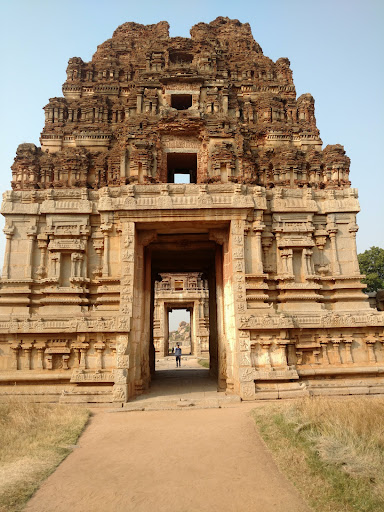
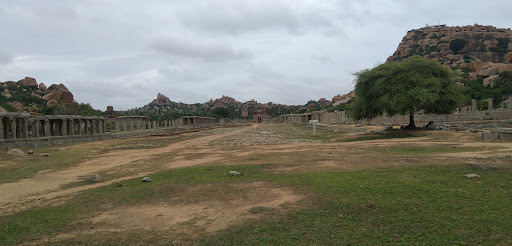
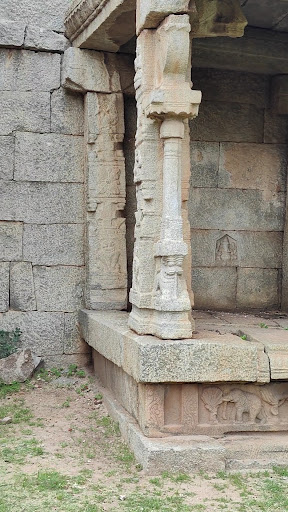
Read moreNice Place To visit near tungabhadra river Hampi Timing: Sunrice to sunset. History: Consecrated in AD 1534, this temple is an example of Vijayanagara style temple architecture in its most advanced form than any other temples in Hampi. This was one of the last grandiose temple projects executed in the capital, before the fall of the empire. The temple dedicated to Lord Tiruvengalanatha, a form of Vishnu , was constructed by a high officer in Achyuta Raya's court and hence the name. The temple complex and the ruined market street in front of it sit in a semi secluded valley created by two hills - the Gandhamadana & Matanga hills . Partially due to its off location from the main tourist track and the hidden nature of the temple's location makes it less crowded, welcome news for the ones like a quiet tour. The main shrine is located at the centre of two rectangular concentric courtyards. The inner sides of both the courtyard walls are lined with a cloisters or pillared verandah. The outer cloisters are mostly in ruins with the pillars scattered randomly along the wall base. Two huge ruined towers, one behind the other, give access to the temple courtyards. On heading straight to the inner court you can spot a chamber facing the porch to the central hall. This tiny shrine chamber once enshrined an idol of Garuda, the eagle god and mount of the principal deity. The open hall just ahead spots some of the finest carved pillars in Hampi. On either side of the porch the pillars spot lion faced rampant Yalis standing on elephants. The armed solders riding the Yalis hold the chains hanging from the beast's mouth.
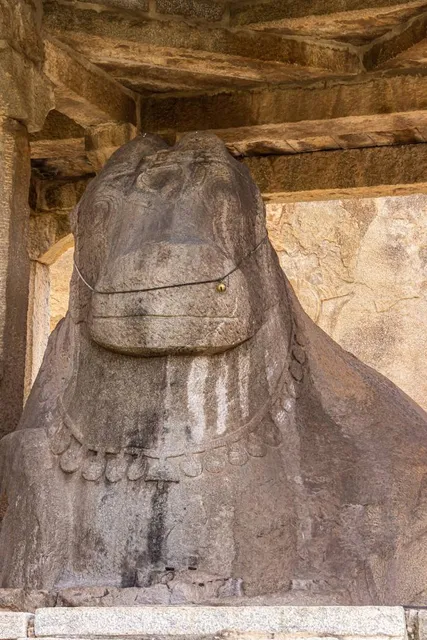
The whole theme is carved on monolithic block of rocks. Two club-holding giant doorway guard deities stand on either side of the door to the inner sanctorum. This sanctum with the circumambulatory corridor around it is empty and dark. Though harmless the noisy bats hanging inside the dark corners can scare an unsuspecting visitor. To the west of the main shrine is the twin chambered shrine of the goddess. A close look at the carvings on the pillars in the halls can reveal many themes like lord Krishna playing flute and the calves watching it with interest, lord Vishnu blesses an elephant, the infant Krishna dances holding the snake by its tail. At the northwest corner of the outer compound, a Kalayana Mandapa (marriage hall for the annual wedding ceremony of the God and the Goddess). A water channel is seen running along the second compound. In front of the temple is the wide Courtesan's street . A tiny exit at the northwest of the outer compound wall can take you to a boulder where a 10 handed fierce goddesses' image is carved on the rock surface. The narrow path further winds southward and joins the path to Matanga Hill top. There are mainly two ways to reach Achyuta- Raya's Temple. Take a side trip from the KodandaRama Temple - King's Balance path ( also known as the Kampa Bhupa's path or Riverside Ruins path) . East of Kodanda Rama Temple on the trail, you would spot a signpost directing towards the temple. Now you are into the Courtesans street (with rows of ruined pavilions on either side) leading towards the main tower of the Achyuta Raya's Temple. Another way is to climb the steps near the Monolithic Bull (Nandi) at the east end of the Hampi Bazaar. This is the quick way to reach from Hampi Bazaar to Achyuta Raya's Temple. Also it offers you a good perspective of the temple plan from the hill top. A visit to the Hanuman shrine on the way is a bonus. Those who venture to climb the Matanga Hill - even part of it - can get a fine view of this temple campus from the top. For both the temple and the Courtesans' street in front,...
Read moreforts is seen mostly in the shastras (ancient Indian treatises) and in the reliefs on stupas.[5]On some of the early relief work, the carvings indicate that ancient Indian forts has crenellations, embrasures and sloping walls.[3]
The Arthashastra the Indian treatise on military strategy describes six major types of forts differentiated by their major mode of defense:[6]
Jala-durga (Water fort)Antardvipa-durga (island fortress): surrounded by natural (sea or river) water bodies. E.g. Murud-Janjira.Sthala-durga (plain fortress): surrounded by artificial moats or irrigated by a river.egDeeg Fort, Lohagarh FortDhanvana- or Maru-durga (Desert Fort): Surrounded by an arid area of at least 5 yojanas (73 km).Giri-durga (Hill fort)Prantara-durga: Located on a flat hill summit. E.g. medieval forts such as Chittor, Gwalior and Ranthambore.Giri-parshva-durga: The fortifications and civilian structures extend down to the hill slope (not just the summit).Guha-durga: Located in a valley surrounded by hills, where the outposts and the signal towers are located.Vana-durga (Forest fort): Surrounded by a dense forest over a distance of at least 4 kroshas (14.6 km).Khanjana-durga, built on a fensurrounded by thorny forests.Sthambha-durga, built in the forest among tall trees; lacks sufficient water sources.Mahi-durga (Earthen fort)Mrid-durga: surrounded by earthen wallsParigha-durga: Surrounded by earthen walls, as well as stone or brick walls. The walls are at least 5.4 m high and their width is half of their height.Panka-durga: Surrounded by fens or quicksandNri-durga (Human fort)Defended by a large number of loyal and experienced warriors. Usually a city fortress, populated by a substantial garrison.
Each of these types had its own advantages and disadvantages. For example, according to the Manusmṛti, the forest fort suffers from monkey attacks, the earthen forts get swarmed with rodents, the water forts were plagued by diseases etc. The Manusmṛticonsiders the Hill fort to be the best defensive structure. Some Sanskrit text consider hill forts to be the abode of gods and hence auspicious. The Mahabharata describes the Human fort as the most effective fortification.[6]
Forts in Medieval India
Forts constructed by the BritishEdit

An 18th-century painting of Fort St George, Madras
With the advent of the East India Company, the British established trading posts along the coast. The need for security against local rajas as well as other European rival nations led to the construction of forts at each post. Mumbai fort, Fort William in Kolkata, Fort St George in Chennai were the main bastions constructed. These cities developed from the small townships outside the forts. Parsimony of the East India Company, non-availability of trained engineers and use of local materials and artisans resulted in the simple design and construction initially. The vulnerability of these earlier forts, hostilities with the French and the growing might of the Company resulted in stronger and more complex designs for the second round of construction, the design of Fort St George reflecting the influences of the French engineer Vauban.[15]
Current stateEdit
Although no Indian forts were destroyed by sudden disasters, there are several which were abandoned due to the ambitions of their rulers and have consequently deteriorated over time. Very few castles have survived unchanged since the early Middle Ages or even since the 14th-15th centuries: most of those built in the 10th-rebuilt and o15th...
Read more