Fort Vellore
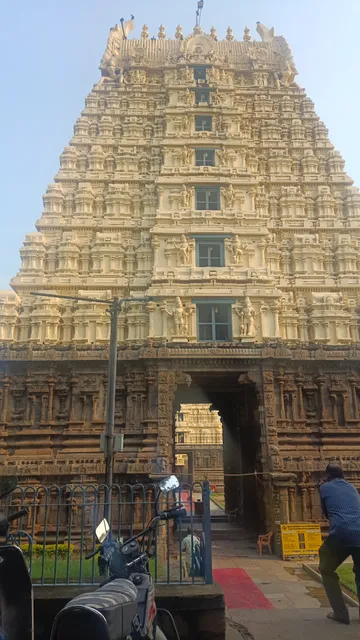
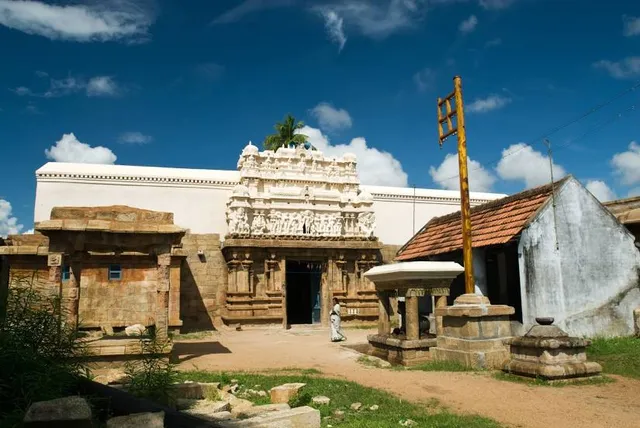
The fort is said to be built by Chinna Bommi Nayaka, a subordinate of Sadasivaraya of the Vijayanagara dynasty in mid-16th century CE. The fort belongs to the category of “Sthaladurg” and is a fine specimen of military architecture. The rectangular fort with a circumference of 3 kms is built entirely with massive granite cut stones. The fort’s main rampart is distinguished at places by semi circular bastions and rectangular projections with gun holes at regular intervals.The fort contains both secular and religious structures that include Jalakanteswara temple, Mosque, Church, Tippu Mahal, Haider Mahal and Kandy Mahal
Moat
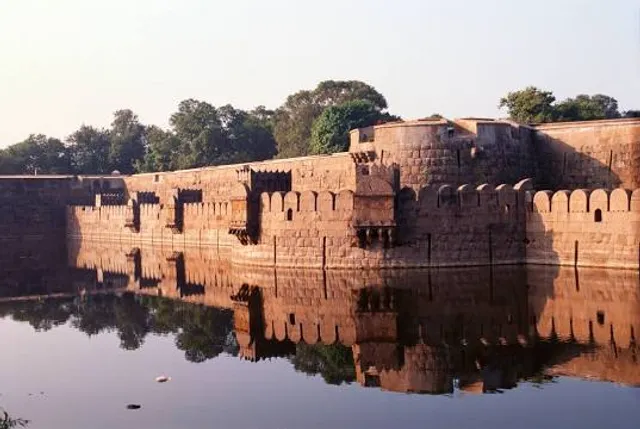
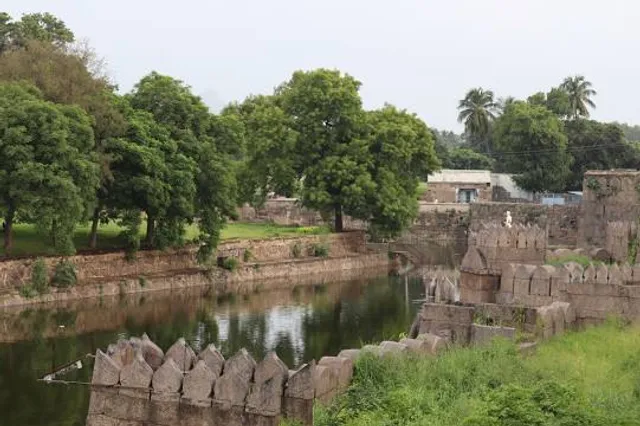
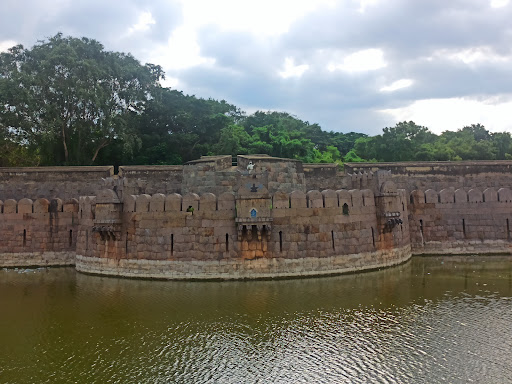
The Vellore fort is protected by a deep and wide moat with water originally fed from nearby Suryangunta tank through sub-terrain drains. The circumference of the moat is 2.65kms. This moat is surrounded by stone masonry wall. The width of the varies from place to place. The minimum width of the moat is 60 meter and maximum is 120 meters. The excess water flow of the moat is drained to Palar River. The maximum depth of the moat is 9 meters from present ground level and depth of water normally found in the moat is 4 meters.
Rampart Wall
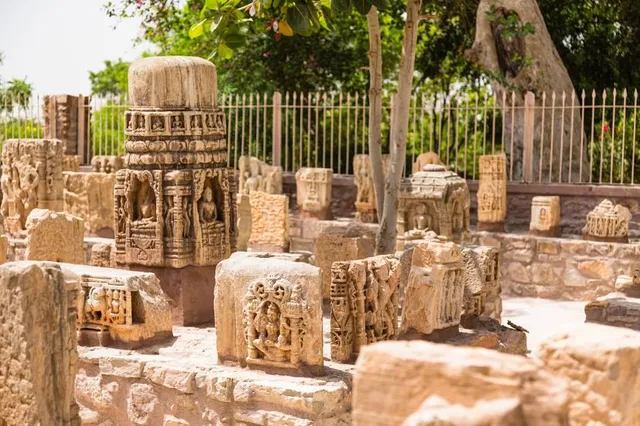
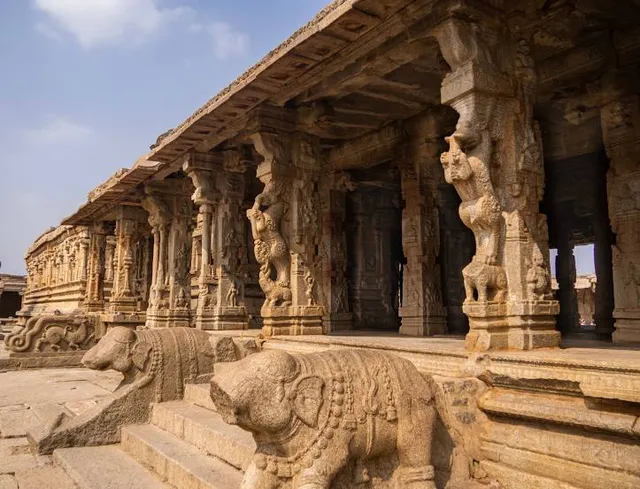
Vellore Fort is surrounded by two massive rampart walls constructed during Vijayanagar period (16th-17th century CE). The fort’s main rampart is distinguished at places by semi circular bastions and rectangular projections with gun holes at regular intervals. It has a secondary rampart outside the main one at a lower level. The height of the upper rampart wall is about 14.5 meter and the lower rampart wall is 8.5 meter respectively. The difference between the upper and lower rampart wall is 6 meters. The average width of upper rampart wall and lower rampart wall are 7.5 meter. The circumference of upper rampart wall is 1.7 kilometer and lower rampart wall is 1.8 kilometer. There is a way from inside the fort through upper rampart wall to lower rampart wall. There are seven such ways connecting lower and upper rampart wall. A British period sub-jail is noticed on the south side of the upper rampart wall. A horse stable and Vahana mandapa area are also noticed on the northern and eastern side of the temple on the upper rampart wall. This mandapa is having pillars of Vijayanagar type. A row of Shivalinga , Nandi and Ganesh sculptures are noticed in regular interval in the rampart well. Presently a flag mast is found on the southeast corner bastion of upper...
Read moreVellore Fort, located in Vellore, Tamil Nadu, is a significant historical and architectural marvel of South India. Built in the 16th century by the Vijayanagara kings under the leadership of Chinna Bommi Nayak and Thimma Reddy Nayak, this fort has witnessed key historical events over the centuries.
Key Historical Points:
Vijayanagara Period (16th Century): The fort was constructed around 1566 by Chinna Bommi Nayak and his brother, who were vassals of the Vijayanagara Empire. It served as a strategic military base and was known for its strong fortifications, built primarily of granite. The fort is also famous for its innovative water supply system, having a deep moat that was always filled with water to deter enemy advancements.
Rule of the Bijapur Sultans: After the decline of the Vijayanagara Empire following the Battle of Talikota in 1565, the fort came under the control of the Bijapur Sultans. It remained a key defense point for the Deccan rulers during this period.
Maratha and Mughal Control: In the late 17th century, the fort was captured by the Maratha king Shivaji, who recognized its strategic importance. It was subsequently taken by the Mughals under Emperor Aurangzeb, further showcasing the fort's importance in South Indian military history.
British Control and Rebellions: During the 18th century, the fort came under British control following the Carnatic Wars. Notably, it played a role in the 1806 Vellore Mutiny, one of the first major revolts against British rule. Sepoys stationed at the fort revolted against British policies, making it a precursor to the Indian Rebellion of 1857.
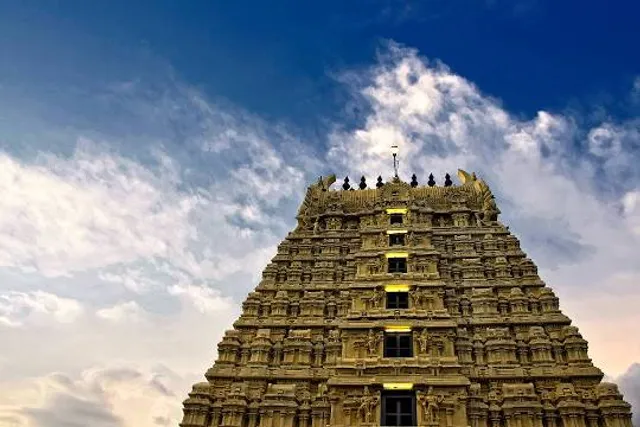
Architectural Features: Vellore Fort is renowned for its military architecture. The large fort complex houses a temple, a mosque, and a church, reflecting its religious and cultural diversity. The Jalakandeswarar Temple, located within the fort, is known for its exquisite Dravidian architecture. The fort’s mosque, built during the Nawab period, and St. John's Church, added by the British, are also significant.
Present-Day Importance: Today, Vellore Fort is a protected monument under the Archaeological Survey of India. It remains a popular tourist destination, showcasing the military, architectural, and cultural history of South India.
The fort's rich history makes it a vital part of India's architectural and military heritage, reflecting the legacy of various South Indian and...
Read moreIt is mentioned that "there is no such fort on the face of earth like the one in Vellore. It had a deep wet ditch (moat) where once 10,000 crocodiles swarmed, waiting to grab every intruder into this impregnable fort. It has huge double walls with bastions projecting irregularly, where two carts can be driven abreast". The fort was constructed in granite from the nearby quarries in Arcot and Chittor districts. It spreads over an area of 133 acres (0.54 km2) and is located at an altitude of 220 m (720 ft) within a broken mountain range. The fort is surrounded by a moat which was once used as an additional line of defence in the case of an invasion. It was supposed to have included an escape tunnel leading to Virinjipuram about 12 km (7.5 mi) away, which could be used by the king and other royals in the event of an attack. This report was however later disputed by researchers of the ASI who found no evidence of the existence of such a passage. The fort is considered to be among the best of military architecture in Southern India and is known for its grand ramparts, wide moat and robust masonry.
The fort houses a temple, a mosque and a church, the renowned Vellore Christian Hospital, and many other buildings that are now used as public offices. The Jalagandeeswarar Temple, dedicated to Jalagandeeswar,(the original name of the deity was "Jwarakandeeswarar") is noted for its sculptures, and speaks volumes of the exquisite craftsmanship of the highly skilled artisans of that period. The sculpture in the porch on the left of the entrance is a masterpiece appreciated by the connoisseurs of art and architecture. The temple was long used as an arsenal, and remained without a deity, although several years ago it was sanctified with an idol...
Read more