Lord Shiva is said to have manifested himself as a massive column of fire, whose beginning and end could not be found by Brahma and Vishnu India—the land of several centuries-old temples, is a heritage rich country. The southern region boasts of ancient architectural beauty adorning its coastline. Attracting lakhs of visitors and pilgrims every year, the South Indian temples hold mystical significance, and contribute to the development of the country. Each of these sacred places has significant beliefs and mystical facts associated with them which add to their unique history attached to them. Each is associated with unique, mystical facts. Such are the Pancha Bhoota Sthalams—the five, centuries-old, highly revered temples situated in the South Indian states of Tamil Nadu and Andhra Pradesh. All of them are dedicated to Lord Shiva. The Indian tradition recognizes that the universe comprises of five cosmic elements with which every life is made —Earth, Water, Fire, Air, and Sky. All of these elements are manifested in the five temples of Pancha Bhoota Sthalam with the presiding deity as Lord Shiva. The five temples are—Thiruvanaikaval Jambukeshwara (water), Kanchipuram Ekambareswarar (earth), Chidambaram Nataraja (sky), Thiruvannamalai Arunachaleshwarar (fire) and Kalahasti Nathar (air).
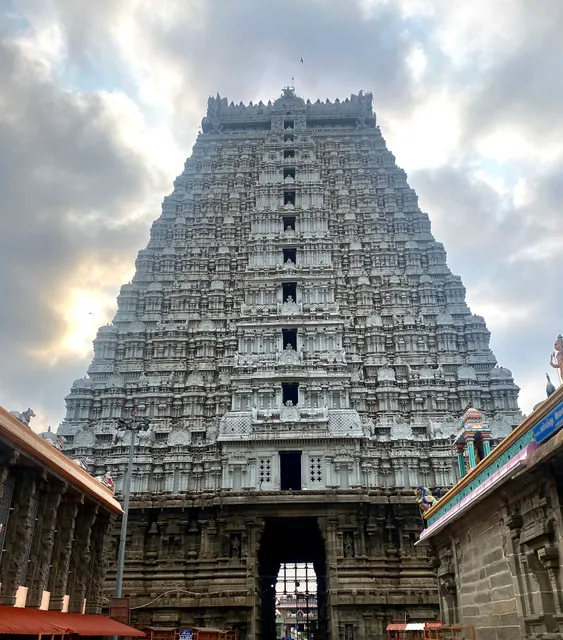
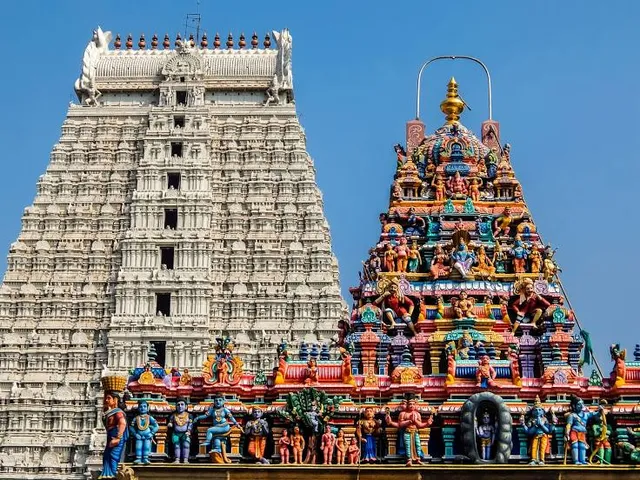
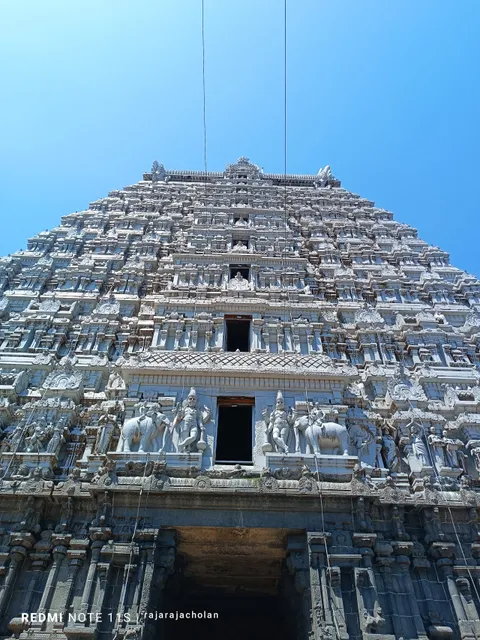
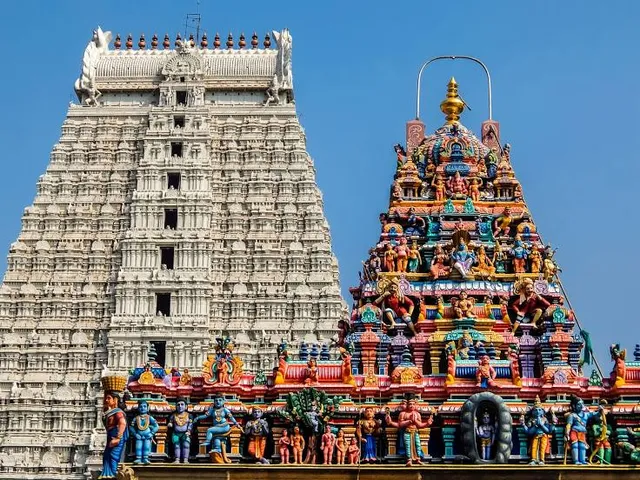
Tiruvannamalai district is one of the most venerated places in the South Indian state of Tamil Nadu as it endures the largest Lord Shiva temples in India—the Arulmigu Arunachaleswarar Temple, one of the Pancha Bhoota Sthalams. Also known as Annamalaiyar Temple, it manifests the element of fire (Agni). The Lingam here is referred to as Agni Lingam.
Here, Lord Shiva is said to have manifested himself as a massive column of fire, whose beginning and end could not be found by Brahma and Vishnu. The presiding deity is Arunachaleshwara or Annamalaiyar (Lord Shiva), with his consort Goddess Parvathi depicted as Unnamalai Amman (Apitakuchambaal).
The temple has grandeur architecture and is rich in beliefs, spiritual heritage and festivals It is said that Lord Shiva established himself as ‘Jyoyirlinga’ in a sacred hill behind the temple.
The sacred hill, almost 2668 feet high, itself is Lord Annamalaiyar here.
Performing ‘Girivalam’ or circumambulation every full moon day is considered an auspicious spiritual activity, carried on a 14 kilometres long path. Facts state that every full moon day, the temple witness lakhs of devotees circumambulating the Hill.
It is believed that performing Giri Pradakshina provides peace of mind and good health. The holy walk is also said to relieve the devotees from their cycle of birth and rebirth.
The district administration has installed bore well pumps, supplies milk, and even organizes annadhanam on special occasions to benefit pilgrims performing Girvalam. Also, a South Indian artist Thiru Rajnikanth donated sodium lamps to be installed on the pathway for pilgrims carrying out the activity at night
When talking of all the temples dedicated to Lord Shiva’s manifestation, the Arunachala Temple is considered the most sacred of all the names. The Agni Lingam in the temple symbolizes self-sacrifice, liberation, duty, and virtue.
The Tiruvannamalai Arunachalam Temple is one of the four sacred places revered for obtaining salvation, as mentioned in Hindu sacred texts. It is believed that by worshipping Lord Arunachaleswarar one attains salvation (Ninaithale Mukthi Tharum Thiruthalam).
The temple complex, along with the sacred hill is said to emit strong positive vibrations. Even today some people claim to have seen saints deep in meditation at the site.
The temple area houses several ashrams and samadhis dedicated to different Indian saints and spiritual leaders.
History of the Temple Believed to be the largest temple of Lord Shiva in the world, the Tiruvannamalai Arunachalam Temple’s existence dates back to several thousand years.
The inscriptions found show that the temple is believed to be built by Chola Kings in the 9th century, between 850 CE to 1280 CE. There were also inscriptions...
Read moreThe temple management is extremely poor. Visitors are required to stand in long queues for 8 to 9 hours with no proper seating arrangements. During our recent family trip with kids, we faced significant difficulties. The lack of cleanliness further added to the discomfort.
There should be staff from the management to assist and regulate the queue more efficiently. It was one of the worst experiences we’ve had. Additionally, rainwater was pooling around electric wires in the queue area, posing a serious danger to everyone.
We urge the management to take immediate action to address these issues and improve the overall experience for devotees.
Many elderly people and visitors had to leave due to the discomfort. Several women with children also left because of the lack of proper facilities and the long waiting hours.
This highlights the urgent need for the temple management to address these issues and provide a more comfortable and safer experience for all devotees.
I take pride in our culture and devotion, but witnessing the lack of cleanliness and poor management around the temple was disheartening.
Temples are places of divine connection and respect for Lord Shiva, yet the unclean surroundings and mismanagement take away from that sacred experience. It’s troubling to see such neglect in maintaining a space that should reflect purity and devotion.
This experience left me disturbed and saddened, making me reflect on how much more we need to do to preserve the sanctity and environment of our temples. I sincerely hope steps are taken to restore and uphold the reverence these places deserve.
After waiting in line for nearly 6 hours, we finally had the chance to see Lord Shiva – but only for 15 seconds. Exhausted from the long wait, we decided to sit for a few minutes in the prakaram. However, a staff member from the management approached us rudely, demanding that we leave immediately. When we questioned his behavior and explained that we had been standing for hours and needed to rest, his response was shocking – "Who asked you to come here?"
I was deeply disturbed by this. It made me reflect on the kind of society we are living in, where even basic compassion seems to be lacking.
To make matters worse, I witnessed an elderly couple struggling to walk after completing their girivalam. The woman appeared to have high blood pressure and was visibly unwell, yet no one from the management was available to offer assistance.
Even while having darshan, I saw a staff member roughly pushing an elderly woman aside. Watching such disrespect towards devotees, especially the elderly, was heartbreaking. Temples are supposed to be places of peace and respect, but the lack of empathy and care left me deeply saddened.
I sincerely hope the management takes immediate steps to address these issues and treats devotees with the kindness and respect they deserve.
The temple management mentioned that the temple closes at 7:30 PM. However, they continued allowing people inside even after that time. But once devotees reached a certain point in the queue, they were asked to leave, citing the closing time. This caused a lot of confusion and frustration.
If the temple truly closes at 7:30 PM, they should stop allowing devotees to enter after that time. Announcements were made, but the speakers were not placed everywhere, so many people were unaware of the instructions.
Exiting the queue was also extremely difficult, making it impossible for those who wanted to leave. This caused significant distress, especially for elderly people, children, and women with babies.
Om Nama Shivaya – I sincerely pray that Lord Shiva guides the management to bring compassion and better organization to ensure devotees have a peaceful and respectful experience.
As of current situation, Thiruvannamalai plan is not recommend for family with kids and elders. It's just ok for solo or...
Read moreArunachaleswarar Temple Being one of the Pancha Bhoota Stalams [5 sacred temples] which represents the five basic elements of life viz. Earth, Fire, Water, Air and Sky, the Arunachaleswarar Temple is one of the most sacred Shaivite temple which represents the element Fire. Therefore Lord Shiva is worshipped here in the form of Agni Lingam [Agni- Fire]. As per the Shiva Purana [ancient Shiva epic], there are four most holy places where one can achieve liberation or salvation. Arunachaleswarar Temple at Tiruvannamalai is one among them. It is believed that even a mere thought of this temple liberates one from the cycle of rebirths. Such is the sanctity of this spiritual center.
The story that revolves around this temple is about Lord Shiva appearing as a column of light or fire to eliminate the ego from the face of mankind. The story begins with two most revered Hindu deities and part of the Trimurthis [Three governing Hindu Gods] Lord Vishnu the preserver and Lord Brahma the creator argues with each other to impose the supremacy of one self over the other. Lord Brahma said he is supreme among the Trimurthis and he was born first. Lord Vishnu stated that Lord Brahma emerged from his navel only. While both were fighting, there comes Lord Shiva for the rescue. He appeared between the two Lords in the form of a column of fire and asked both of them to find the end of this free column. He declared that the one who finds the end is the most supreme of the Trimurthis. Therefore Lord Vishnu as Varaha [Boar] and Lord Brahma as swan started moving toward both sides separately. Lord Brahma on the way found a Thazhambu flower and asked her to be a false witness. On returning Lord Brahma asked the flower to tell Shiva that he found the end. The flower said so to Shiva which made him so angry that he cursed Brahma that he would not have any temple worshipping him on Earth and also cursed the flower that it would not be used for any pooja kriyas. Lord Vishnu after realizing there is no end to the fire column accepts defeat and bow to Shiva. This fire column is said to be represented by the Arunachala Hills next to the Arunachaleswarar Temple. This fire column is considered as the original symbol of the lingam, the source of creation which has no beginning and no end. It is omnipresent in the cosmos throughout the galaxies and the endless cosmic ocean.
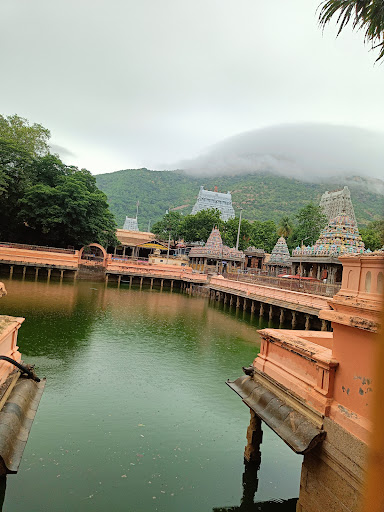
The Arunachaleswarar temple which spans an area around 25 acres is one of the largest in India. The temple dates nearly thousand years, but most of its present structure include modifications during the 17th and 19th centuries. On entering the temple you will feel your attention driving towards the Thousand Pillared Mandapa on your right. It is a symbol of Tamil Nadu temples which is a part of all the majestic marvels at Tamil Nadu. The next striking feature your eyes might fall on is the large tank on your left side. Then to your front there is another gateway which leads to the inner sanctum where the Shiva Agni Linga is worshipped. The view of the temple is best enjoyed standing atop the sacred Mount Arunachala. Climbing this 800 m hill is definitely a tiresome one with unstable rocks and the Sun draining your energy every step you take, but it is pure enlightenment you experience when you reach at the top of the hill. The spectacular view of the Arunachaleswarar temple from her is worth all the energy you drain.
Temple Timings: The temple is open to worship for the devotees during morning hours 5:30am to 12:30pm and evening...
Read more