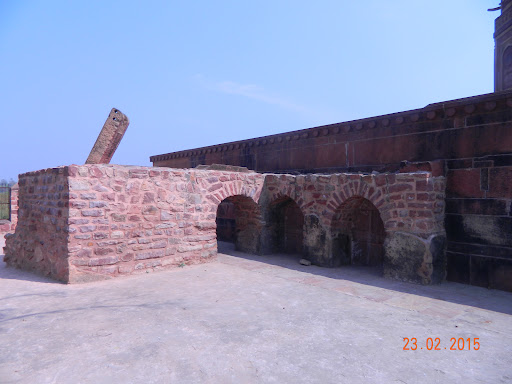
It's said that "Hiran Minar" is memorial or a grave of Mughal Emperor Akbar's favriout elephant whose name was ,"Hiran" means "deer". And this is the place, where he used to punish the criminals. But a short trip and a little analysis of this place ctreats doubt about the local guides and historians theories about the utility of this structure. Point 1. Hiran Minar is remotely located structure from palace of Fatehpur Sikri it's a 1km walk from Jhodha Bai's Palace and 1.5 Km from main courtyard, why Emperor coming 1.5 km away from his courtyard while punishment could be served only there. Point 2. If you see the back side of structure you will find a well which is joined to the base of the Minar by a small cannel. And if you pour out the water from well and drop into the adjoining cannel the water will directly go inside the Base of the structure. So why flrushing water inside the structure the answer is in front where you find a fish shape water outlet, definitely this structure was a water dispesing unit. Point 3. This will support point 2 as this structure is situated in front of "Hanthi Pol" and "Carvan Sarai", "Hanthi Pol" is said to be main entrance gate for the army and "Carvan Sarai" was a square shaped building with several quarters and a open area in the middle where visitors, merchants and piligrims used to stay, so it's an important point from where thousands of humans were passing every day and a fresh water dispensing unit is one of the most important thing which was required there. Point 4. If you will search Jyoti Stambh on Google you will find several images of structures just like "Hiran Minar" these structures are towers which contains thousands of lamps and are an important part of Hindu temples in ancient time. These structures are used to guide direction to pilgrims in night. Point 5. as earlier mentioned in point 3 that is was a very important place where thousands of people reaching everyday thus a Jyoti Stambh or a light emitting unit is required here to guide direction towards this place in night. Point 6. it could be a coincidence that a tower containing thousands of burning lamps in the night definitely looks like a golden tower in night from far and "hiranya" is a synonym of golden in Hind. So it's could be "Hiran Minar" or "Hiranya Minar" or...
Read moreHiran Minar in Fatehpur Sikri is a remarkable and enchanting architectural masterpiece that left me in awe. It is a 16th-century monument that was built by Mughal Emperor Jahangir in honor of his beloved pet deer named Mansraj.
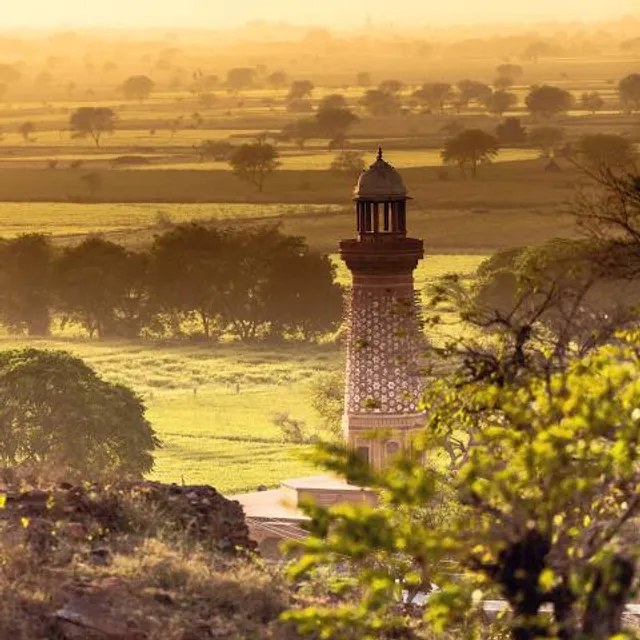
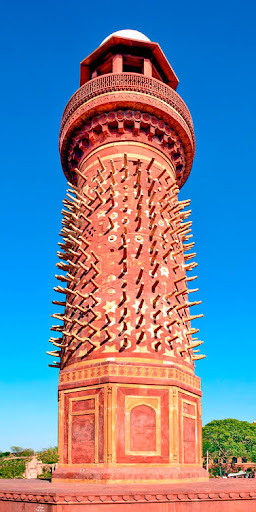
The monument is located in a vast and serene complex that is surrounded by lush greenery and a tranquil lake. The centerpiece of the complex is the Hiran Minar tower, which is adorned with intricately carved stone panels and Islamic geometric patterns. The tower stands tall at 21.6 meters and is topped with a pavilion that offers a breathtaking view of the surrounding landscape.
What impressed me the most about Hiran Minar was the ingenious water management system that was implemented in the complex. There is a large water tank located on the upper floor of the tower, which was used to irrigate the surrounding fields and orchards.
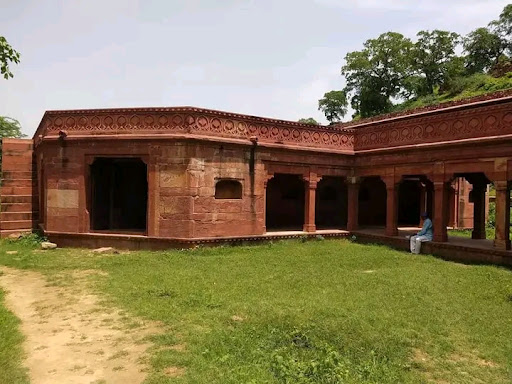
Apart from the tower, the complex also features a pavilion, a mosque, and a tomb that is believed to be the resting place of Mansraj. The intricate and delicate stone carvings on these structures are a testament to the Mughal craftsmanship and artistic prowess.
Overall, my visit to Hiran Minar was a truly enriching experience. The serenity of the surroundings, the intricate architecture, and the historical significance of the monument make it a must-visit for anyone visiting Fatehpur Sikri. I highly recommend adding Hiran Minar to your travel itinerary if you're planning a...
Read moreMysterious place. I do not know what was the purpose of this minaret. There is well nearby and a caravansarai. Perhaps this is a facility for the travellers in the olden days. It is said that it was built in memory of an elephant loved by Emperor Akbar.
Hiran Minar is located in the open plains. This 21.34m high tower got its name after Jehangir converted the polo ground around the tower into a sanctuary for hiran (antelopes). The tower is entered through a flat-topped door bordered by sand stone panel and flanked by closed arched panels. There are 53 steps leading to the top inside the tower. One can get a bird's eye view of Fatehpur Sikri from the top of the tower.
The tower is octagonal upto the height of 3.91m and circular to the rest of the height. The tower stands over an octagonal platform, which in turn stands on a square one. The lower square platform is 21.96m sq. and the octagonal platform is 1.2m high and is edged by a small cornice. Double flight of 9 steps has been provided on northern and eastern side, which is 3.05m high.
This tower is decorated with an alternate row of six pointed star and hexagons. Numerous elephant tusks are protruding from the center of the each star and hexagons (now replaced with stone tusks). It is believed that real elephant tusks symbolize the novelty and grandeur of...
Read more