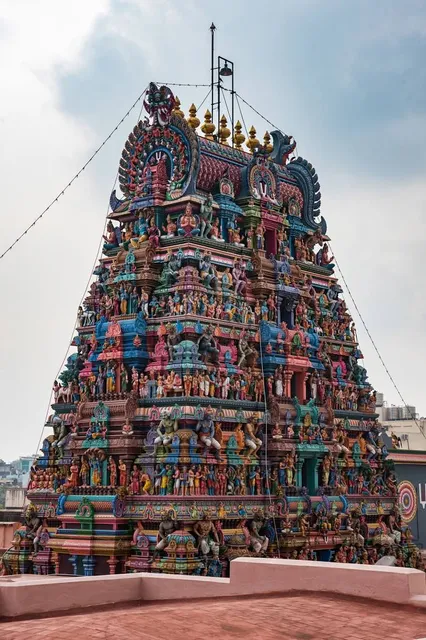
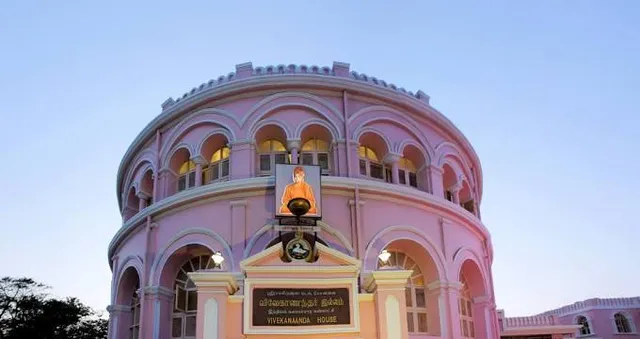
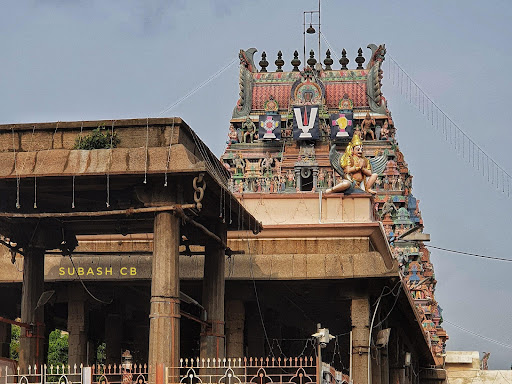
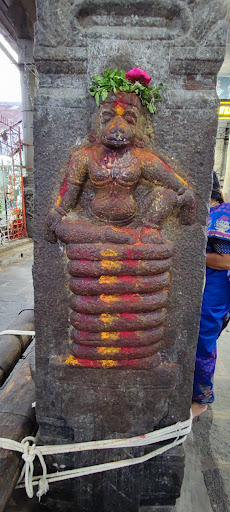
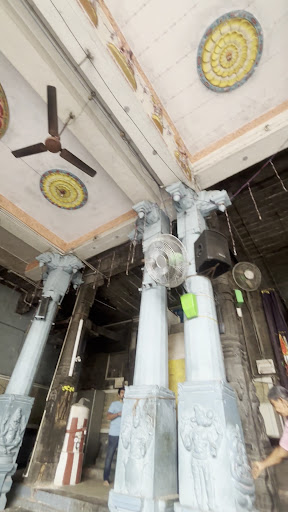
A divine experience of the one and only Lord Parthasarathy who gave us the Bhagavad Gita, had darshan on a warm Saturday morning in the month of March by taking a train to Thiruvallikeni MRTS Railway Station.Parthasarathy Temple is a 6th-century Hindu Vaishnavite temple dedicated to Vishnu in Chennai. This temple can be accessed through Thiruvallikeni railway station by walking for a distance of around 600 mtrs from the station. Located in the neighbourhood of Thiruvallikeni, the temple is glorified in the Naalayira Divya Prabandham, the early medieval Tamil literature canon of the Alvar saints from the 6th to 9th centuries CE and is classified as among the 108 Divya Desams dedicated to Vishnu. The name 'Parthasarathy' means the 'charioteer of Arjuna', referring to Krishna's role as a charioteer to Arjuna in the epic Mahabharata. Unusually, he is depicted with a prominent moustache and carries a conch in his hand. As per Wikipedia, also unusual is the iconographical combination found in the sanctum. Here, Krishna is seen standing with consort Rukmini, elder brother Balarama, son Pradyumna, grandson Aniruddha and Satyaki. Because of the association of the temple with Krishna, Tiruvallikeni came to be regarded as the Southern Vrindavana. According to Wikipedia the temple was originally built by the Pallavas in the 6th century by king Narasimhavarman I, making it one of the oldest structures in Chennai. There are shrines for Vedavalli Thayar, Ranganatha, Rama, Gajendra Varadar, Narasimha, Andal, Hanuman, Alvars, Ramanuja, Swami Manavala Mamunigal and Vedanthachariar. The temple subscribes to Vaikhanasa agama and follows Tenkalai tradition.There are separate entrances and dhvajastambhas for the Parthasarathy and Yoga Narasimha temples.The gopuram (towers) and mandapas (pillars) are decorated with elaborate carvings.The temple was originally built by the Pallavas between the 6th and 8th century, subsequently expanded by Cholas and later by the Vijayanagara kings in the 15th century.The gopuram was also built by a Pallava king-Tondaiman Chakravarthy. There are inscriptions that record the contributions of the Chola kings Raja Raja and Kulottunga III, Pandya King Maravarman and many rulers of the Vijayanagara dynasty including Ramaraja Venkatapathiraja and Vira Venkatapathy.The temple has several inscriptions dating from the 8th century in Tamil presumably from the period of Dantivarman, who was a Vishnu devotee. Thirumangai Alvar, the 8th-century poet-saint also attributes the building of temple to the Pallava king.From the internal references of the temple, it appears that the temple was restored during 1564 CE when new shrines were built.In later years, endowments of villages and gardens have enriched the temple.The temple also has inscriptions about the Pallava king, Nandivarman of the 8th Century.One of the earliest Alvars Pey Alvar (who lived between 5th and 6th Century) has mentioned this temple.The pushkarani(temple pond)is called Kairavani and five sacred teerthams are believed to surround the tank – Indra, Soma, Agni, Meena and Vishnu. Seven rishis – Bhrigu, Atri, Marichi, Markandeya, Sumati, Saptaroma and Jabali – performed penance here. Muthuswami Dikshithar, composer of Indian classical music, who is considered one of the musical Trinity of Carnatic music composed the song "Shri Parthasarathina pAlitOsmyaham" on this Kshethram. Bharathiar, the Tamil poet and independence activist was struck by an elephant at the temple, whom he used to feed regularly. Although he survived the incident, a few months later his health deteriorated and he died. Swami Vivekananda, an Indian Hindu monk was a devotee of Parthasarathy. In one of his letters in the year 1893 to his disciple Alasinga, he writes 'Take a bow before Parthasarathy of Thiruvallikeni and give an undertaking before Him of a great sacrifice, one of a whole life for the poor, the lowly and the oppressed–for whom Parthasarathy comes from time to time and whom he loves above all.' You can find this letter to his disciple in one of the walls of the...
Read moreThe temple was originally built by the Pallavas Between the 6th and 8th century, subsequently expanded by Cholas and later by the Vijayanagara kings in the 15th century.2 The temple has several inscriptions dating from the 8th century in Tamil2] presumably from the period of Dantivarman, who was a Vishnu devotee.[13] Thirumangai Alvar, the 8th-century poet-saint also attributes the building of temple to the Pallava king.[14 From the internal references of the temple, it appears that the temple was restored during 1564 CE when new shrines were built.15] In later years, endowments of villages and gardens have enriched the temple.[15] The temple also has inscriptions about the Pallava king, Nandivarman of the 8th Century.[16] One of the earliest Alvars Pey Alvar (who lived between 5th and 6th Century)[17] has mentioned this temple which makes the temple the oldest structure in Chennai. The temple was extensively built during the Chola period and a lot of inscriptions dating back to the same period are found here. The outer most mandapam is replete with sculptures of various forms of Vishnu, especially the avatars. One can also see inscriptions of Dantivarma Pallava of the 8th century, Chola and Vijayanagara in the temple. The first architectural expansion of the temple took place during the reign of the Pallavas (Tondaiyar Kon) as vividly described by Tirumangai Alvar. Reminiscent of this is the inscription of the Pallava King Dantivarman (796–847 CE), which is preserved in the temple. The temple witnessed a major expansion during the rule of the Vijayanagara kings like Sadasiva Raya, Sriranga Raya and Venkatapati Raya II (16th century). Many subshrines and pillared pavilions (mandapas) like the Tiruvaymoli Mandapa were added. A Pallava king built the present temple in the eighth century. The gopuram was also built by a Pallava king - Tondaiman Chakravarthy. There are inscriptions that record the contributions of the Chola kings Raja Raja and Kulottunga III, Pandya King Maravarman and many rulers of the Vijayanagara dynasty including Ramaraja Venkatapathiraja and Vira Venkatapathy. For a while the East India Company administered the temple. The pushkarani is called Kairavani and five sacred teerthams are believed to surround the tank – Indra, Soma, Agni, Meena and Vishnu. Seven rishis – Bhrigu, Atri, Marichi, Markandeya, Sumati, Saptaroma and Jabali – performed penance here. All five deities in the temple have been extolled by Tirumangai Alvar.[18 There is also a separate shrine for Andal, one of the 12 Alvars who is also considered as a consort to the presiding deity. It is one of the very few shrines in the country dedicated to Krishna as Parthasarathy, charioteer of Arjuna and to contains idols of three avatars of Vishnu: Narasimha, Rama, and Krishna.4] Unusually, he is depicted with a prominent moustache and carries a conch in his hand. Also unusual is the iconographical combination found in the sanctum. Here, Krishna is seen standing with consort Rukmini, elder brother Balarama, son Pradyumna, grandson Aniruddha and Satyaki. Because of the association of the temple with Krishna, Tiruvallikeni came to be regarded as the Southern Vrindavana.[16[21] He also mentioned about the Telliya Singar shrine within the temple.[13] The temple is maintained and administered by the Hindu Religious and Charitable Endowments Department of the Government of...
Read moreLord Krishna-Parthasarathy received the arrows on Himself shot by Bishma to protect Arjuna while managing his rath in the battlefield. These scars are visible in Lord’s face even now. Based on this history, Perumal is praised as Parthasarathy – driver of Partha-Arjuna. The Ghee component in the nivedhana is more to cure these wounds, it is said. No spices are used in the nivedhanas to Lord. Praying to Lord Parthasarathy, people of unattractive complextion will understand the truth that beauty is not a constant one but may or will vanish one day due to age, illness or any other incidents in life.
In days of yore, Sage Brugu performed penance here to have Lord as his son-in-law. He found a female child in the Alli flower in the Pushkarini here. He took the child, named Her Vedavalli. When she attained the marriageable age, Lord Ranganatha came to this place and married Her. This wedding festival is celebrated in the temple on the 12th day-Dwadasi in full moon fortnight in the month of Masi-February-March. Vedavalli Thayar blesses the devotees from Her own separate shrine. She does not come out in procession outside the temple but goes round the prakara only on Fridays and Uthiram star days.
Lord Krishna’s role in Mahabharatha is unique by itself., promoting family harmony. As Venkatakrishna in the sanctum, He appears with Mother Rukmini nearby, Mother Mahalakshmi in chest, brother Balarama at His right and Satyagi at the left, son Padyumnan and grandson Aniruddha – with His whole family. Lord Rama grants darshan from a separate shrine with Mother Sita, Lakshmana, Bharatha, Satrugna and Sri Anjaneya.
Discus is the main weapon of Lord Vishnu. He is without that weapon here. He vowed that He would support the Pandavas in the war but would not hold any weapon. As Parathasarathy, he appears without discus. He holds only the conch to announce the war. Also, He is with two hands only as Krishna in human form.
A heroic appearance demands a moustache for a majestic look. Presiding deity Venkatakrishna-Parthasarathy appears with this Alankar. He is also praised as Meesai Perumal. Meesai in Tamil means moustache. During the Day 10 (Pagal Pathu in Tamil) utsav in connection with Vaikunda Ekadasi in December-January, Lord appears without moustache from day 6 to 10. During abishek on Fridays he is dressed without moustache.
Against the tradition of one deity in presiding status, there are five in this temple with this importance. Lord Venkatakrishna is in the main sanctum sanctorum. Lord Ranganatha and Lord Sri Rama are in the front Mandap. Lords Gajendravaradha and Yoga Narasimha are in the prakara shrines. Hence, the temple is praised as Panchamurthi Sthala. In the Ranganatha shrine, Lord Varaha is near the head and Lord Narasimha at the feet. They are accommodated in the shrine as they accompanied Lord Ranganatha when He came to wed Thayar Vedavalli. Lord is also known as Sriman Natha as addressed by Mother when He came to wed Her. There are flag posts-Kodimarams and entrances for Venkatakrishna facing east and Yoga Narasimha...
Read more