History and legend
An artistic rendition of Sularata, the nat of Sule PagodaSule Pagoda in 1890sSule Bo Bo Gyi
According to Burmese legend the site where the Sule pagoda now stands was once the home of a powerful nat (spirit) named Sularata (the Sule Nat). The king of the Nats, Sakka, wished to help the legendary king Okkalap build a shrine for the Buddha's sacred hair-relic on the same site where three previous Buddhas had buried sacred relics in past ages. Unfortunately, these events had happened so long ago that not even Sakra knew exactly where the relics were buried. The Sule nat, however, who was so old that his eyelids had to be propped up with trees in order for him to stay awake, had witnessed the great event. The gods, Nats and humans of the court of Okkalapa therefore gathered around the Sule Ogre and asked him the location, which he eventually remembered.
Inside the Sule pagoda
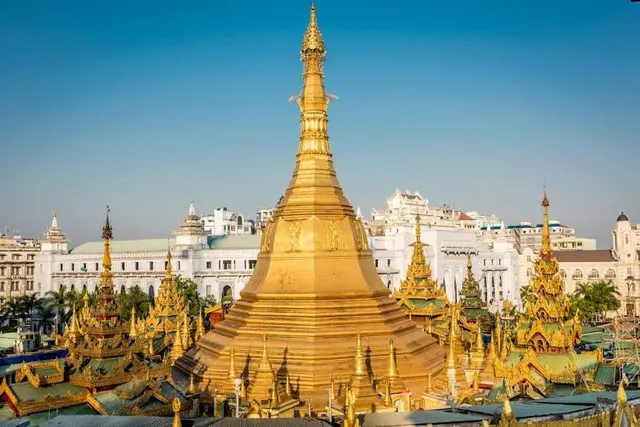
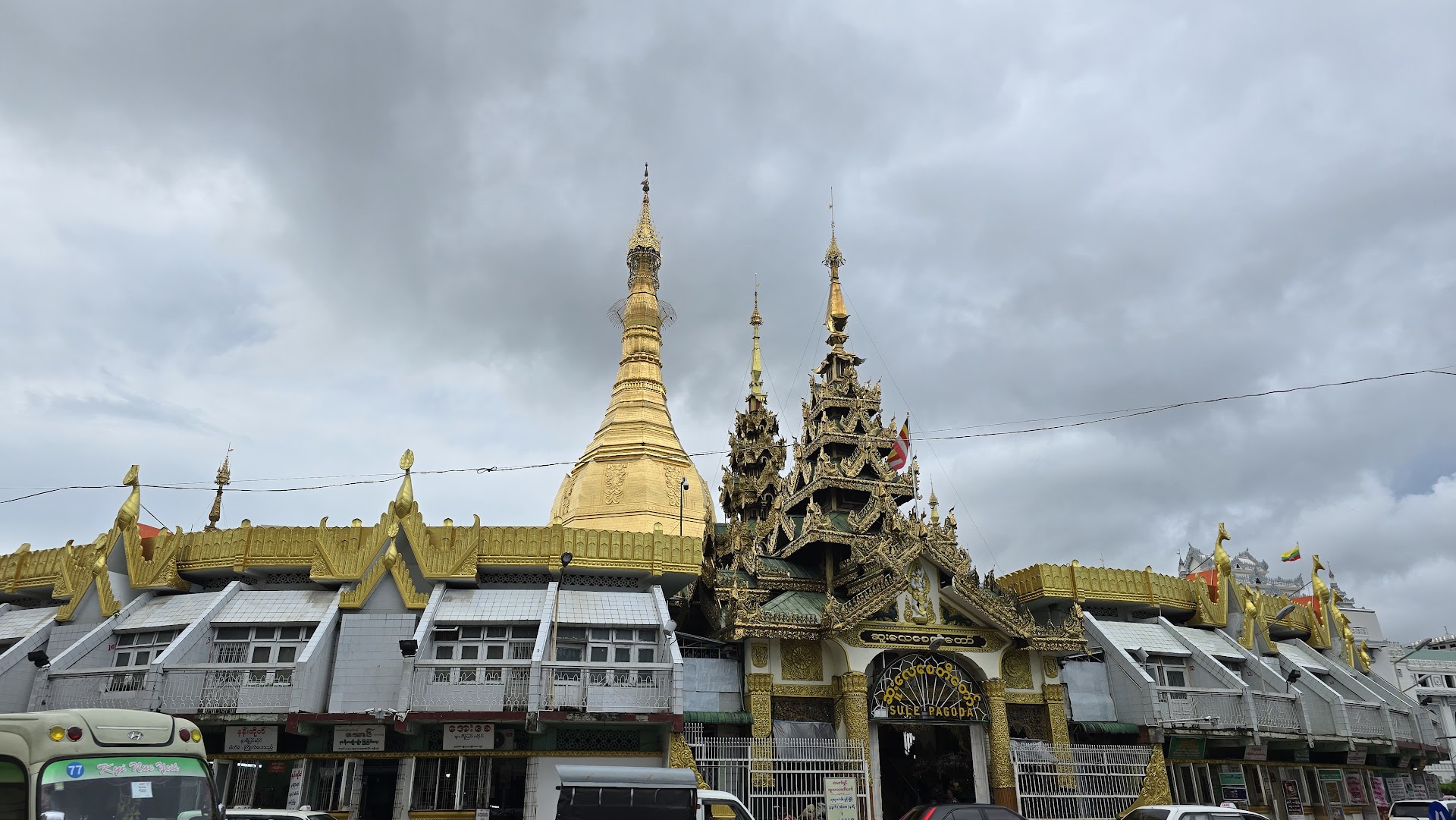
The Sule Pagoda was made the center of Yangon by Lt. Alexander Fraser of the Bengal Engineers, who created the present street layout of Yangon soon after the British occupation in the middle of the 19th century. (Lt. Fraser also lent his name to Fraser Street, now Anawrattha Street and still one of the main thoroughfares of Yangon). It is a Mon-style chedi (pagoda), octagonal in shape, with each side 24 feet long; its height is 144 feet, 9 l/2 inches. Except for the chedi itself, enlarged to its present size by Queen Shin Sawbu(1453–1472), nothing at the pagoda is more than a little over a century old. Around the chedi are ten bronze bells of various sizes and ages with inscriptions recording their donors' names and the dates of their dedication. Various explanations have been put forward for the name, of varying degrees of trustworthiness: according to legend it was called su-way, meaning "gather around", when Okkapala and the divine beings inquired about the location of Singattura Hill, and the pagoda was then built to commemorate the event; another legend connects it su-le, meaning wild brambles, with which it was supposedly overgrown, and a non-legendary suggestion links it to the Pali words cula, meaning "small" and ceti, "pagoda".
Donating in Sule Pagoda.A blessing after money and gold donation.View of the Sule Pagoda Roundabout
Location
The Sule Pagoda is located in the center of downtown Yangon and is part of the city’s economic and public life. During the 1988 and 2007 protests, the Sule Pagoda was a functional meeting point for anti-government and pro-democracy protesters.
Role in Burmese politics
During the 8888 Uprising, the pagoda was an organizing point and destination selected on the basis of its location and symbolic meaning. In 2007, during the Saffron Revolution, the Sule Pagoda was again utilized as a rallying point for the pro-democracy demonstrations. Many thousands of monks gathered to pray around the pagoda. Sadly, in both 1988 and 2007, the Sule Pagoda became the first place to witness the brutal reaction by the Burmese government against...
Read moreThe Sule Pagoda, located in the heart of Yangon, Myanmar, is a stunning landmark that beautifully intertwines spirituality, history, and urban life. With its golden stupa standing at 44 meters, it commands attention from all corners of the bustling city.
Architecture and Design: The pagoda's intricate design reflects the rich tradition of Burmese architecture. The octagonal shape of the stupa is unique, and each side features a series of smaller shrines and statues of Buddha, adorned with detailed carvings and decorations.
Historical Significance: Beyond its architectural beauty, Sule Pagoda holds significant historical value. It has been a focal point for numerous political and social movements throughout Myanmar's history. Legend has it that the pagoda is over 2,500 years old, built during the time of the Buddha.
Atmosphere: The atmosphere at Sule Pagoda is a blend of serenity and activity. The hustle and bustle of city life seem to fade away once you step into the complex. The smell of incense and the sound of prayers provide a peaceful contrast to the outside chaos. It's a place where locals come to pray and meditate, and tourists come to soak in the culture and spirituality.
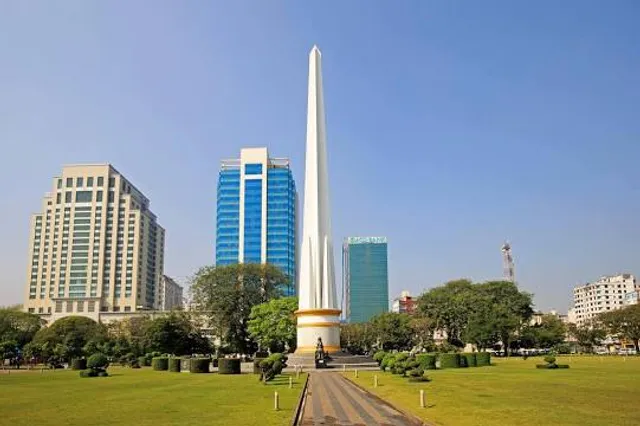
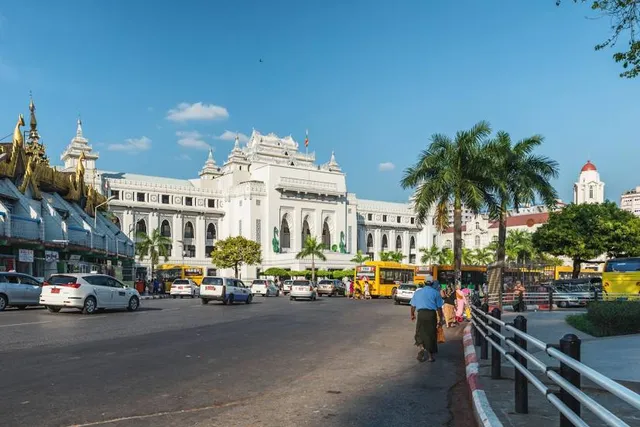
Accessibility: Located at a major intersection in Yangon, Sule Pagoda is easily accessible by public transport. Its central location also makes it a convenient stop for those exploring other nearby attractions, such as the Yangon City Hall and the Independence Monument.
Visitor Experience: Visiting Sule Pagoda offers a unique glimpse into the daily religious practices of the Burmese people. The pagoda is well-maintained, and the entry fee for foreigners is reasonable. Guides are available, and they provide insightful information about the history and significance of the pagoda.
Tips: Dress modestly as it is a religious site. Visit early in the morning or late in the afternoon to avoid the heat and crowds. Don't forget to walk around the entire structure to appreciate the detailed craftsmanship from all angles.
Overall, Sule Pagoda is a must-visit for anyone traveling to Yangon. It offers not just a spiritual retreat but also a historical and cultural immersion into the...
Read moreAccording to Burmese legend the site where the Sule pagoda now stands was once the home of a powerful nat (spirit) named Sularata (the Sule Nat). The king of the Nats, Sakka, wished to help the legendary king Okkalap build a shrine for the Buddha's sacred hair-relic on the same site where three previous Buddhas had buried sacred relics in past ages. Unfortunately, these events had happened so long ago that not even Sakra knew exactly where the relics were buried. The Sule nat, however, who was so old that his eyelids had to be propped up with trees in order for him to stay awake, had witnessed the great event. The gods, Nats and humans of the court of Okkalapa therefore gathered around the Sule Ogre and asked him the location, which he eventually remembered.
The Sule Pagoda was made the center of Yangon by Lt. Alexander Fraser of the Bengal Engineers, who created the present street layout of Yangon soon after the British occupation in the middle of the 19th century. (Lt. Fraser also lent his name to Fraser Street, now Anawrattha Street and still one of the main thoroughfares of Yangon). It is a Mon-style chedi (pagoda), octagonal in shape, with each side 24 feet long; its height is 144 feet, 9 l/2 inches. Except for the chedi itself, enlarged to its present size by Queen Shin Sawbu (1453–1472), nothing at the pagoda is more than a little over a century old. Around the chedi are ten bronze bells of various sizes and ages with inscriptions recording their donors' names and the dates of their dedication. Various explanations have been put forward for the name, of varying degrees of trustworthiness: according to legend it was called su-way, meaning "gather around", when Okkapala and the divine beings inquired about the location of Singattura Hill, and the pagoda was then built to commemorate the event; another legend connects it su-le, meaning wild brambles, with which it was supposedly overgrown, and a non-legendary suggestion links it to the Pali words cula, meaning "small"...
Read more