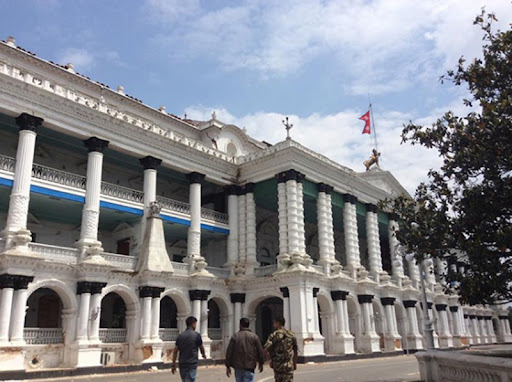
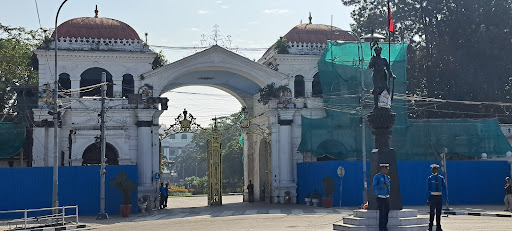
Singha Durbar (Nepali: सिंहदरवार; translation: Lion's Palace) is a palace in Kathmandu, the capital of Nepal. The palace complex lies in the centre of Kathmandu, to the north of the Babar Mahal and Thapathali Durbar and east of Bhadrakali.2] This palace was built by Chandra Shumsher JBR in June 1908.[3] The palace used to be one of the most exquisite and lavish of palaces in the world until the 1950s.
Singha DurbarGeneral informationArchitectural styleNeoclassical architecture, Palladian architecture, and European styles of architectureTown or cityKathmanduCountryNepalCostUnknownClientChandra Shumsher JBRTechnical detailsStructural systemBrick and MortarDesign and constructionArchitectKumar Narsingh Rana, Kishor Narsingh Rana[1]

Aerial shot of Tundikhel along with Singha durbar
HistoryEdit
It was built by Shumsher immediately after accession to the post of Prime Minister. It was initially a small private residence, but grew bigger during the construction. Immediately after construction Shumsher sold this property to the Government of Nepal for 20 million Nepali rupee as the official residence of Prime minister.[3] After his death in 1929, it was used as the official residence of prime ministers of Rana dynasty except Padma Shumsher JBR, who lived in his own Bishalnagar Durbar. The last Rana Prime minister to occupy Singha Durbar was Mohan Shumsher JBR. Even after the fall of Rana Dynasty in 1951, Mohan used this place, but in 1953 he was ordered by His Majesty's Government to leave the palace which became a National Property.[3]

Shingha Durbar
DesignEdit
Exterior structureEdit
The structure was designed by Kumar Narsingh Rana, Kishor Narsingh Rana. The architecture of the palace is a unique example of merging building traditions, including Palladian, Corinthian, Neoclassical mansions along with Baroque architecture.[1
Interior spaceEdit
Before the fire of 1973, Singha Durbar had 7 courtyards and 1700 rooms with marbled floor, painted ceilings, silver furniture and expanses of crystal lighting.1
State HallEdit

View of the Durbar from the gardens
The State Hall is the largest and the most decorated room in this palace. This hall is adorned with foreign imported art pieces like Murano glass crystal chandeliers, Belgian mirrors along with English stained glass doors and Italian marble floors with floral patterns in walls and ceilings.[3]
Gallery BaithakEdit
Chandra Shumsher built a private theater and named it Gallery Baithak. It is used as a parliament building.
Under Government of NepalEdit

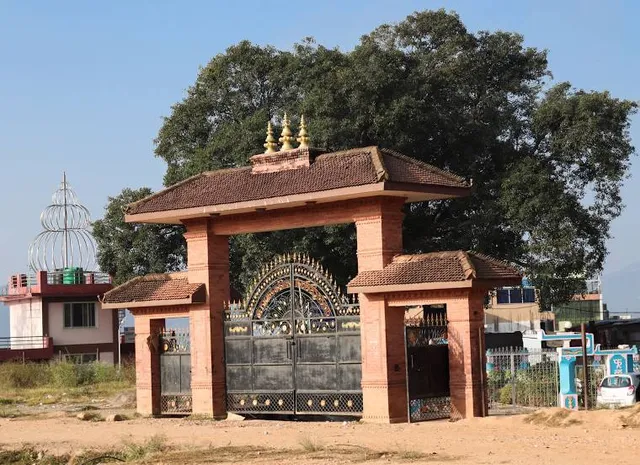
Main Gate of Singha Durbar
After the end of the hereditary Prime Minister system (Ranas), the government of Nepal used this palace compound to house government offices. The palace compound is occupied by both chambers of the Parliament of Nepal (the Pratinidhi Sabha, or House of Representatives, and the Rashtriya Sabha, or House of the States). It holds 20 ministries and government offices. Singh Darbar is also the headquarters of Radio Nepal and Nepal Television.
DisastersEdit
Fire of 1973Edit
On Monday, 9 July 1973, a huge fire broke out in Singha Durbar engulfing all three wings of the palace except the front facing wing . To prevent the front wing from catching fire, cannon destroyed three wings facing North, South and West.[4] After the fire was put out, the whole area was rebuilt on the old foundation.[4]
Earthquake of 2015Edit
Singha Durbar was seriously damaged during the April 2015 Nepal earthquake. It was designated unsafe and was...
Read moreSingha Durbar was built by Chandra Shumsher JBR immediately after accession to the post of Prime Minister. It was initially a small private residence but grew bigger during the construction. Immediately after construction, Chandra Shumsher JBR sold this property to the Government of Nepal for 20 million Nepali rupees as the official residence of Prime minister. After his death in 1929, it was used as the official residence of prime ministers of Rana dynasty except Padma Shumsher JBR, who lived in his own Bishalnagar Durbar. The last Rana Prime minister to occupy Singha Durbar was Mohan Shumsher JBR. Even after the fall of Rana Dynasty in 1951, Mohan used this place, but in 1953 he was ordered by His Majesty's Government to leave the palace which became National Property.
After the end of the hereditary Prime Minister system (Ranas) on 1907 B.S., the Government of Nepal used this palace compound to house government offices. The palace compound is occupied by both chambers of the Parliament of Nepal (the Pratinidhi Sabha, or House of Representatives, and the Rashtriya Sabha, or House of the State). It holds 20 ministries and government offices. Singh Durbar is also the headquarters of Radio Nepal and Nepal Television.
Exterior Structure
The structure was designed by Kumar Narasingh Rana, Kishor Narasingh Rana. The architecture of the palace is a unique example of merging building traditions, including Palladian, Corinthian, Neoclassical mansions along with Baroque Architecture.
Interior Space
Before the fire of 1973, Singha Durbar had 7 courtyards and 1700 rooms with marbled floors, painted ceilings, silver furniture and expanses of crystal lighting.
State Hall
The State Hall is the largest and the most decorated room in this palace. This hall is adorned with foreign imported art pieces like Murano glass crystal chandeliers, Belgian mirrors along with English stained glass doors and Italian marble floors with floral patterns in walls and ceilings.
Gallery Baithak
Juddha Shumsher built Gallery Baithak to meet foreign dignitaries. During that time, ambassadors from friendly countries used to present their credence at the Hanuman Dhoka. Later the Gallery Baithak was used as the...
Read moreSingha Durbar (सिंहदरबार) – A Symbol of Nepal's Governance and Heritage
Singha Durbar, situated at the heart of Kathmandu, stands as a symbol of Nepal’s governance and rich heritage. Constructed in 1908 by Prime Minister Chandra Shumsher JBR, it was once regarded as one of the largest and most opulent palaces in Asia. Today, it serves as the administrative nucleus of the Nepalese government, accommodating the Prime Minister’s Office and multiple ministries.
Architectural Grandeur and Historical Significance
Singha Durbar is a masterpiece of neoclassical European architecture, featuring grand facades, intricately designed wooden carvings, and vast halls. Despite enduring damage from earthquakes over the years, dedicated restoration efforts have helped preserve its original splendor. This historic palace signifies Nepal’s transition from the autocratic Rana regime to a democratic system of governance, embodying the nation's political evolution.
A Pillar of Modern Nepal
Beyond being a governmental complex, Singha Durbar is a powerful emblem of Nepal’s political transformation. It has been a witness to significant historical milestones, including the fall of the Rana dynasty and the establishment of democratic institutions. The palace remains a hub where crucial decisions shaping the country’s future are made.
Sustaining Legacy and Future Prospects
Despite challenges, including infrastructure maintenance and modernization needs, Singha Durbar continues to be the epicenter of Nepal’s administrative framework. Ongoing efforts aim to modernize government operations while ensuring that the site's cultural and architectural heritage is safeguarded. The balance between tradition and innovation remains key to preserving its grandeur for future generations.
A Living Monument of Nepal’s Aspirations
For those interested in history and architecture, Singha Durbar stands as an enduring symbol of Nepal’s resilience, governance, and heritage. While public access is restricted, its legacy speaks volumes about the nation’s rich past and its unwavering journey toward a...
Read more