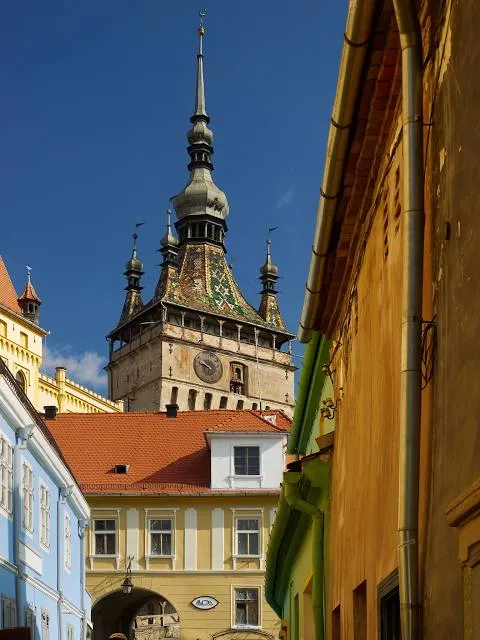
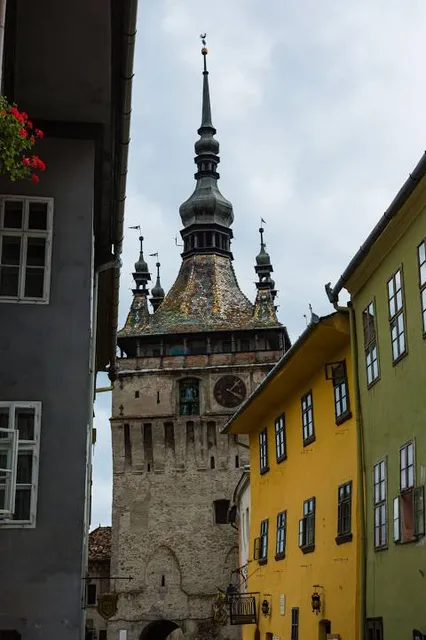
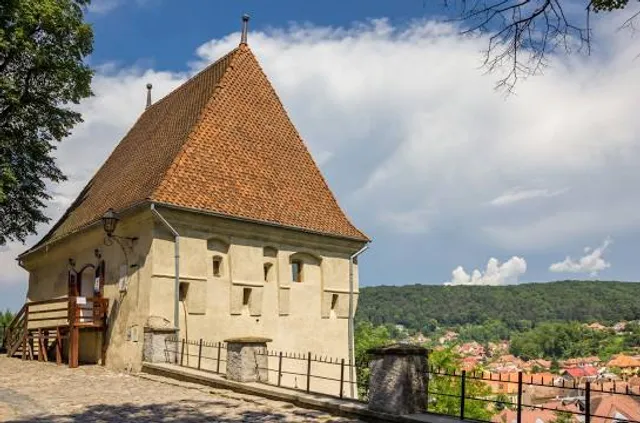
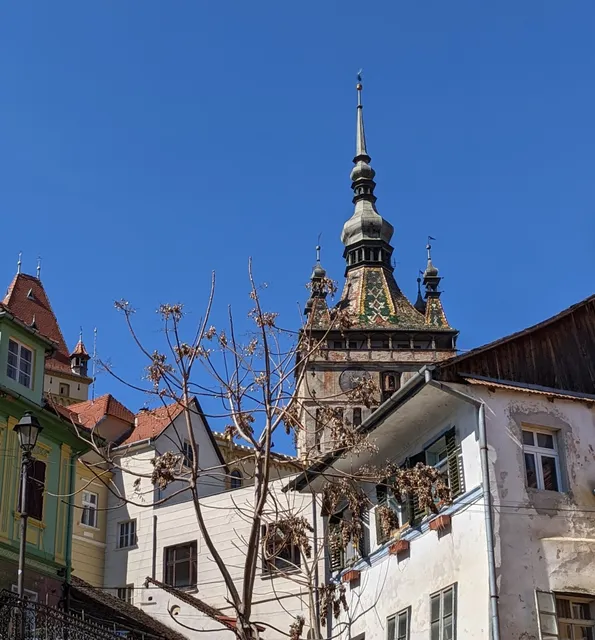
In every fortification system there is one fortress that dominates the others: the master-tower. The Clock Tower of Sighișoara (Romanian: Turnul cu Ceas) is the main entry point to the citadel, opposite guarded by Taylor's Tower. With its 64 meters of height, the tower is visible from almost every corner of the city from Mures County, its purpose was to defend the main gate of the citadel and also served as the town hall until 1556. Now It's considered one of the most expressive clock tower in the whole Transylvania. The tower began to be built at the end of 13th century, It was built in the 14th century as a simple gate tower with a maximum of two levels: the ground floor and first two floors of the tower were made of sandstone and river rock, the first stage of the tower construction probably had a form identical to the Tailors tower. The thickness of the base walls were 2.35 meters, 1.30 meters on the second floor, stone tiles of basalt were used only at the corners. In the 16th century the old roof was demolished, they have added two floors built of brick and it was built a balcony and the roof. Nobody knows for sure how the roof was before the 1676 fire. The actual 5 turrets baroque roof with bulbs represents an exceptional achievement of the three Pilgrim masters: Veit Gruber from Tyrol, Philip Bong of Salzburg and carpenter Valentinus Auslander, who rebuilt the tower after the great fire of 1676 from March to September 1677 for 650 florins. What makes this tower unique in all the country is its clock with puppets inside. It's a symbol of Sighisoara, and, despite all the other towers that were owned and defended by different guilds, the Clock Tower was a public good. It used to host the Public Administration, and, during holidays, the city orchestra; since the end of 19th century though it hosts the History Museum of Sighisoara. Another important feature of this tower is the balcony which is the most important observation point of the city: the wide view allowed to sight eventual fires in time in order to reach promptly one of the nine places in all Sighisoara that could provide water. It was vital to prevent the spread of flames because at that time the city did not dispose of much water; it was necessary in fact to dig for 35m to find a...
Read moreThe Clock Tower (Turnul cu Ceas) in Sighișoara is one of the most iconic landmarks in Romania and an absolute must-visit for anyone exploring this medieval city. As the main gate to the old citadel and a symbol of Sighișoara’s rich history, the Clock Tower stands tall, offering both a glimpse into the past and stunning views of the surrounding area.
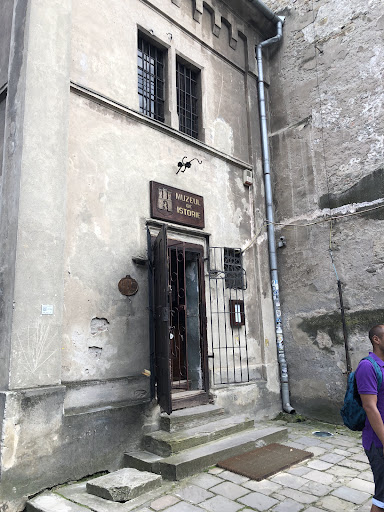
Dating back to the 14th century, the tower has served multiple purposes throughout the centuries, including as a defensive structure and a seat of the city’s council. Today, it houses a fascinating history museum that spans several floors, each level showcasing different aspects of Sighișoara’s past, from its medieval weapons and artifacts to the vibrant history of the Saxons who once inhabited the region.
One of the most captivating features of the Clock Tower is its clock mechanism, which includes a set of figurines that symbolize different virtues and characters, such as Justice and Fairness. These figurines rotate daily, adding a charming, almost magical element to the tower. Climbing to the top of the tower is well worth the effort, as the panoramic views over Sighișoara’s colorful rooftops and cobblestone streets are truly breathtaking.
The Clock Tower not only offers a deep dive into the local history but also provides an unforgettable visual experience. The tower itself is a masterpiece of medieval architecture, with its distinctive Baroque roof and the intricate craftsmanship evident in every detail.
Visiting the Clock Tower is like stepping back in time, allowing you to connect with the rich cultural heritage of Sighișoara while enjoying one of the best viewpoints in the city. Whether you are a history enthusiast, an architecture lover, or simply someone who appreciates beautiful vistas, the Clock Tower will undoubtedly leave a...
Read moreThe Clock Tower of Sighișoara (Turnul cu Ceas) is one of the most iconic landmarks in Romania and a symbol of the medieval town of Sighișoara, which in my opinion is the best place in the country.
Built in the 14th century, the Clock Tower originally served as the main gate of Sighișoara's fortified city and the town hall.
It was expanded in the 16th century and fitted with a beautiful clock mechanism in 1604, crafted by Swiss artisans.
The tower stands 64 meters tall, making it the tallest structure in Sighișoara.
It has a baroque-style roof, added in 1677 after a devastating fire destroyed the original.
The roof is adorned with colorful glazed tiles, creating an eye-catching pattern visible from afar.
At the top, there's a golden globe and a weathervane.
The mechanical clock features wooden figurines that represent allegorical characters such as Justice, Peace, Law, and Day/Night.
These figurines rotate at specific intervals, marking the passing of time in a visually captivating display.
Today, the tower houses the History Museum of Sighișoara, showcasing exhibits related to the town's rich medieval heritage.
Visitors can climb the wooden staircase inside to reach the balcony at the top, offering panoramic views of Sighișoara's historic center.
The Clock Tower, along with the Sighișoara Citadel, is part of the UNESCO World Heritage Site, recognized for its well-preserved medieval architecture.
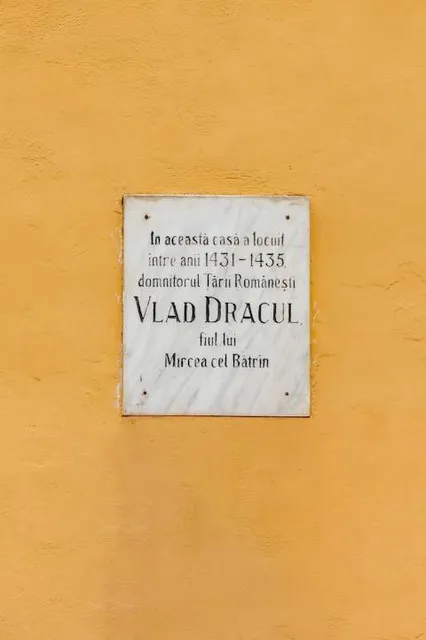
Fun Fact: The tower is often associated with Vlad the Impaler (Dracula), as Sighișoara is believed to be his birthplace.
When you visit Sighișoara, the Clock Tower is a must-see attraction, and ilyou cannot miss it. This offers a historical insight and stunning views of this charming...
Read more