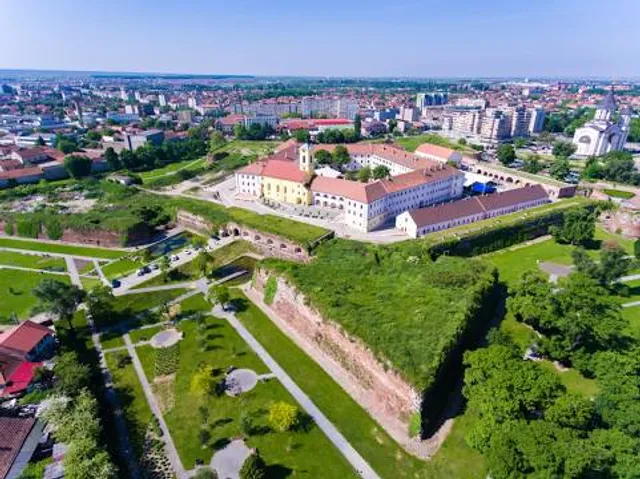
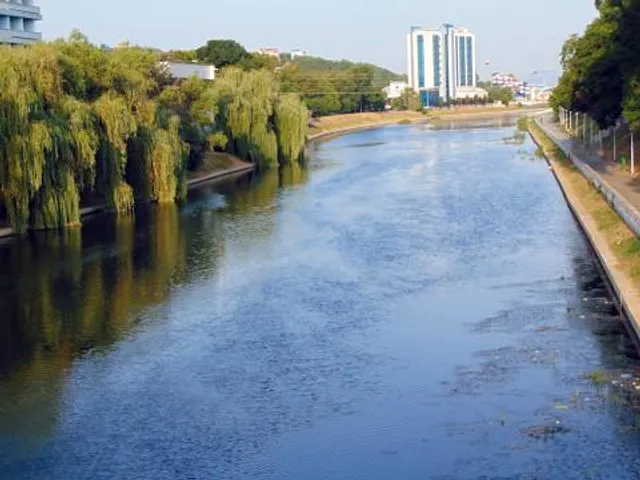
The name of the city, situated on the two banks of the Crișul Repede (Hu: Sebes-Körös) river just as it exits the embrace of Crater Forest and the Copper Mountains, along the road to Transylvania, suggests the existence of a fortification (Hu: nagyvár, “great castle”) at the time the settlement was established. This could be put to the second half of the 11th century and can be attributed to Saint Ladislaus, according to the tradition: “when hunting around the river he found a place where he decided, admonished by an angel, to build a monastery in honour of Virgin Mary, and he called this place Várad.” The settlement grew in importance when around 1092 Ladislaus I. moved the seat of the bishopric of Bihar, from the Bihar destroyed by the Cumans to Várad. The defence of the cathedral and of the bishop’s palace, which serves as the burial place for the king, was probably ensured already at the beginning by the construction of a castle with an earthwork-timber structure, or reusing an existing one, in the area crossed by the Peța (Hu: Pece / Hévjó) stream and Crișul Repede. According to Rogerius canon, who depicted the events of the Tartar invasion of the city, the sight of the fortress with earthworks and timber towers, and recently fortified on the weaker side, first made the Tatars retire. Later, they returned with their siege machines and took the walls that were partially already built of stone, and destroyed the buildings inside. During the reconstruction work, new castle walls were erected for sure already in the second half of the 13th century. In the 15th century the construction of the bishop’s castle continued, resulting in a fortification with an irregular circular layout, situated on about 3 hectares of land, with fortifications running in two concentric circles at a distance of 9–13 m. The walls of limestone and sandstone were 1.3 m wide on average. On the south side, the bishop’s palace with an L-shaped layout was lined up in the protective system, and two bastions could be identified in the northeast. In 1598 there still stood a tower on the west side, in the chapel of which St. Ladislaus prayed, according to tradition. We have relatively few documentary data about the medieval bishop’s castle: around 1375 cathedral statuettes speak of the castle moat and the northern castle gate, in 1456 the castellan was first mentioned, and in 1497 the court judge. We also know about the constructions of Bishop János Filipecz and Fráter György Martinuzzi, the latter fortifying the western side. In the winter of 1474, Turkish troops crossing the frozen Danube unsuccessfully besieged the castle. After the disappearance of the bishopric, in the period of the Transylvanian principality, Várad assumed the new role of border fortification, and the completely changed military technical conditions made the construction of a more advanced defence system necessary. Giulio Cesare Baldigara might have designed the more or less regular pentagonal fort with a new Italian-style bastion, built between 1569 and 1619, which surrounded the bishop’s castle, and the image of which is faithfully rendered by Georg Houfnagel’s and Cesare Porta’s contemporary drawings. In 1598 it passed the test of a powerful Turkish siege, but in 1660, the few and insufficiently armed guards could no longer hold against the Ottoman force, and capitulated. The castle was retaken by the Austrian army led by General Donat Heissler in 1692. The fortress of Oradea is one of the most representative military and ecclesiastic historical ensembles in Transylvania. The fortress and its buildings hide secrets the uncovering of which can only come from several decades worth of comprehensive archaeological research, even though we have at our disposal abundant written historical sources. One of the most important features of the fortress-ensemble is that it hosts a cathedral founded by Saint Ladislaus, as well as the fact that it is the burial place of Sigismund, Holy Roman Emperor or otherwise known as Sigismund of Luxemburg...
Read moreThe city of Oradea was founded by King Ladislaus (1) the Holy (1077-1095), who built in the second half of the 11th century a cathedral complex dedicated to the Holy Virgin Mary, where he was buried after his death in 1095. After his sanctification in 1192, the founder king's tomb became a pilgrimage site of European importance. The Episcopal Center in the fortress became a religious center with a special significance, being a royal burial site, a place were trials by ordeal were performed, a humanist cultural-scientific center of European significance.
As it was described by canon Rogerius, the Mongolian invasion in 1241 led to the destruction of St. Ladislau's fortress.
The new fortress built in the 14th century had an irregular, rounded shape and towers.
The reconstruction of the Gothic cathedral and the building of the episcopal palace begun during the time Andrei Bathori (1329-1345) and Demetrius Futaki (1345-1372), were bishops.
The fortress is decorated with St. Stephen's, St. Emeric's and St. Ladislau's bronze statues (1370). King Ladislau's equestrian statue was made later, in 1390, but all four of them were created by sculptors Martin and Gheorghe from Cluj.
A remarkable cultural and scientific life developed in the 15th Century in the Episcopal Center from Oradea thanks to the patronage of the bishops. The court of bishops Andrea Scolari (1409-1426), John Vitéz de Zredna (1445-1465),, John Filipec (1476-1490) and Sigismund Thurzo (1506-1512) became one of the most important cultural centers of the Eastern-Central European Renaissance. It was the place where the episcopal library was built, where Janus Pannonius (1434-1472), was a canonist, where a European Literary Asylum functioned and Tabula Varadiensis was written by Viennese astronomer Georg Peuerbach, the father of astronomy.
Due to the political and military changes in the late 16th century, the Principality of Transylvania came into possession of the fortress, led by the Great Captaincy of the Oradea Fortress (1557).
Transylvanian princes quickly recognized the strategic military importance of the fortress, whose reconstruction began under the rule of prince John Sigismund (1540-1571). The medieval episcopal fortress was gradually transformed into a strong redout specific to late Renaissance and it was built in two stages: between 1569 and 1598, the outer redout with five bastions, between 1618 and 1650, the inner fortress, the princely palace of princes Gabriel Bethlen (1612-1629),, George Rákóczi I (1630-1648) and George Rákóczi II...
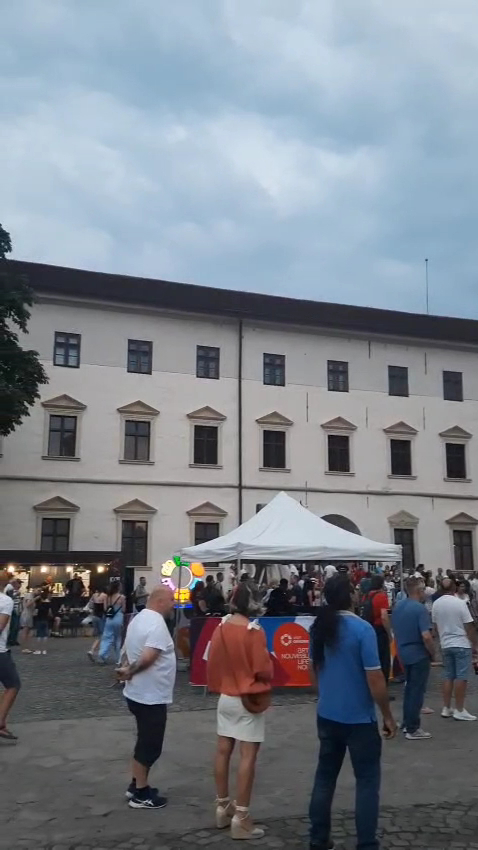
Read moreDuring the IX century of its existence the constructions what raised on this surface of 150.000 m had an eventful history. Until 1241 it had been a fortress with earthy ditch and a wooden bridge. Between 1247-1569 raised a circular fortress of stone. The fortress of Oradea how it is today - pentagonal, with battlements at its corners and water ditch - was built between 1570-1618 by Italian architects remained the best kept Italian renaissance fortress of central Europe. Between 1097-1557 served as residence of the Roman Catholic bishop of Oradea period when the fortress became an important religious and cultural center. In the fortress functioned a library, an astronomical observatory, a printing house and a school.In the catholic church and in its cemetery found their eternal peace not less then seven crowned person: Ladisla I (died on the 25th of July 1095 in Zvolen, taken to Oradea between 1130-1134), Andrei II (had been buried in 1235 in Oradea, later taken to the abbey of Agria), Alexander II, Ladisla IV the Cunsenian (killed in 1290 at Cheresig), queen Beatrix (wife of Carol Robert de Anjou, in 1319), queen Mary (wife of Sigismund de Luxembourg, in 1396) and king Sigismund de Luxembourg (in 1437). The fact that these kings were buried in Oradea seems to confirm the legend that the city was truly founded by St. Ladisla (Ladisla I). Since 1557 the role of the fortress had become strictly military being attacked by the Tartars (1241), Turks (1474, 1598, 1658, 1660), Transylvanian revolutionaries (1290, 1514, 1664, 1703-1710), armies of the Transylvanian Principality (1557, 1603) and by the Austrians (1692). The fortress had been besieged without any success for 5 weeks by the Turks. The Oradeans had on their side the reign of the Romanian Country Mihai Viteazul as well as the weather. The rains were flooded into the Turkish camps and the illnesses decimated them. Today we are witnesses of the restorations of the fortress. The first results are already visible, the most spectacular being the frescoes in the waiting room and reception hall. Source( welcometoromania.ro). It is a beautiful place to spend the afternoon , to walk in the fortress park where are many species of plants . More recently inside the fortress Oradea organizes events like Toamna Oradeana, fairs of all kind and many...
Read more