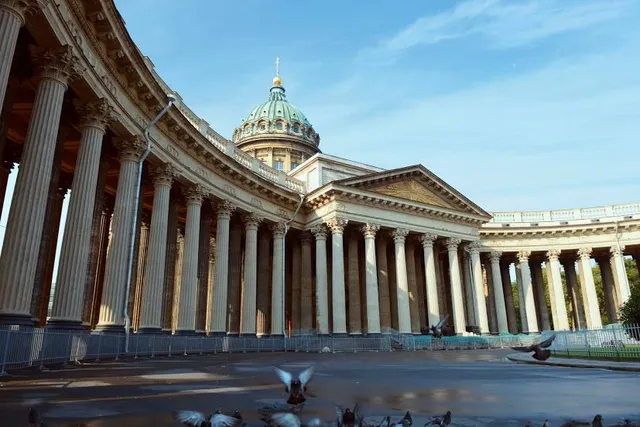
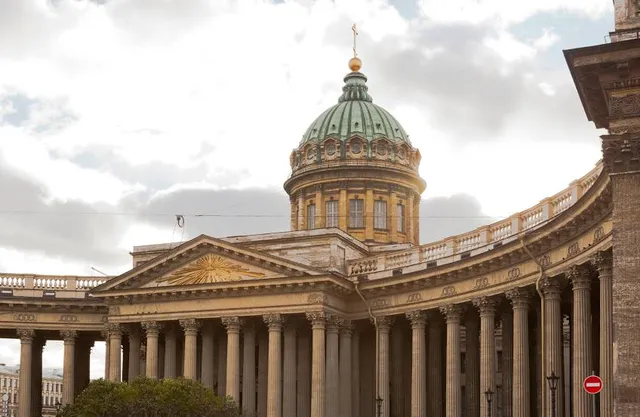
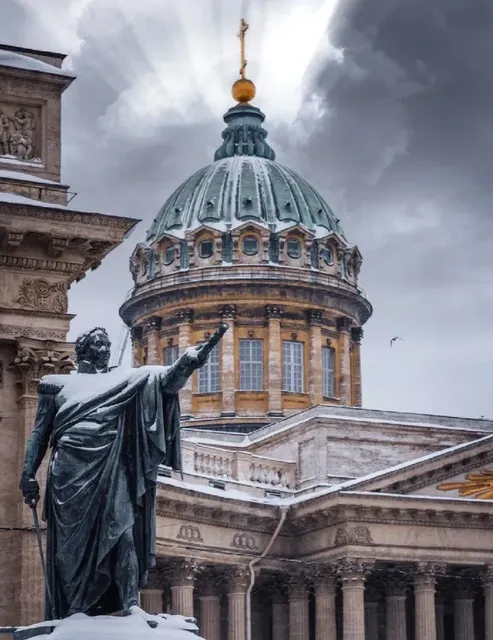
Kazan Cathedral or Kazanskiy Kafedralniy Sobor (Russian: Каза́нский кафедра́льный собо́р), also known as the Cathedral of Our Lady of Kazan, is a cathedral of the Russian Orthodox Church on the Nevsky Prospekt in Saint Petersburg. It is dedicated to Our Lady of Kazan, one of the most venerated icons in Russia.
Construction of the cathedral started in 1801 and continued for ten years under the supervision of Alexander Sergeyevich Stroganov.[2] Upon its completion in 1811, the new temple replaced the Church of Nativity of the Theotokos, which was disassembled when the Kazan Cathedral was consecrated.
The architect Andrey Voronikhin[3] modelled the building on St. Peter's Basilica in Rome.[2] Some art historians assert that Emperor Paul (reigned 1796-1801) intended to build a similar church on the other side of Nevsky Prospect that would mirror the Kazan Cathedral, but such plans failed to materialize.[citation needed] Although the Russian Orthodox Church strongly disapproved of the plans to create a replica of a Catholic basilica in Russia's then capital, several courtiers supported Voronikhin's Empire Style design.
After Napoleon invaded Russia (1812) and the commander-in-chief General Mikhail Kutuzov asked Our Lady of Kazan for help, the church's purpose altered. The Patriotic War over, Russians saw the cathedral primarily as a memorial to their victory over Napoleon.[3] Kutuzov himself was interred in the cathedral in 1813; and Alexander Pushkin wrote celebrated lines meditating over his sepulchre. In 1815 keys to seventeen cities and eight fortresses were brought by the victorious Russian army from Europe and placed in the cathedral's sacristy. In 1837, Boris Orlovsky designed two bronze statues of Kutuzov and of Barclay de Tolly which stand in front of the cathedral.
In 1876 the Kazan demonstration, the first political demonstration in Russia, took place in front of the church. After the Russian Revolution of 1917 the authorities closed the cathedral (January 1932). In November 1932 it reopened as the pro-Marxist "Museum of the History of Religion and Atheism".[4] or, as one contemporary writer put it more baldly, "Leningrad's largest antireligious museum", complete with Spanish Inquisition waxworks . Services resumed in 1992, and four years later the cathedral was returned to the Russian Orthodox Church. As of 2017 it functions as the mother cathedral of the metropolis of St. Petersburg.
The cathedral's interior, with its numerous columns, echoes the exterior colonnade and is reminiscent of a palatial hall, being 69 metres in length and 62 metres in height. The interior features numerous sculptures and icons created by the best Russian artists of the day. A wrought-iron grille separating the cathedral from a small square behind it is sometimes cited as one of the finest ever constructed.
The cathedral's huge bronze doors are one of four copies of the original doors of the Baptistery in Florence, Italy (the other three are at Grace Cathedral in San Francisco, United States, at the Nelson-Atkins Museum of Art in Kansas City, United States, and at the Florence Baptistery itself).
The Kazan Cathedral is considered to be the model for the neoclassical style of Helsinki Cathedral, one of the most iconic landmarks of...
Read moreThe Kazan Cathedral in Saint Petersburg, Russia, is a remarkable architectural and cultural landmark. Officially known as the Cathedral of Our Lady of Kazan, it is not only a place of worship but also a symbol of Russia's historical and artistic heritage.
Corinthian Columns
One of the most striking features of the cathedral is its Corinthian colonnade, which extends in a grand semi-circular shape, reminiscent of St. Peter's Basilica in Vatican City. These towering columns, with their intricate capitals, represent the grandeur of classical architectural styles. The colonnade is a marvel to behold, offering a sense of elegance and strength while serving as a welcoming approach to the main structure.
Interior Spectacle
Stepping inside, visitors are greeted by a breathtaking interior. The vaulted ceilings, adorned with detailed frescoes, and the grand altar with its opulent decorations create an atmosphere of solemnity and awe. The cathedral houses an icon of Our Lady of Kazan, one of the most revered religious artifacts in Russian Orthodoxy, drawing pilgrims and art enthusiasts alike.
Immense Size and Design
The sheer size of the cathedral is awe-inspiring, with its expansive dome and vast interior spaces capable of accommodating thousands of visitors. Designed by architect Andrey Voronikhin, the cathedral combines elements of neoclassical style with traditional Russian ecclesiastical architecture. Its immense scale and symmetrical design reflect not only religious devotion but also the political aspirations of Imperial Russia at the time.
Visit
Visitors are often captivated by the spiritual ambiance and historical significance of the cathedral. It has witnessed key moments in Russian history, from Napoleon's defeat to its transformation into a museum of atheism during the Soviet era. Today, it serves as a functional cathedral and a cultural monument, representing resilience and artistic brilliance.
Stopping by the Kazan Cathedral offers a unique opportunity to admire its architectural beauty, explore its rich history, and experience a sense of reverence within its...
Read moreKazan Cathedral, or Казанский кафедральный собор, located in Kazan Square, St. Petersburg, is a stunning masterpiece of Russian Orthodox architecture that captivates visitors with its grandeur and spiritual significance. Inspired by St. Peter’s Basilica in Rome, this impressive cathedral boasts a monumental colonnade, elegant domes, and exquisite details that reflect both Russian and European influences. Its neoclassical design makes it one of the most iconic landmarks in the city, blending harmoniously with the surrounding historical architecture.
As you approach the cathedral, you’re immediately struck by the beauty of its semicircular colonnade, which seems to embrace visitors. The massive bronze doors and intricately designed façade hint at the magnificence inside. Once you enter, the interior doesn’t disappoint. It is a place of solemn reverence, with tall columns, gilded iconostases, and impressive mosaics that create a serene and majestic atmosphere. The central dome allows light to flood in, illuminating the rich decorations and sacred icons that adorn the walls.
The cathedral is not just a stunning architectural site but also a place of deep religious significance, housing the revered icon of Our Lady of Kazan, one of Russia’s most venerated religious artifacts. Many visitors come to offer prayers and light candles, adding to the cathedral’s profound spiritual ambiance.
Kazan Cathedral is a must-see when in St. Petersburg. Whether you’re an architecture enthusiast, history buff, or simply a curious traveler, this cathedral offers an enriching experience. The surrounding area is also perfect for a leisurely stroll, allowing you to take in the charm of this beautiful city. A visit to Kazan Cathedral leaves you in awe of its beauty and significance, making it an unforgettable highlight of any trip to...
Read more