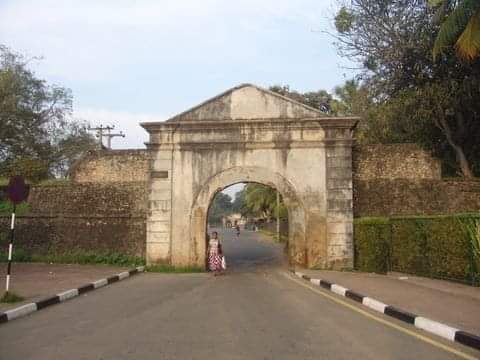
Matara Fort HISTORY
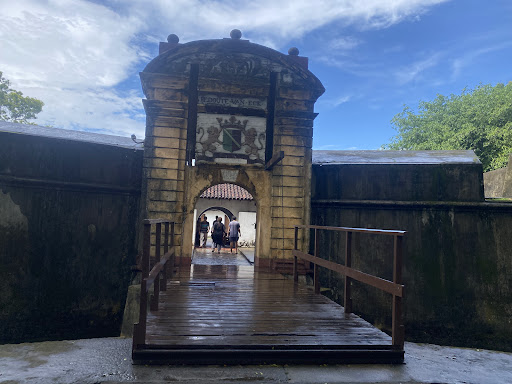
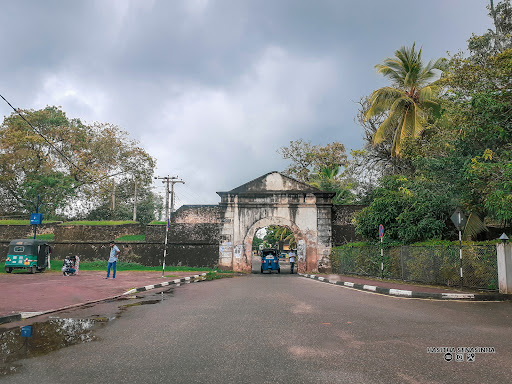
The Portuguese constructed the first fortifications in 1595,1] with the assistance of Don Juan Dharmapala, the ruler of the Kingdom of Kotte.[2] In 1640 the Dutchcaptured Matara from the Portuguese,[3] and in 1645 they were responsible for the construction of the current fortifications.[2]The fort consists of a 240 m (790 ft) long, 13 m (43 ft) thick, 5 m (16 ft) high rampart and the gateway constructed from local limestone, granite and coral.[1 The rampart originally had a ditch in front of it, two half bastion projections at each end and a larger projection in the centre close to the gate with a bridge across the ditch.3] It was built to protect the administrative buildings of VOC (Dutch East India Company), who were attracted by the deep and sheltered estuary of the Nilwala Ganga, making Matara an important centre for cinnamon and elephanttrading.
During the 'Matara Rebellion' of 1761, the fort was captured by a Kirti Sri Rajasinha's Kandyan army[4] that bombarded the town with cannonballs that went over the wall. After spiking their own cannon and destroying their ammunition and provisions, the garrison was evacuated by two ships that were waiting at sea.[1] The Dutch recaptured the fort on 2 February 1762,[2] finding eight cannon on the walls, including an English one.[5] During the Dutch rule the District Secretary's house, the cinnamon, areca nut, gunpowder storage and an elephant kraal[2[5] were constructed within the fort. The oldest building within the fort is the Dutch Reformatory Church, which is situated near the entrance. It was built by the Dutch in 1706[6] the date however etched above the entrance, 1767, refers to the reconstruction of the church by the Dutch following the Matara Rebellion.[6] The door and window panels are made of heavy wood while the walls now show signs of crumbling as the proper mixture to rebuild them could not be found within Sri Lanka. Inside are gravestones on the floor dating back to 1686, of significant community members and beneficiaries of their time.[6]
On 24 February 1796 the Fort was handed over to the British by the Dutch. The southern bastion facing the sea was subsequently removed by the British, in order to grant access to the town along the ocean foreshore.[7] During the British occupation, the Courts Complex (including the Magistrate Court and the High Court), Rest House and the Matara Police Station were constructed within the fort area.[2] The majority of walawwas or mansions that belonged to Sri Lankan aristocratic families within the fort area are now utilised for other purposes, such as commercial offices, guesthouses and temples, while others have been let to fall into ruin.[1]
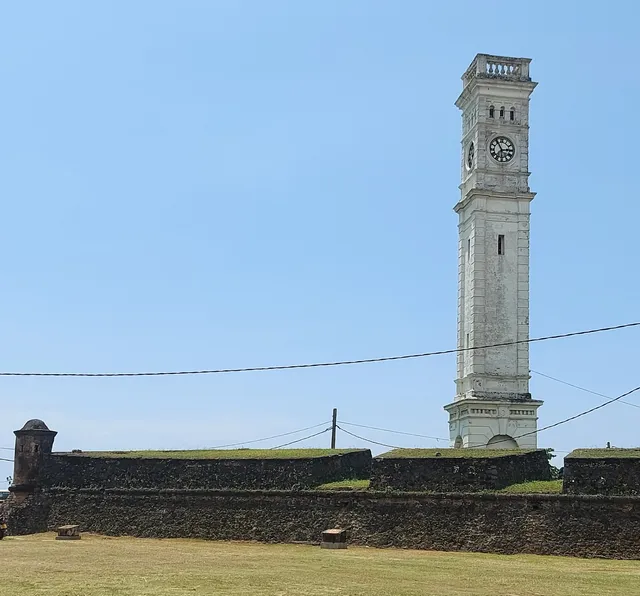
In 1883 the British built a 12 m (39 ft) high clock tower atop the remaining rampart.[1]
The rampart was declared a protected monument under the Antiquities Ordinance No 9 of 1940 section 33.[1] The gate and walls of the main fort were restored in 1985-86 by a Dutch firm, Ballast Nedam.[3]
Matara fort is currently the administration centre for the entire Matara District, with the offices of the District Secretariat, Divisional Secretariat, Courts of Law and numerous other...
Read moreIt is believed that Matara Fort was built by Portuguese. Though it is accepted that the fort was built by them at Matara with the assistance of King Don Juan Dharmapala in 1595 A.D. the fort, which exists now in the triangular piece of land of the estuary of Nilwala River between the lagoon and the sea was built by the Dutch in 1645 A.D. The date inscribed on the entrance is 1789 A.D. It could be the date the fort was repaired and not the date it was built. The fort that the Dutch built was taken possession by the Sinhala army in 1761 A.D. at the time of the invasion from the hill country known as Matara Rebellion. Again on 02nd February 1762 the Dutch managed to take possession of the fort. On 24th February 1796 Matara Fort was handed over to the British by the Dutch. Matara Fort is built with granite and limestone and its gateway at the entrance and the rampart are very well preserved. There had been an elephant kraal, the official residence of the Government Agent, an old church, stores of cinnamon, arecanut, and a gunpowder store during the Dutch occupation. The oldest remains of a building existing now are the Old Dutch Church, with a circular apex and an upper floor depicting the Dutch architecture. Among the Dutch tombstones in the church, the oldest tombstone is dated 1686 A.D. During the British occupation, the Courts Complex, Rest House and the Matara Police Station...
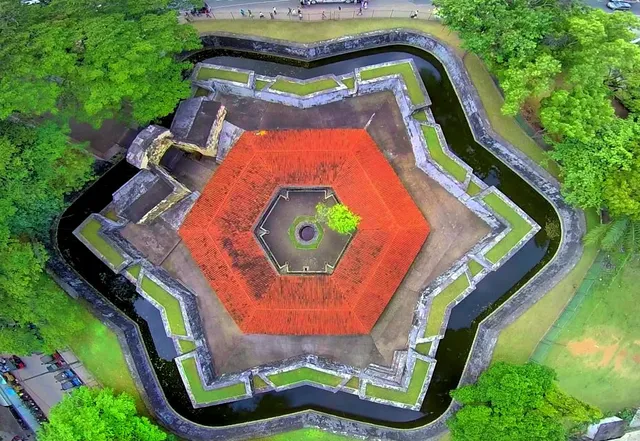
Read moreTharaka Kotuwa, also known as the Star Fort, is a small Dutch-built fortress located on the eastern bank of the Nilwala River in Matara, Sri Lanka. It was constructed between 1763 and 1765 by the Dutch, soon after they regained control of Matara following the Matara Rebellion of 1761, when the local forces captured the main fort.
To strengthen the city’s inland defenses, the Dutch Governor Van Eck ordered the building of this new fort, which was named Redoute Van Eck in his honour. The fort has a six-pointed star shape, designed to fire cannons in all directions, and is surrounded by a moat. Its thick granite and coral walls, two prison cells, central well, and drainage system showcase excellent 18th-century military engineering.
When the British took over Ceylon in 1796, the fort lost its military importance and was used for administrative work. Later, it became a public library and was then taken over by the Department of Archaeology. Major restoration work was done in the 1980s, and today the fort is preserved as a historical monument and museum.
Standing as one of the last forts built by the Dutch in Sri Lanka, Tharaka Kotuwa remains a proud symbol of Matara’s colonial heritage and...
Read more