The Selimiye Mosque was built at the peak of Ottoman military and cultural power. Sultan Selim II, the son and successor of Suleiman the Magnificent, chose Edirne instead of Istanbul (the Ottoman capital) as the location to build his own sultanic mosque. The reasons for this decision are a matter of debate among historians.5] Selim II appeared to have a passion for the city, having served as its governor between 1548 and 1550, and he visited it frequently after becoming sultan.[6 Edirne, a former Ottoman capital, was also one of the most important cities in the empire and a major stop on the imperial highway between Istanbul and the Balkan provinces.6 Other motivations may have included the fact that there were no more prominent hilltop sites in Istanbul available for the construction of an imperial mosque complex – at least not without resorting to mass expropriations.8 At the time of the mosque's commission, Selim II had also not commanded a victorious military campaign, which Islamic scholars of the time considered to be a requirement for building a sultanic mosque in Istanbul.8]
In March 1568 Selim II had asked Sinan to renovate the city's Old Mosque. Plans for a new imperial mosque, located on the hilltop above the Old Mosque, were probably begun around the same time.[6] Construction on the mosque was begun in 1568 or 1569 (976 AH) and completed in 1574 or 1575 (982 AH).[911] The mosque's construction and its waqf (charitable endowment) were ultimately funded with the help of the sultan's share of the spoils from the successful conquest of Cyprus, which was completed in 1571 with the surrender of Famagusta.[9] Selim II died in December 1574, before he was able to see the mosque fully completed.[12]
Later history Edit The mosque underwent its first repairs by Sinan in 1584, after minor damage caused by lightning. An earthquake in 1752 also caused minor damage.[13] In 1808 some of the calligraphic decoration in the mosque was restored and a roof was added over the courtyard fountain, though it has since disappeared. During the reign of Abdülmecid I (1839–1861), the mosque's interior was re-plastered and its decoration redone, in a style partially imitating the former ornamentation.[13]
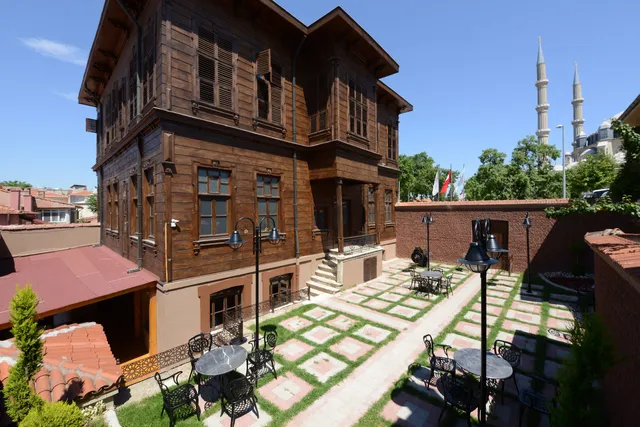
In 1865 Baha'u'llah, the founder of the Baha'i Faith, arrived with his family to Edirne as a prisoner of the Ottoman Empire and resided in a house near Selimiye Mosque,[14] which he visited often until 1868. It was at Selimiye mosque[15] where he was supposed to have had an open debate with Mírzá Yaḥyá Núrí (also known by the title of Ṣubḥ-i-Azal), an important event in the split of the Bábi Faith, which ultimately resulted in the formation of the Baha'i Faith guided by Baha'u'llah and the Azali Bábi Faith guided by Mírzá Yaḥyá.[16]
During the Russo-Turkish War of 1877–1878, some of the decorative tiles on the walls of the sultan's loge were looted and transferred to Moscow.[17 During the siege of the city in 1913, the dome of the mosque was damaged by artillery fire. On the orders of Atatürk, traces of the damage were left unrestored, as a reminder and warning to future generations. Soon after, at the end of the Second Balkan War, some of the mosque's oldest carpets were stolen by retreating Bulgarian troops.[13]
The mosque underwent restorations between 1954 and 1971, and some parts were also restored 1982 and 1984.[17] The mosque was depicted on the reverse of the Turkish 10,000 lira banknotes of 1982-1995.[18] In late 2021 another comprehensive restoration project on the mosque began, scheduled to be completed...
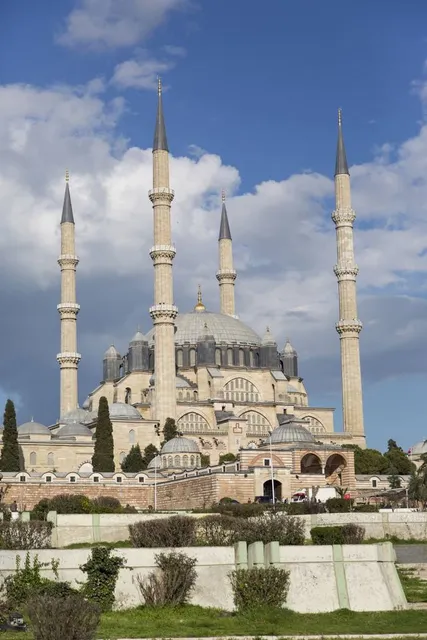
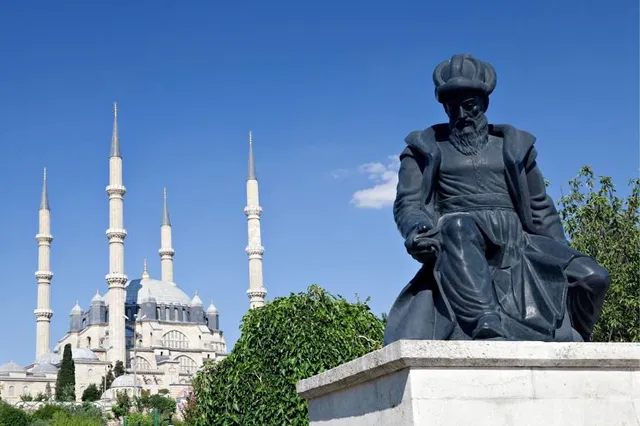
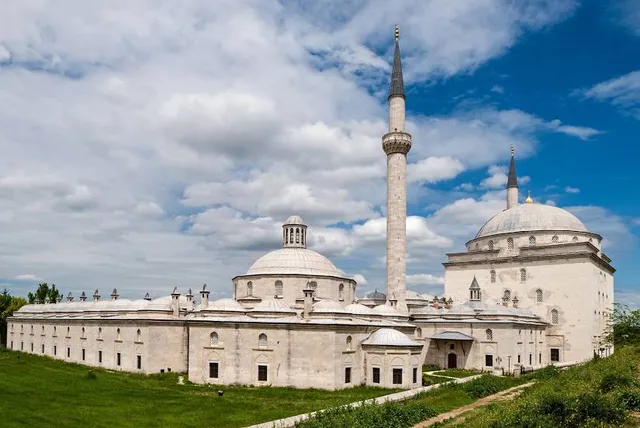
Read moreThe Selimiye is the greatest of all the Ottoman mosque complexes, the apogee of an art form and the culmination of a life’s ambition for its architect, Sinan. Built on a slight hill, the mosque is a prominent landmark. Its complex includes a medrese, housing the Museum of Turkish and Islamic Arts, a school and the Kavaflar Arasta, a covered bazaar. Selim II commissioned the mosque. It was begun in 1569 and completed in 1575, a year after his death. The dome was Sinan’s proudest achievement. In his memoirs, he wrote: “With the help of Allah and the favour of Sultan Selim Khan, I have succeeded in building a cupola six cubits wider and four cubits deeper than that of Haghia Sophia.” In fact, the dome is comparable in diameter and slightly shallower than the building Sinan had so longed to surpass.
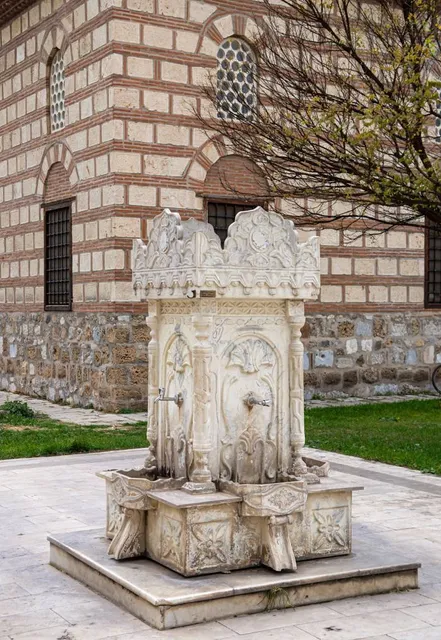
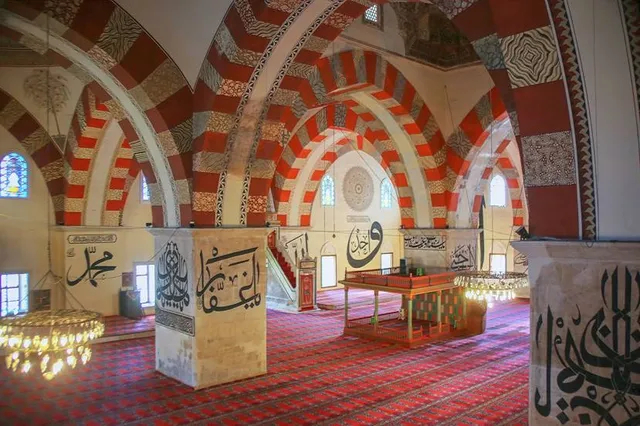
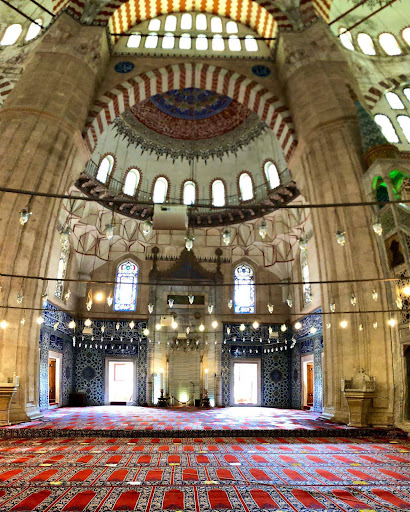
Ablutions Fountain Intricate, pierced carving decorates the top of the 16-sided open şadırvan (ablutions fountain), which stands in the centre of the courtyard. The absence of a canopy helps to retain the uncluttered aspect. Minarets The mosque’s four slender minarets tower to a height of 84 m (275 ft). Each one has three balconies. The two northern minarets contain three intertwining staircases, each one leading to a different balcony Dome The 43 m (141 ft) dome dominates the interior of the mosque. Not even the florid paintwork the original 16thcentury decoration underwent restoration in the 19th century detracts from its effect. Sultan’s Loge The imperial loge is supported on green marble columns. They are connected by pointed arches; whose surrounds are adorned with floral İznik tiles. Unusually, its ornately decorated mihrab contains a shuttered window, which opened on to countryside when the mosque was built The Interior The mosque is the supreme achievement of Islamic architecture. Its octagonal plan allows for a reduction in the size of the buttresses supporting the dome. This permitted extra windows to be incorporated, making the interior...
Read moreSelimiye Mosque in Edirne stands as an unparalleled marvel, encapsulating the historical grandeur of the Ottoman Empire and the brilliance of Mimar Sinan, an architectural virtuoso. Edirne, once the capital before Istanbul, bears witness to a rich historical legacy, and the Selimiye Mosque has emerged as an iconic symbol of this city.
This architectural masterpiece, born during the zenith of the Ottoman Empire's dominance, serves as a testament to Mimar Sinan's genius, his ability to shape imperial might through awe-inspiring architecture. The mosque transcends its role as a mere gem of Ottoman heritage; it is rightfully celebrated as one of the most revered landmarks in global architectural history. Mimar Sinan's profound influence is evident in every detail, from the majestic dome that signifies his mastery to the gracefully designed minarets.
The recognition of Selimiye Mosque and Complex on the UNESCO World Heritage List is a global endorsement of its significance. Exploring this site offers more than a glimpse into the past; it's an immersive experience into an era marked by imperial splendor and architectural excellence. The serene atmosphere within the mosque and its complex adds to the allure of this historical gem.
Visiting Selimiye Mosque in Edirne is not just a journey to a significant historical site; it's an encounter with a masterpiece that continues to captivate admirers worldwide. Prepare to be mesmerized by the architectural prowess that earned Selimiye Mosque its well-deserved place among the world's...
Read more