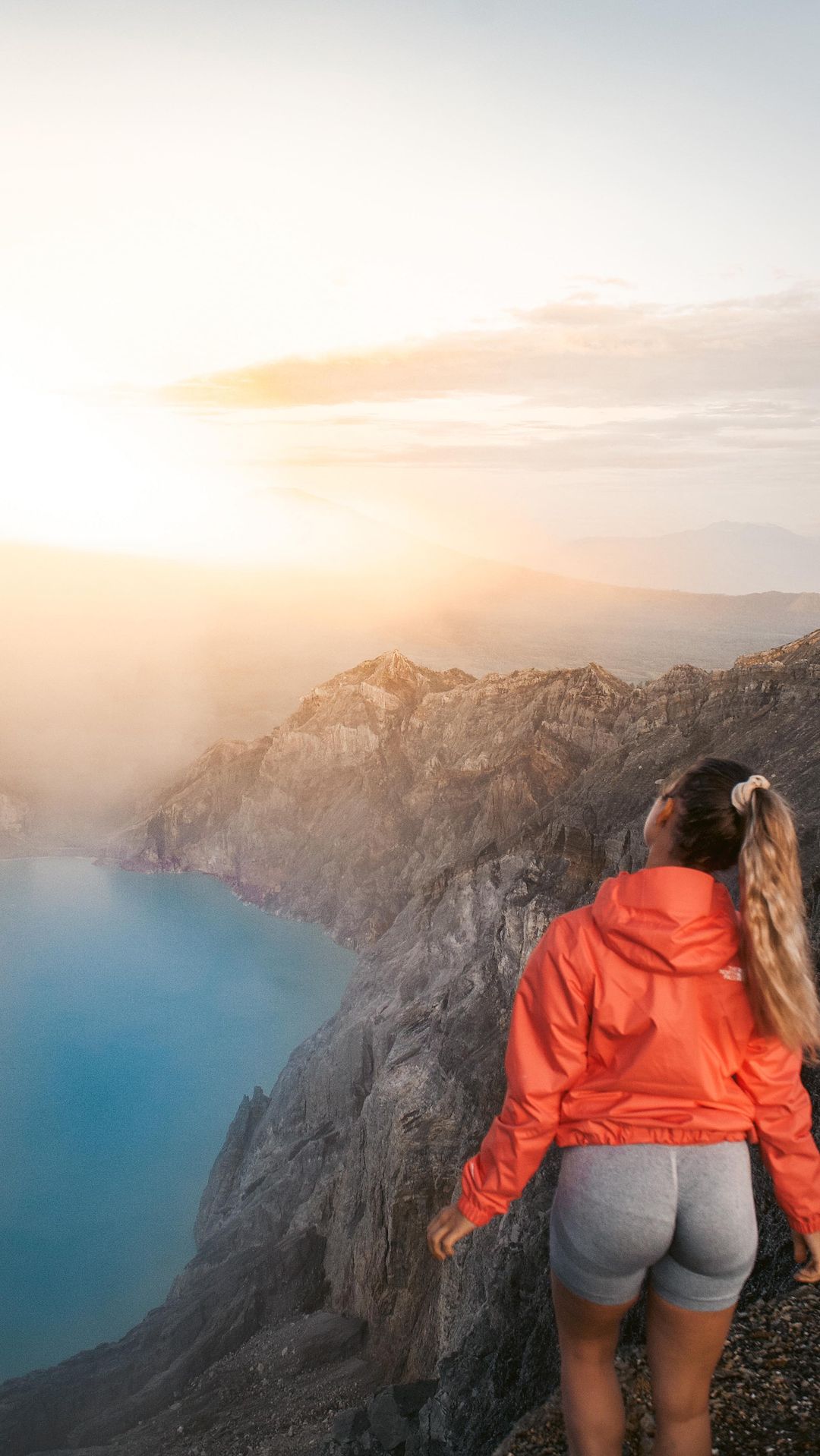
(Hike done in sept 2022) The most spectacular way to see Ijen is by hiking up in the middle of the night to see both the blue flames as well as the sunrise. We did it as a 'day' trip from Ubud, Bali by taking the ferry between Gilimanuk and Ketapang. There are multiple roadside travel agencies scattered around Ubud, though most only focus on the volcanoes on Bali. Eventually, we found Blue Flame Tour agency online.
Volcano Ascent
Since youāre starting at night at an altitude of 1800m, it can be quite chilly at about 10°C (sept 2022). The gates open at 2 am and the walk up is about two hours during which you'll be warming up in no time. Some parts of the path can be somewhat slippery, especially after rain. For a fee, the sulphur miners offer to take you up in carts, but if you have moderate fitness, you can do the walk up just fine.
The walk up from 1800m to 2300m is in complete darkness, so be sure to bring a torch or head light if it is not included. We walked up with about 300 others, but on peak (holi)days this can be up to several thousands.
Blue Flames
Once you've hiked up to the crater rim, it's time go down again! It takes another hour to go down the crater in a long line together with the other tourists. As it's still dark and the path is very rocky, the descent can be quite tricky.
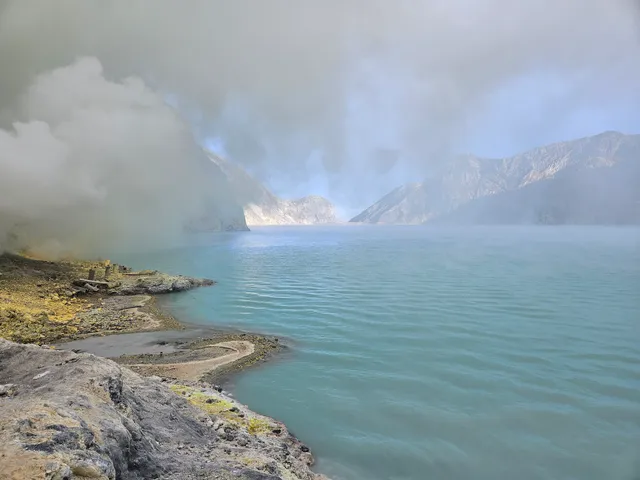
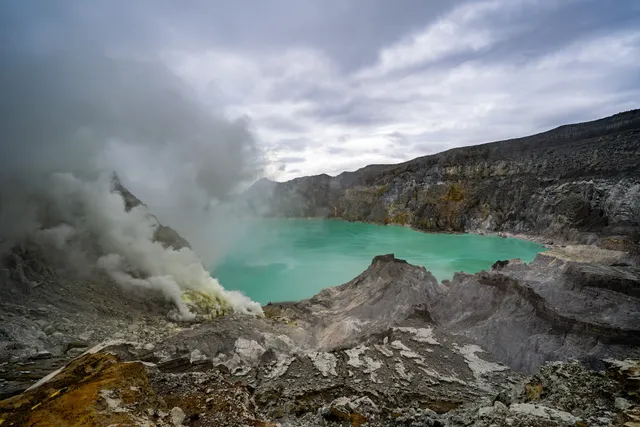
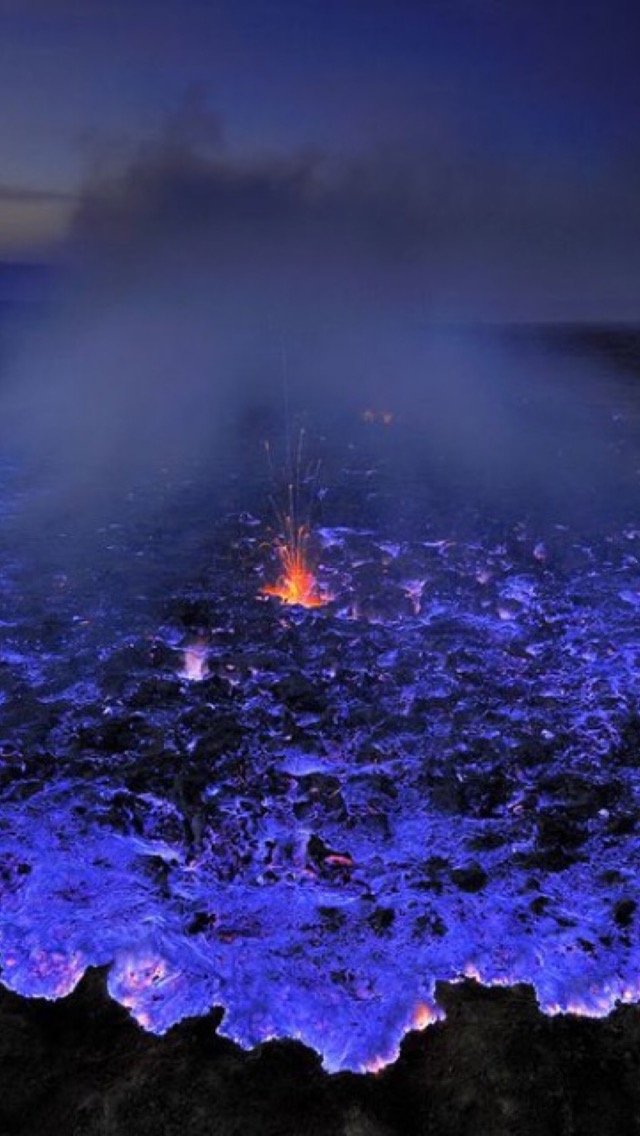
At the bottom you should be able to see the unique blue flames where the sulphur fumes exit the vents, come in contact with oxygen, and ignite.
If you're lucky with the wind, you won't need your gas mask until you're all the way down. Although even with a mask on, you'll still smell the rotten eggs. Furthermore, your eyes might start to burn, which is why guides will advise you to stay a maximum of 15 minutes at the bottom before going back up.
Sulphur Mining
As the sulphur fumes condense and solidify, big chunks of solid yellow sulphur are formed. These are carried up in baskets by the miners, and two full baskets weigh up to 60 kg. As most of the miners have been doing this from a young age (sometimes even at 16 years old), they are used to the smell and do not wear gas masks.
At the rim of the crater, the sulphur chunks are placed into carts and transported down the mountain. For every 100 kg the miners receive Rp125,000. Most sulphur is turned into sulphuric acid for chemical and agricultural use, though pharmaceuticals and cosmetics also use their fair share.
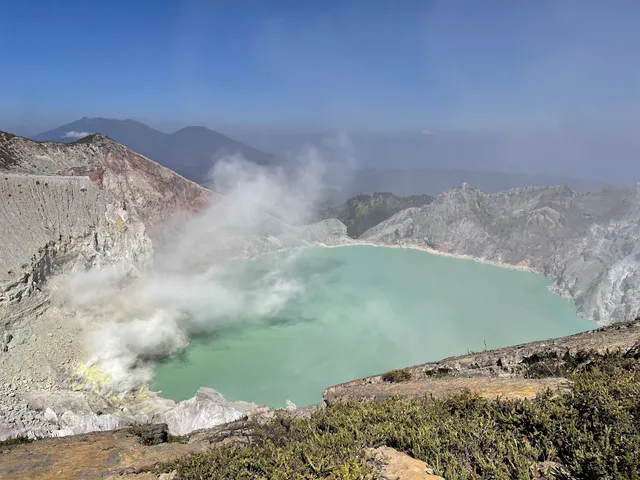
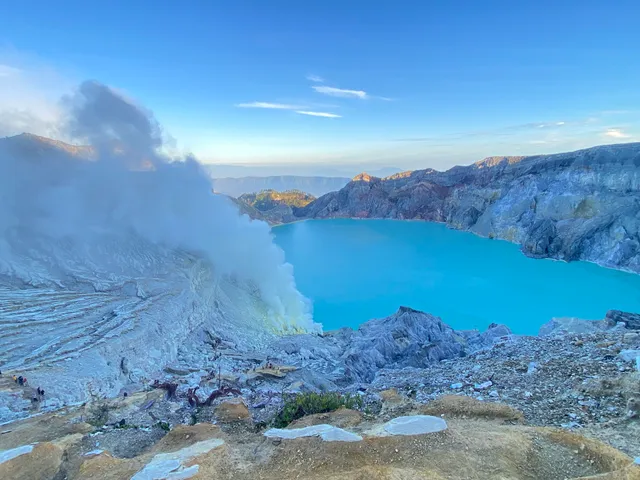
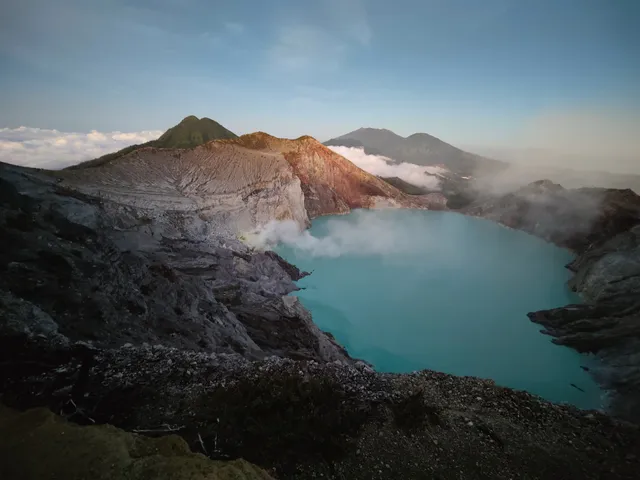
The clear blue colour of the crater lake is also because of the sulphur. It is actually recognized as the most acidic lake in the world with a pH as low as 0.2!
Sunrise Views
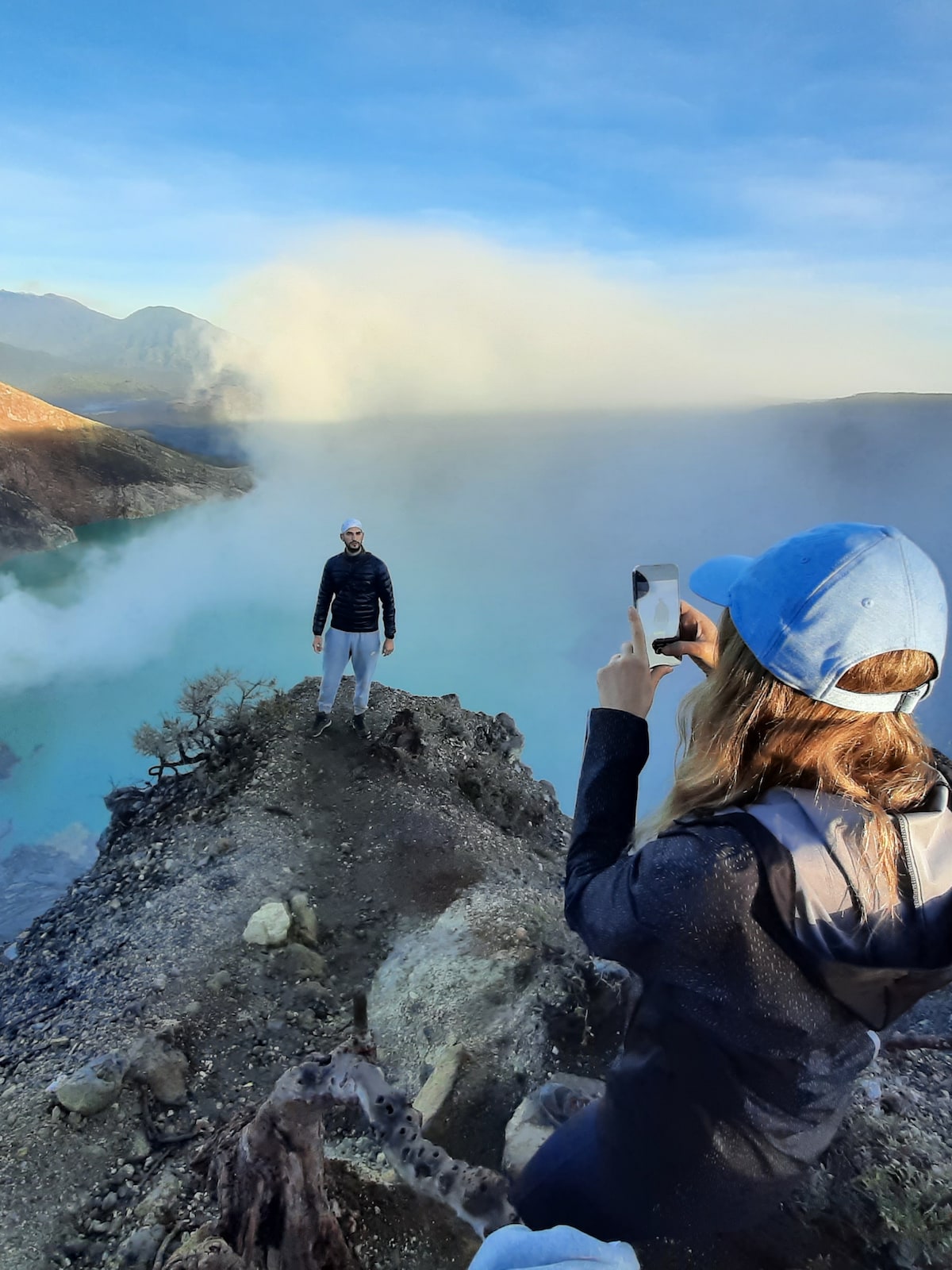
Once you climb back up after viewing the blue flames, the sun will start to rise. Even though the sun will rise mostly behind the neighbouring mountain Merapi, the hue on the surrounding mountains will be beautiful to see, as well as the views over the surrounding area.
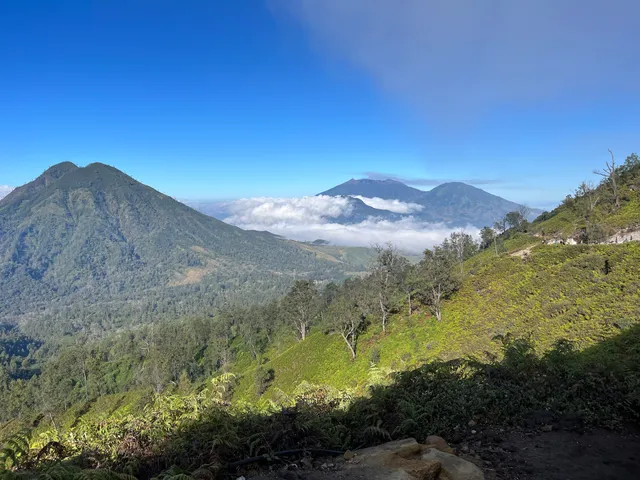
After taking a walk around the area, especially along the rim up top to get some beautiful views of the crater lake, it's time to walk back down again. The way back down is the same as up, and now you'll see which path you've exactly walked in the middle of the night.
Along the route, some shops will be opened to get some breakfast and stop for a toilet break.
Tips:
⢠Sturdy shoes - Be sure to wear some good hiking shoes, especially for the descent into the crater, as this part can be quite rocky and slippery. The path going up was slippery due to the loose sand and can also become really muddy with rain. ⢠Comfy and warm clothes - It is cold in the early morning and quite a hike so we recommend comfortable and warm layers. The path is clear of vegetation and we weren't bothered by any insects. ⢠Rain gear - Make sure to bring some rain gear just in case. ⢠Torch/headlamp - If you choose to do the hike before sunrise bring a torch or a headlamp. ⢠Snacks - Bring snacks as you are hiking in the night with probably little to no sleep and are probably skipping breakfast or eating breakfast after the hike. We noticed that with an empty stomach the fumes were quite...
Ā Ā Ā Read moreThe Kawah Ijen has the largest high-acid crater lake in the world. It is also one of three places in the world where you can see the so-called "blue fire" or burning sulfur. Of course, this is only best seen at night. That is why the night tour starts at 2 am when the "park" officially opens. You are accompanied by a local guide, in my case Addi who did not speak a word of English but was still helpful in his way with helping you descend and with climbing because it is tough if you want to do this tour (in my case untrained and 60 years old š) Beforehand you got the advice to wear warm clothing, including a jacket, for me the temperature was not too bad as a Dutchman, but I saw lots of people wearing hats and even gloves š I can also emphasize that this jacket bothered me quite a bit simply because you sweat like an otter during the climb. The distance to travel to the crater and the "blue fire" is approximately 3 km, with the first 1.5 km going up steeply, which is really not easy, I can tell you. I also have to admit that I've had on some point the feeling, I'll stop š but these kinds of occasions/moments are excellent for pushing your boundaries š which I did because you started something and that's why you want to end up by doing it too simply because you just want to finish something and see what you started for. Although I must admit that the last part (about 200 meters) to the crater is over boulders and gravel which is not easy because it is sometimes slippery and you can easily slip. Also because it is quite crowdy because you are definitely not the only one in that respect, so you really have to be careful. Because you also have to deal with people who have already been to the crater and are going back up again and passing is quite difficult on those narrow rocks. Eventually you reach the sulfur mine with the "blue fire", the fumes there force you to put on a gas mask and the stinging in your eyes is also unprecedented. But it is an amazing experience even though it is so crowdy š I also planned to see the sunrise but I was too late because my journey to the crater had taken too long. Nevertheless, I thought it was beautiful to see it and the azure blue gets more and more color as it gets lighter, what a beautiful sight. All in all, I recommend everyone to do this tour, but don't underestimate the "journey" to it.
There are also, as the locals call it, taxis that take you up and down again. These carts with a sturdy brake are operated by former miners since the sulfur mine can no longer employ so many people and in this way the "redundant" miners still have a certain form of income. I must admit that I am not jealous of these men who really have to work hard and sometimes have to bring tourists up with three people. The price you pay for this "taxi ride" there and back is approximately IDR 1,000,000, which converts to approximately Euro 60 unless you have haggled. I must admit that I was also guilty by using this on the way back, but for the last 400 meters because I was curious to also experience this experience. Well I can tell you if they have to guide someone like me weighing 95 kilos down a steep road with ruts and grooves in the sand and tree roots then it is really heavy and I did not think it was necessary to pay the price of IDR 200,000 to haggle.
Although the proportions in terms of income are somewhat skewed as the miners who still work in the sulfur mine have to settle for considerably less. These people who work without protection from 00:00 to 09:00 and every time have to carry baskets of sulfur weighing about 60 kilos š upstairs, in words and writing IDR 20,000 are converted to Euro 12. Which of course is completely out of proportion to what the "taxi drivers " to get. I am therefore afraid that these people who have to lug those heavy baskets upstairs every time will not have a long life. Sad! The entire "walk" up and to the crater took me about 2 hours, as I did make use of the various rest points...
Ā Ā Ā Read moreWe booked an Ijen trip through Klook. Our driver, Pande ji, came to pick us from our Airbnb in Sanur, Bali around 7 pm and we drove for about 4 hours to reach the Gilimanuk port from where we took a ferry to the Ketapang port, Java Island. The ferry ride took about 45 minutes. We reached the port around 1 am.
From Ketapang port, we were picked up in a different car by driver Alam and taken to the base camp, with a stop at the local health center for medical clearance, they just check your basic vitals and give a fitness certificate. It must have roughly taken about 60 to 90 minutes to reach the base camp from the port. The drive was through the jungles of Java and it was giving an eerie feeling. We reached the base camp around 2:30 am.
It starts getting cold from here, so a jacket is a must. In addition to the jacket, you'd also need a pair of good hiking shoes, I made the mistake of wearing heavy boots which almost cost me my trip. You could also rent a walking/hiking stick (optional), torch (must), gas mask (must) and glasses (optional but highly recommend, to stop your eyes from burning, read on).
We met our guide Adi who briefed us about the hike plan. The gates to Mount Ijen open around 2:00 am, buy the entry tickets here, organized tours already have the guides buy them for you. As we went on a Sunday, there was a lot of crowd, mostly foreigners and some locals. You must first hike from the gate to the rim of the volcano, the hike is roughly about 3.7 kilometers but it feels like forever due to the incline and terrain, and mostly because you're walking in the dead of the night and can't see how far ahead the destination is.
There are three pit stops on the way:
Pitstop 1: less incline, moderately easy to climb, some people give up at the first stop
Pitstop 2: deep incline, moderately difficult to climb, some more people give up at the second stop
Pitstop 3: more incline than pit 1 but less than pit 2, some more people give up at the third stop
But most people still carry on with the ultimate goal in mind, that is to see the blue flame (more about it below). Some people also hire the Lamborghinis and Ferraris of the mountain, pulled and pushed by local guides who offer the ride for 800k to 1 million IDR for one way or 1.7 million IDR for a round trip.
After you have hiked to the top, then you need to climb down into the crater which is a little tricky, especially in the night with a lot of people around, a small mistake could prove fatal. Patience is the key here, although you may be running out of time and it'd be very tempting to rush, you may still want to observe patience both for yourself and your fellow hikers. It roughly takes about 45 minutes, more or less, to get to the bottom of the crater.
There are two things here: firstly, the mining area where the blue flame burns. The whole reason people come here is to see the blue fire, a natural phenomenon in which a fire burns the Sulphuric gas causing a visual effect, that lasts until some time before the sunlight. So, you have very little time in hand to reach here. Try to reach the bottom of the crater by 4:30 am and you still have a chance to see the blue fire. Anything later than that, you'd probably miss it. Of course, the weather conditions play a major role here.
The blue flame is visible only in two places in the world, one here in Mount Ijen and the other somewhere in Ethiopia. The blue fire is really a remarkable phenomena, something definitely worth all the effort. Be careful though as the fumes could cause very bad reaction, your eyes, nose, throat will burn so bad you'd want to just totally disappear from here. Hence, a good gas mask and glasses to completely cover your eyes is super recommended to avoid significant exposure. Despite all the protective gear, you'd still be exposed to the Sulphur gas and have a mild discomfort. This part of the attraction is the most crowded, so you may want to be careful to avoid any untoward incident, although it's very...
Ā Ā Ā Read more