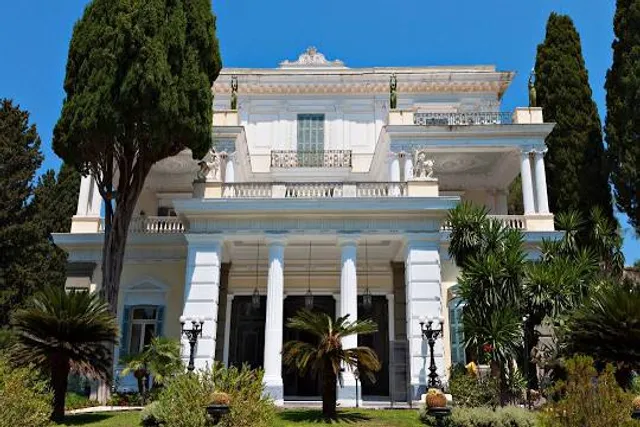
Visiting Achilleion Palace was an unforgettable experience, not only for the beauty of the building itself but also for the history and unique atmosphere that surrounds it.
The palace was built at the end of the 19th century by Empress Elisabeth of Austria (Sisi), who was deeply in love with Greece and its mythology. She dedicated this residence to her favorite hero – Achilles. This dedication is visible everywhere: from the majestic sculptures in the gardens to the interior decorations that portray Achilles both as a heroic and tragic figure.
As soon as you step inside, you are impressed by the neoclassical architecture with Pompeian influences. The grand staircase, decorated with statues and murals, leads you to rooms where every corner tells a story about Sisi’s life and passions. One of the most striking highlights is the large painting “The Death of Achilles”, a dramatic masterpiece that captivates you instantly.
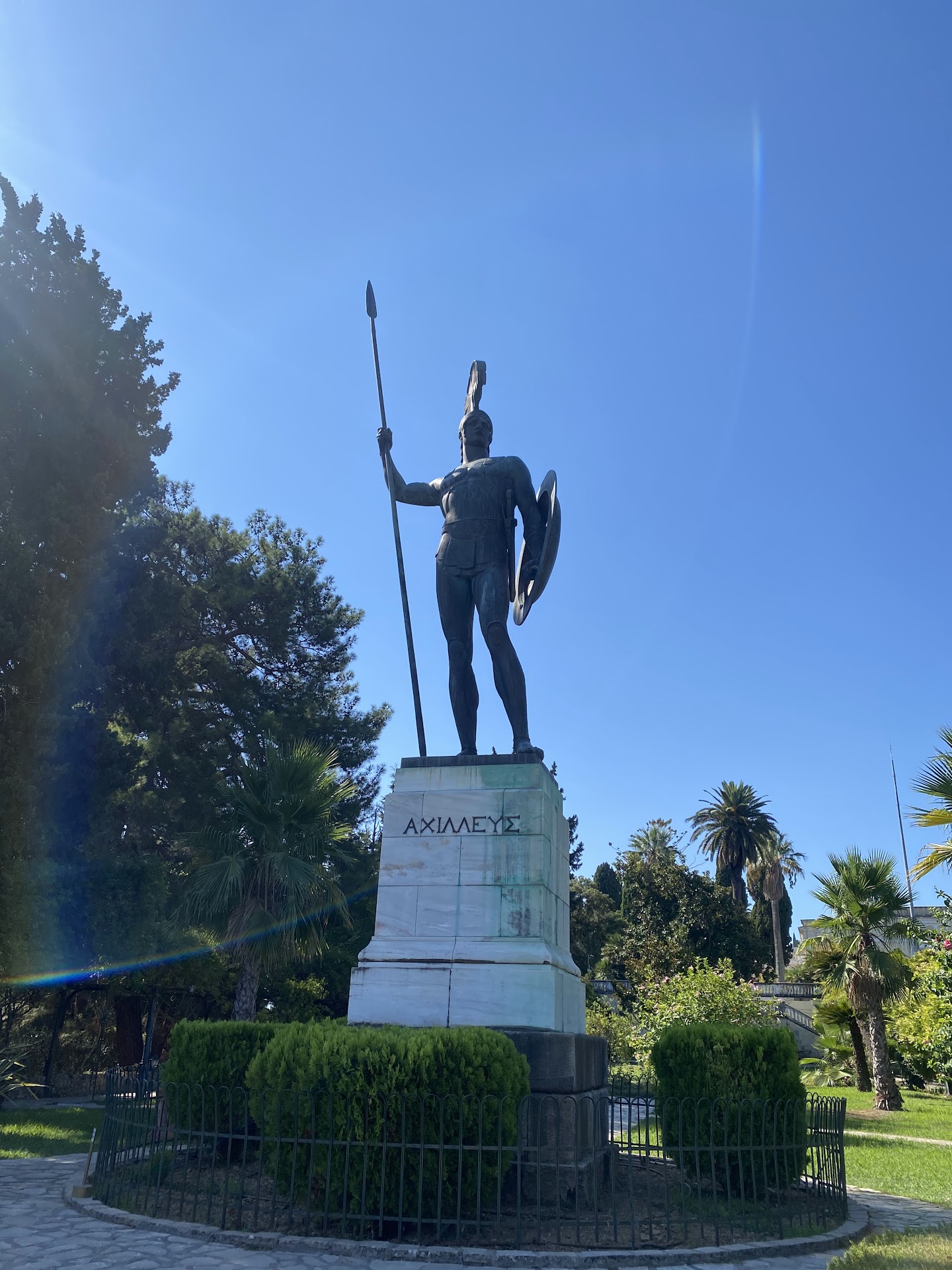
Still, the most magical part of the palace is undoubtedly the gardens and terraces. Here you’ll find dozens of statues of Greek gods and heroes, including the famous “Achilles Triumphant” sculpture. From this spot, you can enjoy breathtaking views over Corfu, the Ionian Sea, and even the distant coast of Epirus. It’s the perfect place for photos, but also for moments of reflection and calm.
Historically, it’s fascinating to know that later on, the palace was also used by Kaiser Wilhelm II of Germany, who added his own touches – including the monumental statue “Achilles as Warrior”. This gives the Achilleion a unique blend of Austrian, German, and Greek cultural influences.
A visit usually takes about 1–2 hours. The entrance ticket costs only €7, which is a very reasonable price considering the amount of art, history, and beauty you get to experience. I recommend visiting either early in the morning or later in the afternoon to avoid the crowds. There are also audio guides available, which really enrich the experience.
In conclusion, Achilleion Palace is not just a museum – it is a journey back in time, into the romantic spirit of the 19th century, Greek mythology, and European history. For anyone visiting Corfu, it is an...
Read moreAchilleion Palace is a pompeian styled Palace designed by Italian Architect Raffaele Carito built in 1889-1891. The Palace replaced a former mansion of Petros Vrailas-Armenisa a promenient Corfiot by the Empress of Austria & Queen of Hungry Elizabeth - urgent of the Austrian Consul Alexander Von Watzberg. Achilleion was named by Elizabeth in respect for Ancient Greece & to honour Hormer's hero Achillies having been impressed by his strength & beauty. Elizabeth used to visit the Achilleion untill she was murdered in 1898 by ltalian anarchist Luigi Lucheni. Elizabeth's Achilleion in 1907 was sold by her heirs to Emperor of Germany & King of Prussia Wilhem ll (Kasier). The King use to visit the palace frequently where it was the centre of Diplomacy until 1914 when WW1 started. During the war the palace was used as a military hospital for both French & Serbian troops. After the war & Germany's defeat, the Palace became the property of the Hellenic State under the Treaty of Versailles & war reparations (1919). Between both world wars, various buildings around Achilleion was used by various Greek institutions & most of the Palace contents were auctioned off. During WW2 Achilleion was occupied by Italian & German forces as a headquarters. After WW2 it was used by the Hellenic Tourism Organisation. In 1962 the building was leased to a private company that operated the 1st floor as a casino while the ground floor was used as museum. In 1983 the lease ended. In 1994 the palace was used for the annual EU Summit meeting. In 2003 it was used for a meeting of EU Agricultural Ministers. The palace remains as a museum & is occasionally used for private & public events arranged by the Hellenic Tourist Properties SA. It is worth visiting to check out the craftsmanship used throughout, its furnishings (beautiful painting of the imperial yacht), gardens & the scenery overlooking...
Read moreLoved the place but felt like I was taking a walk in "Les jardins du Luxembourg" of Paris. What I mean by that is, even though it's of great beauty, it's lacking in guides and enough information like so many places and museums I ve visited abroad (and imagine I am Greek). The ticket mentions audio guide but the staff told us that the only audio guides that exist are given to guided tours and groups of tourists and foreigners, so, apparently visiting the place with a friend or gf/bf without booking a tour means you don't get an audio guide either, even though you pay 10 euros per person. The staff present at Achileion is not interested in providing information about the exhibits, they are more like security personnel standing at the entrance or taking a break, all at the back of the museum, leaving the place largely unwatched and unguarded. Even though there are pieces within the museum that provide a tiny bit of information, it's only elaborating on the how and with what materials they were made, which is, at least for me, completely useless, since I am not visiting a gallery or painting shop, it's a place of archaeological value.
Last but not least, the place is only.open on the ground floor and the gardens around it, meaning that the 2 upper floors are not accessible, which, from what I ve heard is closed for at least a couple of years now, on and off during tourist...
Read more