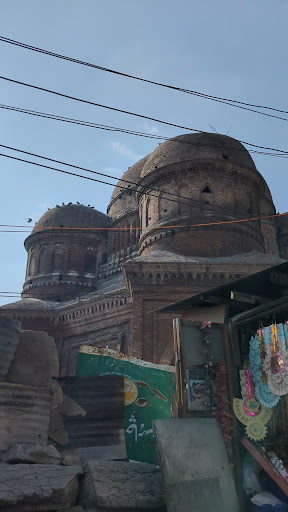
This is another monument in Srinagar’s old city but is unlike most others, being a royal tomb instead of a mosque/shrine. However it is interesting in a couple of ways, the first being in the architecture of the main mausoleum itself, and the second in the evidence of it having being built at the site of an earlier Hindu temple.
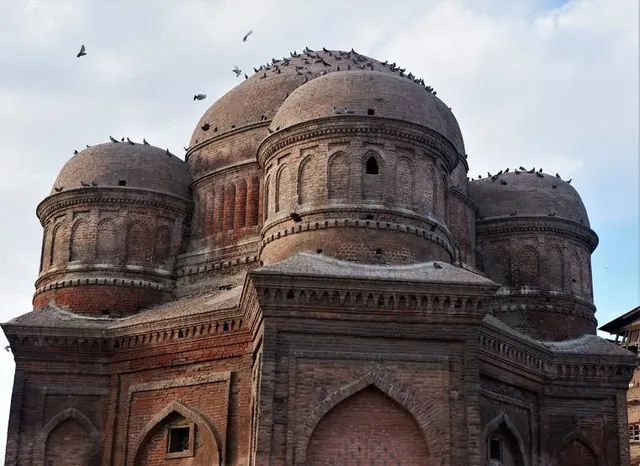
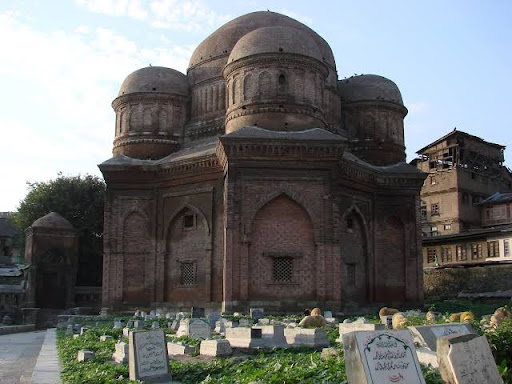
The main mausoleum (containing the tomb of the eponymous mother of Zain-ul-Abidin) is a 15th c brick masonry structure decorated with glazed blue tiles. The shape of the structure is unusual though, being reminiscent (to my eye) of church architecture. The central domed tomb chamber is flanked by four auxiliary domed rooms that resemble chapels adjacent to the apse of a cathedral. In plan the structure will resemble a symmetrical cross. Of course these are only visual cues, and this kind of tomb design may have precedent in Central Asia etc, but it is unusual in my experience of South Asian architecture.
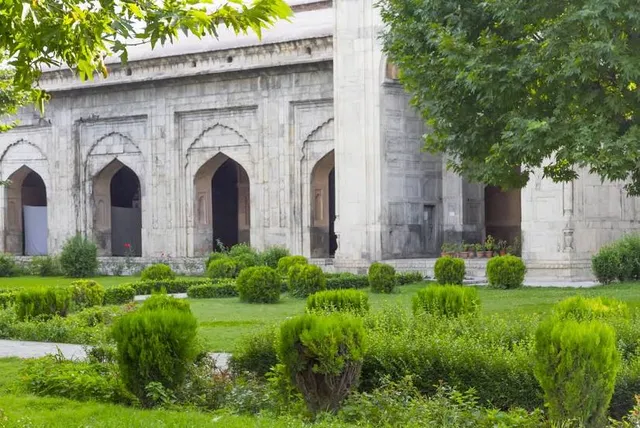
The other aspect is the evidence of earlier Hindu temples at the site. This is interesting at many levels, because the temples in Kashmir were themselves very unusual in style (as evidenced at Avantipur and Martand), being heavily influenced by the Gandhara school of art, and in many ways vastly different from the styles of stone temple design in the rest of South Asia. In fact it is possible that the base of the main mausoleum follows the lines of an earlier temple at the same spot, since there are a lot of similarities between the base of this structure and the base of the Avantishwara temple at Avantipur (see the Avantishwara temple section in my Avantipur and Martand post linked to earlier in this paragraph). I haven’t read any scholarly work on this, so right now I’m just conjecturing about it.
My interest in this is not because I want to highlight the destruction of temples (I don’t know what the state of the temple was at the time the mausoleum was constructed), but because I find this layering of styles and histories fascinating. Also, the construction of mausoleums and (more frequently) mosques at the site of earlier temples indicates a certain reverence to the site and it’s symbolism.
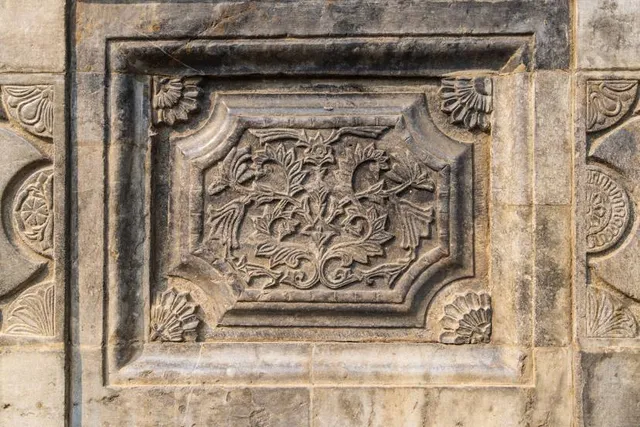
In the case of this tomb in particular, this was my first interaction with the Gandharan-influenced iconography of Hindu temples in Kashmir (I had not been to Avantipur and Martand yet), and found the Greek and Roman-inspired elements quite fascinating in this setting, with an unusual Islamic tomb which itself seemed to reflect elements of western Christian architecture. It all seemed like a happy architectural history hodgepodge!
Copy from...
Read moreAccording to the ‘Baharistani Shahi’, Sikander Butshikan (“Sikandar the iconoclast”), the sixth Sultan of the Shah Mir dynasty established the ‘Mazar-e-Salatin’ a royal mausoleum on the banks of the Jhelum. His son, Sultan Ghiyas-ud-din-Zain-ul-Abudin, the ‘Budshah’, was a liberal ruler who reversed much of the oppressive policies of his father. His patronage of the arts attracted several artisans, craftsmen and engineers from Central Asia, introducing carpet weaving, paper mache, silk etc to the Valley. The main tomb was built by Sultan Zain-ul-Abudin for his mother, in the 15th century. The brick monument is an unexpected, delightful contrast among the timber framed dhajji construction of the ‘Shehr-e-khas’ Srinagar. The octagonal structure comprises of a larger central dome surrounded by four smaller domes, built over a Greek cross plan. The brick arches, vaulting & dome technique, glazed tile ornament etc are a rare example of surviving Silk Road architecture within the Kashmir valley. Sultan Sikander, Sultan Zain-ul-Abudin and Sultan Habib Shah also lie buried within the royal mausoleum complex. There might be a more ancient reverence and symbolism to these sacred grounds on the bank of the Jhelum. Evidence suggests that the ‘Mazar-e-Salateen’ of the Shah Mir dynasty was built over the site of a previous monument, possibly a temple. The brick structure of the royal tomb appears to rest over an earlier stone plinth. Elsewhere around the mausoleum complex, compound walls, arched portals and other landscape features are curiously embellished with several Greco-Roman inspired Gandhara components (peculiar to Kashmiri temples) within their built fabric. Much intrigued by this layering of Byzantine and Gandhara style influences within an...
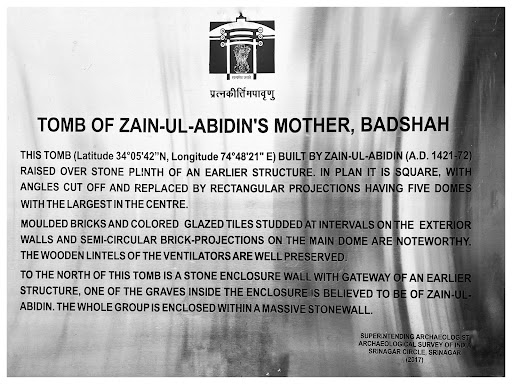
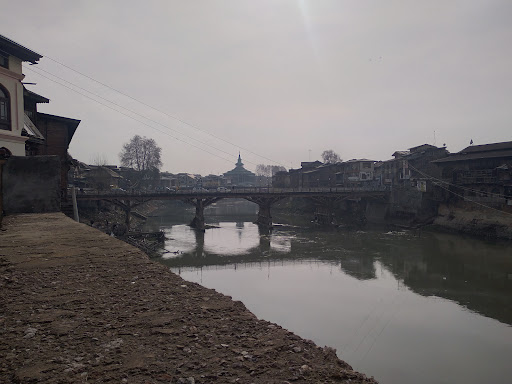
Read moreThe Badshah Tomb marks the final resting place of the mother of the famous ruler of Kashmir, Sultan Zain-ul-Abidin (1421 AD to 1474 AD), in Srinagar. It has been erected on the plinth of an old temple. An unusual five-domed brick structure, it is considered a unique piece of architecture, dating back to the 15th century. There are claims that it looks more like a structure from the Byzantine empire. The tomb is a peaceful place and provides a great view of the surrounding greenery from the top. When seen from the new Zaina Kadal (bridge), the city's oldest bridge, it forms an important part of the classic view of Old Town Srinagar.
River Jhelum flows near the Badshah Tomb. It is believed that Sultan Zain-ul-Abidin deliberately had the tomb erected next to a water body as per traditional Muslim beliefs and traditional ceremonies, rites and rituals.
Sultan Zain-ul-Abidin used to be fondly called the great king, the 'Budshah' or simply the 'Badshah' by his people. He ruled over Kashmir for over 50 years and that entire period is counted as one of the most peaceful periods that the region has ever seen. Sultan Zain-ul-Abidin was the son of Shah Mir, who started the rule of the Mughal dynasty in India in the mid-14th century, when he migrated to India from Central Asia. The sultan was loved and hailed by his people throughout his reign and after the death of his beloved mother, he had the Badshah Tomb built in her...
Read more