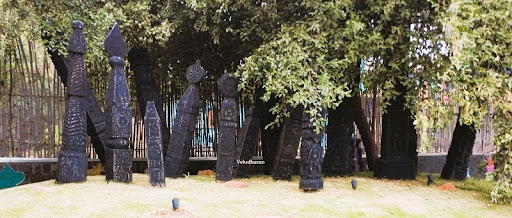
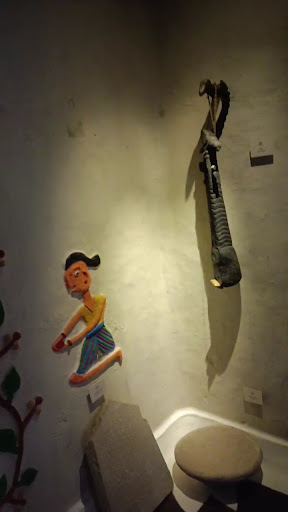
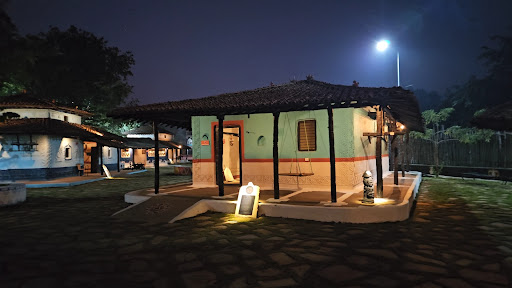
State Museum for Tribal and Folk Art, consists of display of Hero Sthambas, Terracotta dolls, Paintings, and Village Houses/Huts. Tribal communities worship their ancestors with great respect. They are also their gods who protect them all the time. Different customs are prevalent in different tribes for them. The Kol tribe has the practice of creating memorial pillar for the dead person, which is called Sanehi. Sanehi is established where the cremation of the deceased is done. The rectangular shaped Sanehi is made from wood of Sarai tree and its upper portion is triangular. Nowadays, the date of the death of the deceased is engraved on the upper side of the sanehi, while the house, kalash (urn), goth, tools, animals and birds etc. are engraved on the lower side. In fact, by installing Snehi, the family shows affection and respect towards their dead relatives. The work of making 'Sanehi' is a very costly ritualistic work. Pithora is the most beautiful example of Bheel painting tradition. This is the most pious and important occasion for invoking and worshiping the deities. In fact, It's a ritual representation in the form of a mural painting. The tradition of its drawing is present specially in the Dhar, Jhabua and Nimar region of Madhya Pradesh. Pithora making can be seen in the Bheels of Gujarat and Rajasthan as well. Pithora worshiping is a centuries-old ritual of invoking rain god and worshiping water as a divine deity in Bheeli areas of less rainfall. The Indi king (Indradev - the king of deities) took renunciation by handing over his throne to his nephew (sister's son) Pithora, this belief lies in the basic spirit of the mural painting of the Pithora myth. Actually the Pithora murals are an artistic expression of the vast mythological world of the tribal memory of the Bheels. It is related to biological, productiveness, fertility of agriculture and grain opulence. Horse painting with the story of Dharmiraja and kajalrani is mainly done in Pithora. Pithora is the only narrative depicted in any tribe of Madhya Pradesh, in which story-singing and playing of instrument are also accomplished simultaneously. Pithora is sung by Badwa (local priest) along with 'Dhank' instrument and Likhandara paints according to the story of the song. This is his traditional job. The most important thing is that it can be performed within ritualistic practices. A vow is taken to perform it. After the desired purpose is accomplished, pithora making is done on the wall in front of the entrance of the house, so that gratitude can be expressed while entering and exiting the house. In Jhabua district, every village has a particular dwelling place of Baabdev. Villagers gather twice in a year at the time of Deepawali and Diwasa i.e on no moon-night, to worship Baabdev. Cocks, goats, vermilion, barley or local crop & terracotta figures of horse, sometimes pigs, cats are also offered to propitiate Baabdev desiring the well-being of the entire village. Along with this a goat or hen each also offered to the deity with millet, vermilion etc. as a sacred sacrifice. However, there is no idol of Baabdev but a stone as a symbol and many places a wooden lion or a horse are placed. These places can be seen from a distance due to the heap of terracotta horse figures that are offered...
Read moreThe Tribal Museum in Khajuraho is a wonderful place to visit for anyone interested in tribal culture. With its interesting exhibits, affordable tickets, and clean environment, it offers a unique and enriching experience. It provides a fascinating look into their art and daily life.
Architecture
Design: The building is modern but has a tribal feel. It is spacious and well-lit, making it welcoming for visitors. Interiors: Inside, the museum uses earthy colors and natural materials that go well with the tribal artifacts on display. The layout is easy to navigate.
Tribal Art and Culture
Artifacts: The museum has many tribal items, including traditional clothes, jewelry, tools, and household objects. Each item is labeled with information about its background. Art: There are beautiful tribal paintings, sculptures, and pottery. These artworks show the creativity and cultural richness of the tribes. Cultural Displays: Exhibits on tribal rituals, dances, and festivals provide a complete view of their customs and traditions.
Ticket Price
Affordable Entry: The ticket price is Rs. 20/- per person, Rs 100 for Photography.
Closed on Monday.
Cleanliness and Neatness
Well-Maintained: The museum is very clean and organized. Exhibits are arranged neatly, making it a pleasant place to visit. Hygiene: The museum has clean restrooms and comfortable seating areas for visitors.
Uniqueness
Focus on Tribes: The museum is unique because it focuses specifically on the tribal communities of India, offering a special insight into their lives. Educational Value: It is a great place for learning about the history and culture of...
Read moreAbsolutely disgraceful museum. I arrived with my disabled husband carrying proof of disability with ID card. On the entrance details it was clear that a disabled person gained free access. The exceptionally rude and surly woman at the ticket office repeatedly told me that this was not for foreigners! I am not sure what makes an Indian any more eligible for a disabled concession than a Uk citizen? We have travelled through Delhi, Gwalior, Datia and Orchha and covered all the major sites and so far this concession has been available everywhere. I had to argue for 10 minutes but to no avail. Eventually demanded to speak to a Manager who agreed to the concession but the ticket lady continued to argue; eventually but grudgingly she provided a concession. What a thoroughly unpleasant and humiliating experience for my husband. The museum really was not worth the fight to get a ticket, nor was it worth the 400rp entry fee for me. It’s a very new and tidy building that looks more like a children’s theme park. We learnt precisely nothing about tribal cultures. Each building, despite being from a different tribe is basically the same with modern day artefacts that are the same throughout. There is so much to learn about tribal cultures in India but this was most certainly not the place to go to gain this knowledge. Terrible experience all round and we should have saved the humiliation and 400rp entrance. Don’t waste...
Read more