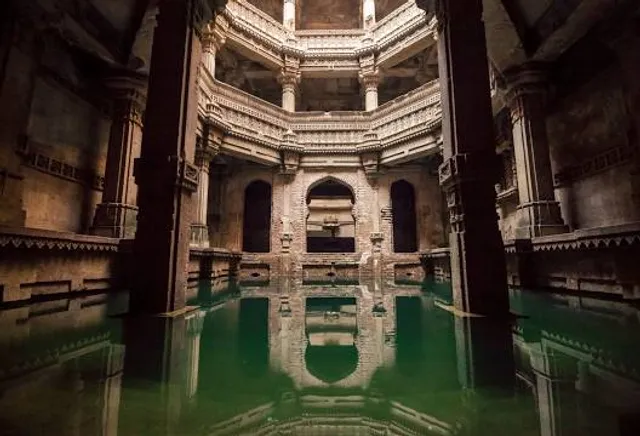
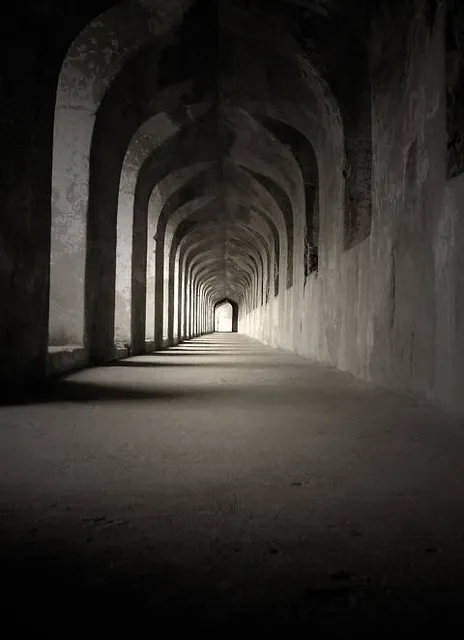
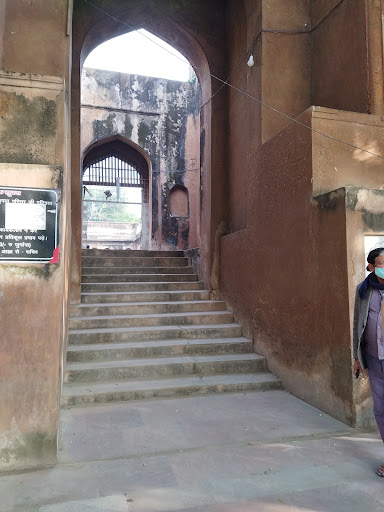
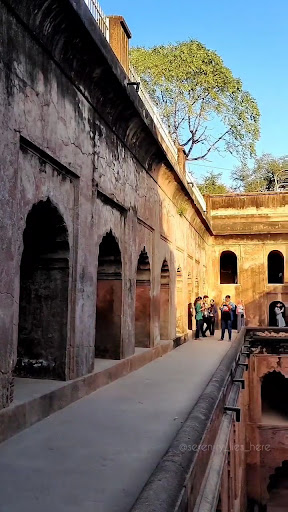
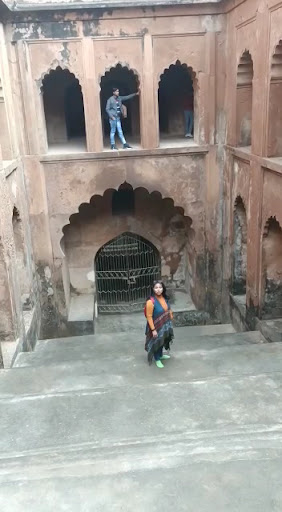
The Shahi Baoli was constructed in order to be used as a water reservoir. Myths like water of this well being connected to the river flowing nearby or a secret treasure map and the key to the treasure being thrown into this well have been quite popularly widespread. Baoli is extensively popular for it’s exceptional architectural design. Nawab Asif-ud-daula built it during the years 1784-1794 and got the design of this baoli drafted by Kifayat-ullah, who was one of the most skilful architects of those times. The exquisite Indo-Islamic architectural design of this structure makes it an impeccably unique edifice. The Shahi Baoli was built along with the other units of the Bada Imambara in order to provide food and work to the famine-stricken natives of Awadh. To the east of the main courtyard of the Bada Imambara lies the Shahi Baoli. Entrance to the Shahi Baoli is through a double arched gateway. On moving further, an open flight of stairs lead down to the step-well. Encompassing this well stands a multi-storeyed structure which comprises many open arched windows and inter-connected galleries.
The most fascinating feature of this baoli is the secret view of the visitors that it offers. Because of the alignment of one of the windows of the building and it’s entrance pathway, one can see the colorful shadow of the visitors standing at the entrance of this structure, on the water of the well. Many of the royal guests have described this building in their travelogue as a five-storeyed palace or the Panch Mahal, consisting of halls and several resting rooms for the guests. Moreover, a water supply of hot as well as cold water was available to them for bathing. The entry to this palace was from the east whereas exit to it was from the west. Three storeys of this palace are now submerged into water’, says the famous historian of Awadh, Mr. Roshan Taqui. ‘Surprised to see shadows of the visitors on the waters of the well. It’s unbelievable!’, says Anjali Tuteja, a tourist from Bangalore. Memories of visiting such architectural wonders is a treasure for lifetime. It’s a marvellous piece of work!’ says, Sandeep Rawat, an engineer. Now-a-days, the water of the well is seen covered with green algae and seems excessively filthy. People are often seen throwing coins, empty wrappers and plastic bags into the well. Even the walls of the facade sustains scribblings, patches of betel juice, cracked...
Read moreThe entrance of the Shahi Baoli is through a double-arched gateway, just after that, there is a flight of open stairs in the middle which leads down to the stepwell. Around the stairway, there are galleries with interconnected hallways on 3 sides at each level. The hallways and galleries have many arched windows facing either the entry area or the inner stepwell. The levels have stairs from inside too & one can move around. The Shahi Baoli is said to have served as Royal Guesthouse on many occasions – Warren Hastings, the Governor-General of East India Company had stayed here temporarily. One of the windows is aligned in such a way with the main entrance that the visitor can see the reflection of the visitors at the entrance in the water of the well but the visitors can not see us. This place was used as a CCTV camera in the olden times like a person would be standing inside the Bauli and would keep an eye and if anyone comes in there they won't be able to see that man standing but the person who is keeping an eye can see everything. The stepwell was the location where the Nawab buried his treasure (during the period of revolution) and the British army was not able to find it. It is said that the treasurer of the Nawab was Mr. Moolchand Rastogi who knew the secret of the treasure and where it was hidden; he had the key and the map which he threw in the stepwell and no one was able to find it. It is also said that Moolchand threw the key into the well which is 300feet deep. When he threw the key into the deep well the Britishers could not empty the well and could not get the key. He also apparently suicide and remained loyal to his master, not allowing the greedy British army to find the treasure. And to date, nobody is successful in finding that treasure...
Read moreHere are some detailed facts about Shahi Baoli:
Location: Shahi Baoli is located in the heart of Lucknow, India, near the Bara Imambara complex.
History: Built in 1784 by Asaf-ud-Daula, the Nawab of Awadh, as a part of the Bara Imambara complex.
Architecture: A stunning example of Mughal architecture, featuring intricate carvings, calligraphy, and ornate designs.
Stepwell Design: A unique stepwell design, with 102 steps leading down to the water level, surrounded by arched recesses and galleries.
Water Source: The stepwell was originally connected to the nearby Gomti River, but now relies on groundwater.
Ornate Carvings: Features intricate carvings of floral patterns, geometric designs, and calligraphy on its walls and ceilings.
Arched Recesses: The stepwell has arched recesses and galleries, providing shade and seating areas.
Historical Significance: Served as a community gathering place, a source of water, and a symbol of the Nawab's generosity.
Restoration: Undergone restoration work to preserve its original architecture and beauty.
Tourist Attraction: A popular tourist attraction in Lucknow, showcasing the city's rich history and architecture.
Spiritual Significance: Considered a sacred place by locals, who come to pray, meditate, and seek blessings.
Archaeological Importance: Recognized by the Archaeological Survey of India as a monument of national importance.
These detailed facts highlight the significance, beauty, and importance of Shahi Baoli, making it a must-visit destination for anyone interested in history, architecture,...
Read more