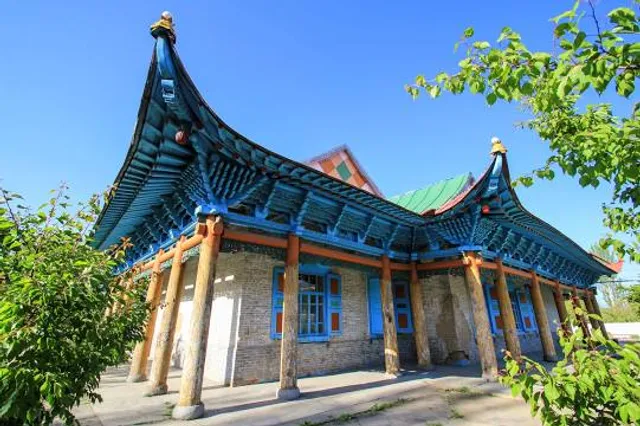
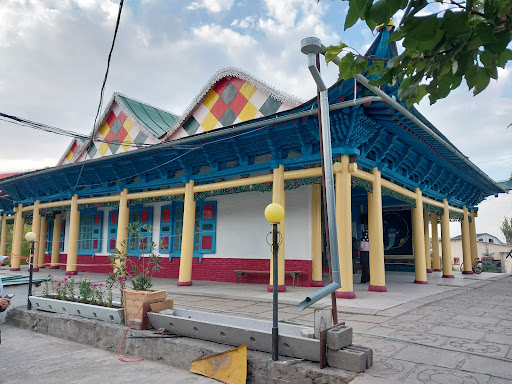
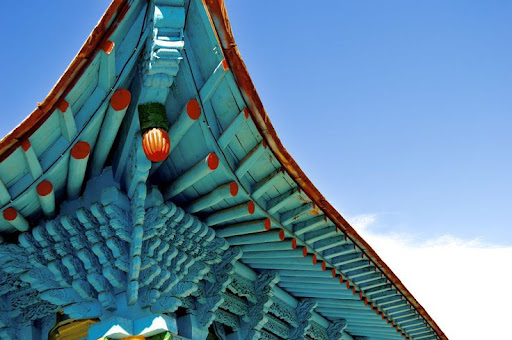
Karakol grew in the 19th century after explorers came to map the peaks and valleys separating Kyrgyzstan from China. In the 1880s Karakol's population surged with an influx of Dungans, Chinese Muslims fleeing warfare in China.The town itself boasts a number of places that would be of interest to tourists, such as a very pretty wooden mosque built by Chinese artisans for the local Dungans between 1907 and 1910. Completed in 1910, the mosque was built to serve Karakol's community of Dungans (Chinese Muslims who fled persecution in the 1880s). Designed by a Chinese architect, the building is constructed entirely without nails and much of its imagery, including a wheel of fire, reflects the Dungans' pre-Islamic, Buddhist past. Instead of a minaret the mosque has a wooden pagoda. Despite being closed by the government from 1933-43, the mosque continues to be used as a place of worship. These days worshippers are not exclusively Dungan and include a large Kyrgyz contingent. The 'Dungan Mosque' has therefore become simply 'The Mosque' in local parlance. Women are not always allowed to enter, but the friendly caretaker, who lives in the grounds, will open its doors and allow you to peer inside.
All colors represent different Dungan cultural concepts, red - protects from evil spirits, yellow - contributes to the accumulation of wealth and brings prosperity and green - symbolizes happiness.
The History of Dungan Mosque in Karakol begins in the end of 19th and early 20th century. Due to the rebellion in 1877 about 300,000 Dungan, passing through the dangerous Torugart Passover fled from Chinese punitive squads. Many Dungan died of cold, died of starvation, but many of them have reached the Karakol town, where they were warmly received by representatives of Russian and...
Read moreThe Dungan Mosque, also known as the "Dungan Mosque" or "Dungan Temple," is a unique architectural masterpiece located in Karakol, Kyrgyzstan. Built between 1907 and 1910 by Chinese Muslim immigrants (the Dungans), this mosque is renowned for its intricate design, which blends Chinese, Islamic, and Central Asian architectural styles. Unlike most mosques, it is constructed entirely without nails, using interlocking wooden beams, and painted in vivid colors, featuring dragon and phoenix motifs typically seen in Chinese temples.
The mosque is a spiritual center for the local Dungan Muslim community, symbolizing their cultural heritage and resilience. Despite its turbulent history, including periods of Soviet repression, the mosque has remained a place of worship and a testament to the region's multiculturalism. Today, it stands as a popular tourist destination, admired for its beauty, historical significance, and the harmonious blend of different cultural elements. Visitors are welcomed but must respect the mosque's customs, such as dressing modestly and removing shoes...
Read moreThe Dungan Mosque, located in Karakol, Kyrgyzstan, is a fascinating historical and cultural site. It is not only a place of worship but also a stunning example of unique architectural blending influenced by Chinese, Islamic, and Dungan traditions.
Built between 1907 and 1910 by the Dungan people, a Muslim Chinese ethnic minority who migrated to Kyrgyzstan to escape persecution, the mosque was constructed under the supervision of a Chinese architect named Chou Seu and built entirely without the use of nails, a remarkable feature of its design. The materials used include wood and stone, and the mosque is adorned with brightly painted floral patterns and natural imagery, reflecting Dungan culture. The structure serves as a place of Muslim worship, incorporating symbolic Islamic designs and motifs.
The mosque welcomes visitors who want to learn about its history and admire its beauty. However visitors are advised to respect local customs, dress modestly, and follow any guidelines provided when entering the mosque.
Alhamdulillah… for the opportunity to pray inside this...
Read more