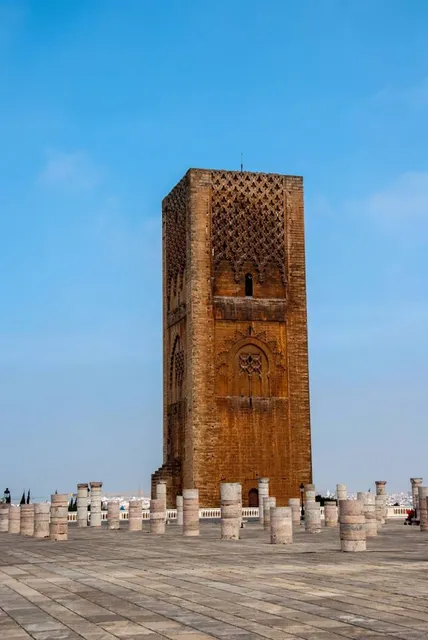
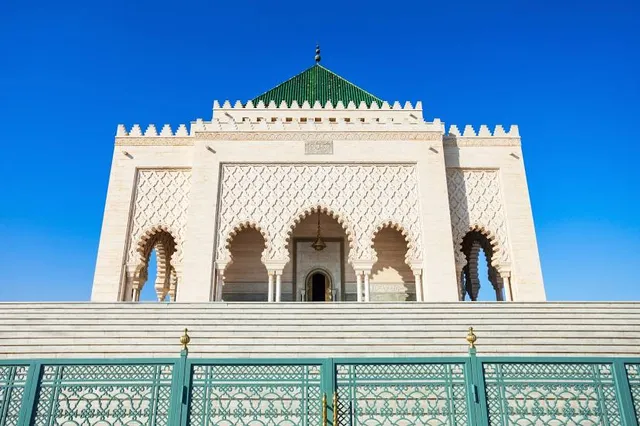
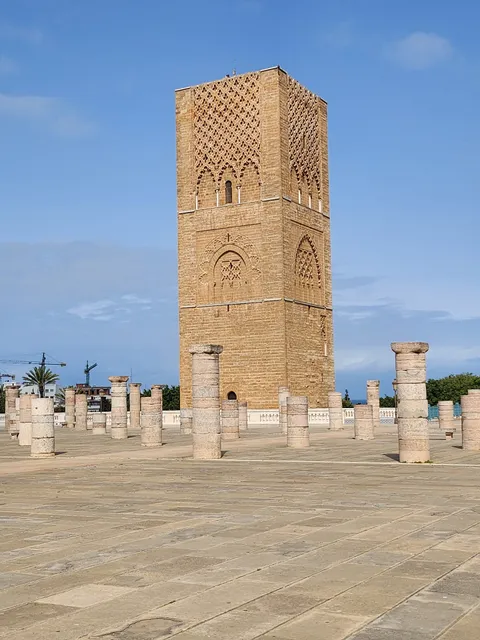
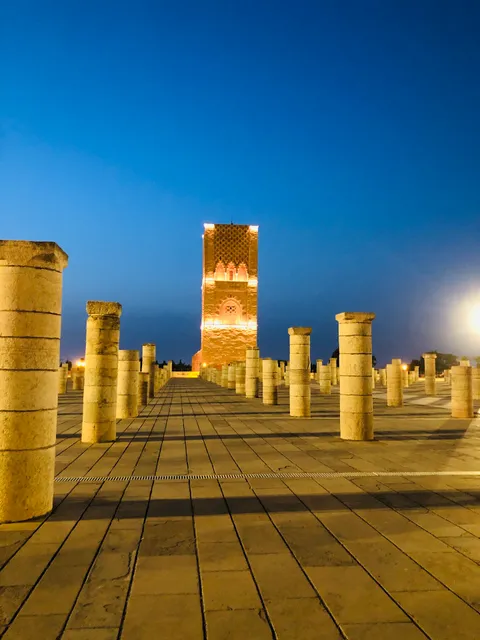
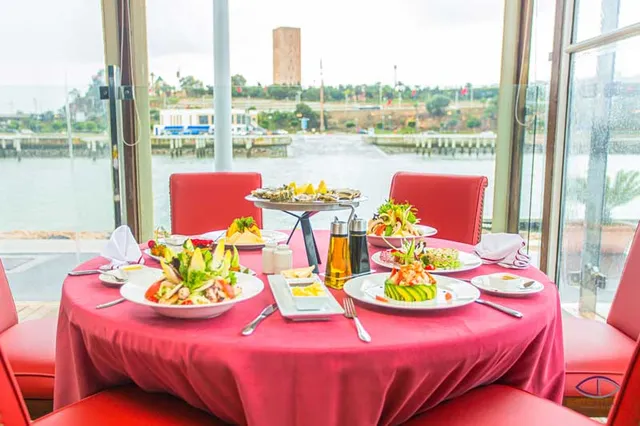
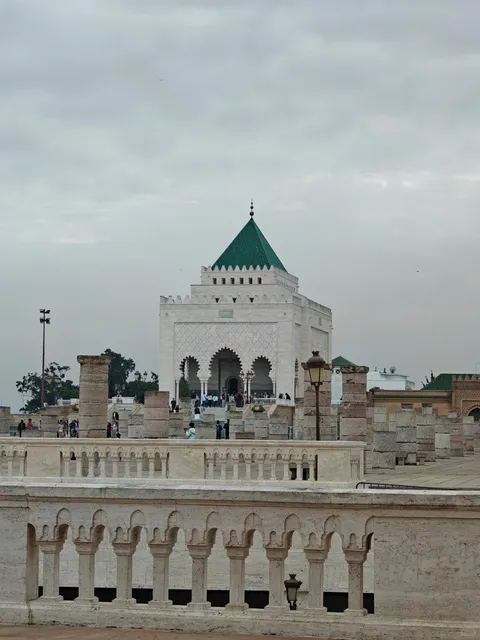
One of the greatest historical places in Morocco, for fun: there is a funny story about it, as you can see in pictures, the tour is not complete, it's half is gone, this was described in arabic books as ( nisfoha dahab ) which means its half has gone, but people confused ( Dahab ) which means ( gone ) with ( Dahab ) which means Gold in arabic language, so a lot of people thought that the half of tour was made of Gold and lot of people started inspecting the hidden gold. Here are some verified informations from Wikipedia : Hassan Tower or Tour Hassan (Arabic: صومعة حسان) is the minaret of an incomplete mosquein Rabat, Morocco.[1] Begun in 1195, the tower was intended to be the largest minaret in the world along with the mosque, also intended to be the world's largest. In 1199, Sultan Abu Yusuf Yaqub al-Mansur, the third Caliph of the Almohad Caliphate, died and construction on the mosque stopped. The tower reached 44 m (140 ft), about half of its intended 86 m (260 ft) height. The rest of the mosque was also left incomplete, with only the beginnings of several walls and 200 columns being constructed. The tower, made of red sandstone,[2] along with the remains of the mosque and the modern Mausoleum of Mohammed V, forms an important historical and tourist complex in Rabat.

Remnants of wall at Hassan Tower, Rabat, Morocco
Instead of stairs, the tower is ascended by ramps. The minaret's ramps would have allowed the muezzin to ride a horse to the top of the tower to issue the call to prayer.
Yaqub al-MansurEdit
Founder of the Hassan Tower, Yaqub al-Mansur was a member of the Almohad Caliphate, a Berber Muslim empire in the Maghreb and Iberia. The tower, according to some traditions, was designed by an astronomer and mathematician named Jabir ibn Aflah who was also supposed to have designed Hassan's sister tower, the Giralda of Seville in Al Andalus (modern day Spain). Both of the towers were modeled on the minaret based on the Koutoubia Mosque in Marrakech. Jabir's involvement in the design of the structure can not be confirmed though and many scholars assume that the from belfry on top of the Giralda, which was converted from a minaret to a bell tower for the Seville Cathedral after the Reconquista.
Yaqub al-Mansur conducted other works in Rabat, most notably reconstruction of the Kasbah of the Udayas and conversion of the Chellah ancient complex, built by the Phoenicians and Romans,[3] to...
Read moreThe Hassan Tower is one of the historical religious monuments, located in the Moroccan Rabat region, and the silo is a magnet for many Moroccan visitors and tourists, because it is an authentic Islamic architectural symbol, and it has a heritage and civilization value overlooking the Atlantic Ocean. It was built in the era of the Almohad state, by order From Ya`qub Al-Mansour in 593 AH in 1197 AD. Hassan's silo occupied the first place in terms of size during his reign, but the construction of this silo was not completed after his death, and it was exposed to many circumstances that led to its demise, such as the earthquake that struck Rabat in 1755 AD, but it was rebuilt in 1962 by order of King Muhammad. Fifth. The silo was built from materials that were used in the construction of Andalusia in Morocco, and materials capable of withstanding and resisting the humidity coming from the Atlantic Ocean were chosen, such as carved stone, sandstone, and plaster, which mainly consists of lime, then marble and wood, and was supplied with water from Ain Agboula, through channels built by Youssef Al-Mansour. The dimensions of the Hassan silo are square in shape, its length is about forty-four meters, and it includes many stairs that reach up, and its yard includes many circular-shaped marble columns beautifully carved in addition to many fountains decorated with Islamic shapes and drawings that reflect a clear and vivid picture of High Islamic art, as it has two main doors, and in front of each door there are two Moroccan knights wearing traditional Moroccan clothes, riding two horses. The silo has a garden that includes many roses, flowers and trees, and fountains that are traditionally designed, and many traditional old lamps, so the visitor of the silo at night sees the magic of heritage, especially with the lighting directed at the silo, and it overlooks the mouth of the Bouregreg River, and a large mosque stands in front of it Prayer is held in it, and this mosque is one of the largest historical mosques in the Islamic world. This mosque was built in the traditional way, but each of its doors and walls were decorated with marble, carved stone and copper, which gave it an Islamic...
Read more"Soumaya Hassan II Mosque" is an ancient monument located in the city of Rabat, Morocco. It was built between 1195 and 1199 by the Muslim architect Yakoub al-Mansour, who worked for the Andalusian Sultan Youssef Ibn Tachfine.
The Hassan II Mosque is one of the most famous cultural and historical symbols in Morocco and is considered one of the most important tourist attractions in Rabat. It is characterized by its magnificent Islamic Andalusian design, with a large part of it consisting of beautiful and diverse Islamic decoration that reflects the rich culture and history of Morocco.
The mosque is distinguished by its height, which reaches up to 44 meters, and b It was built by Sultan Yaqoub Al-Mansour Al-Muwahhid, and it was considered one of the largest mosques in his era. However, this ambitious project was halted after his death in 1199, and it was also exposed to extinction due to the earthquake that struck Rabat in 1755 AD. Its ruins testify to the extent of the original building of the mosque, with a length of 180 meters and a width of 140 meters. The hermitage, which is one of the three sisters of the and Marrakesh in its importance. Abu Yaqoub and Abu Yusuf in the establishment of a of its construction, as it was of the Marinids, then the Saadians, and even the days of the Alawites during the reign of Sultan Abdullah bin Ismail, when pirates from Salé and Rabat made a ship out of the wood of the aforementioned mosque and called it the Karakjieh ship, affected this...
Read more