HTML SitemapExplore
logo
Find Things to DoFind The Best Restaurants

Peterhof Palace — Attraction in Peterhof

Name
Peterhof Palace
Description
Nearby attractions
Нижний парк
Razvodnaya Ulitsa, 2, St Petersburg, Russia, 198516
Samson Fountain
Razvodnaya Ulitsa, 2, St Petersburg, Russia, 198516
Grand Cascade
Pravlenskaya Ulitsa, St Petersburg, Russia, 198510
Petrodvorets
Razvodnaya Ulitsa, д. 2, St Petersburg, Russia, 198516
Voronihinskaya colonnade
Razvodnaya Ulitsa, 2, St Petersburg, Russia, 198510
Fontan Yeva
St Petersburg, Russia, 198516
Gmz Petergof
Razvodnaya Ulitsa, 2, St Petersburg, Russia, 198516
Verkhniy Sad
Razvodnaya Ulitsa, 2, St Petersburg, Russia, 198516
Kitovyy Fontan
St Petersburg, Russia, 198516
Scientific Archives of the State Museum-Reserve "Peterhof" |
Razvodnaya Ulitsa, 2, St Petersburg, Russia, 198516
Nearby restaurants
Shtandart
Нижний парк, 3, St Petersburg, Russia, 198516
Kladovaya
Kalininskaya Ulitsa, 7, St Petersburg, Russia, 198510
Family (Family)
Razvodnaya Ulitsa, 7/1, St Petersburg, Russia, 198516
BONA
Razvodnaya Ulitsa, 7 корпус 1, Петергоф, Saint Petersburg, Russia, 198516
Alex House
Sankt-Peterburgskiy Prospekt, 44, St Petersburg, Russia, 198510
Gastropub Duck&Drake
Sankt-Peterburgskiy Prospekt, 34, Петергоф, Saint Petersburg, Russia, 198510
Romance Cafe
Sankt-Peterburgskiy Prospekt, 27, St Petersburg, Russia, 198510
Shashlychnyy Dvorik
Torgovaya Ploshchad', 8В, Петергоф, Saint Petersburg, Russia, 198510
Restoran
St Petersburg, Russia, 198510
Nearby hotels
Samson Hotel
Sankt-Peterburgskiy Prospekt, 44А, St Petersburg, Russia, 198510
New Peterhof Hotel
Sankt-Peterburgskiy Prospekt, 34, Петергоф, Saint Petersburg, Russia, 198510
Quattro Hotel
Region, Zolotaya Ulitsa, 4, St Petersburg, Russia, 198516
Дом Трувеллера F&F
Sankt-Peterburgskiy Prospekt, 42, St Petersburg, Russia, 198510
Related posts
Keywords
Peterhof Palace tourism.Peterhof Palace hotels.Peterhof Palace bed and breakfast. flights to Peterhof Palace.Peterhof Palace attractions.Peterhof Palace restaurants.Peterhof Palace travel.Peterhof Palace travel guide.Peterhof Palace travel blog.Peterhof Palace pictures.Peterhof Palace photos.Peterhof Palace travel tips.Peterhof Palace maps.Peterhof Palace things to do.
Peterhof Palace things to do, attractions, restaurants, events info and trip planning
Peterhof Palace
RussiaSaint PetersburgPeterhofPeterhof Palace

Basic Info

Peterhof Palace

Razvodnaya Ulitsa, 2, St Petersburg, Russia
4.8(26.6K)
Open 24 hours
Save
spot

Ratings & Description

Info

Cultural
Outdoor
Scenic
Family friendly
Accessibility
Luxury
attractions: Нижний парк, Samson Fountain, Grand Cascade, Petrodvorets, Voronihinskaya colonnade, Fontan Yeva, Gmz Petergof, Verkhniy Sad, Kitovyy Fontan, Scientific Archives of the State Museum-Reserve "Peterhof" |, restaurants: Shtandart, Kladovaya, Family (Family), BONA, Alex House, Gastropub Duck&Drake, Romance Cafe, Shashlychnyy Dvorik, Restoran
logoLearn more insights from Wanderboat AI.
Phone
+7 812 602-23-46
Website
peterhofmuseum.ru

Plan your stay

hotel
Pet-friendly Hotels in Peterhof
Find a cozy hotel nearby and make it a full experience.
hotel
Affordable Hotels in Peterhof
Find a cozy hotel nearby and make it a full experience.
hotel
The Coolest Hotels You Haven't Heard Of (Yet)
Find a cozy hotel nearby and make it a full experience.
hotel
Trending Stays Worth the Hype in Peterhof
Find a cozy hotel nearby and make it a full experience.

Reviews

Nearby attractions of Peterhof Palace

Нижний парк

Samson Fountain

Grand Cascade

Petrodvorets

Voronihinskaya colonnade

Fontan Yeva

Gmz Petergof

Verkhniy Sad

Kitovyy Fontan

Scientific Archives of the State Museum-Reserve "Peterhof" |

Нижний парк

Нижний парк

4.9

(10.7K)

Open 24 hours
Click for details
Samson Fountain

Samson Fountain

4.9

(765)

Closed
Click for details
Grand Cascade

Grand Cascade

4.9

(699)

Closed
Click for details
Petrodvorets

Petrodvorets

4.8

(355)

Open 24 hours
Click for details

Nearby restaurants of Peterhof Palace

Shtandart

Kladovaya

Family (Family)

BONA

Alex House

Gastropub Duck&Drake

Romance Cafe

Shashlychnyy Dvorik

Restoran

Shtandart

Shtandart

3.4

(153)

Click for details
Kladovaya

Kladovaya

4.6

(260)

Click for details
Family (Family)

Family (Family)

4.2

(490)

$$

Click for details
BONA

BONA

4.1

(56)

Click for details
Get the Appoverlay
Get the AppOne tap to find yournext favorite spots!
Wanderboat LogoWanderboat

Your everyday Al companion for getaway ideas

CompanyAbout Us
InformationAI Trip PlannerSitemap
SocialXInstagramTiktokLinkedin
LegalTerms of ServicePrivacy Policy

Get the app

© 2025 Wanderboat. All rights reserved.
logo

Reviews of Peterhof Palace

4.8
(26,636)
avatar
5.0
4y

The Peterhof Palace (Russian: Петерго́ф, IPA: pʲɪtʲɪrˈɡof],[1,[2] is a series of palaces and gardens located in Petergof, Saint Petersburg, Russia, commissioned by Peter the Great as a direct response to the Palace of Versailles by Louis XIV of France.[3] Originally intending it in 1709 for country habitation, Peter the Great sought to expand the property as a result of his visit to the French royal court in 1717,[3] inspiring the nickname of "The Russian Versailles".[4] The architect between 1714 and 1728 was Domenico Trezzini, and the style he employed became the foundation for the Petrine Baroque style favored throughout Saint Petersburg.[5] Also in 1714, Jean-Baptiste Alexandre Le Blond, likely chosen due to his previous collaborations[6] with Versailles landscaper André Le Nôtre, designed the gardens. Francesco Bartolomeo Rastrelli completed an expansion from 1747 to 1756 for Elizabeth of Russia. The palace-ensemble along with the city center is recognized as a UNESCO World Heritage Site.

In the early 1700s, the original Peterhof appeared quite different from today. Many of the fountains had not yet been installed and the entire Alexandrine Park and Upper Gardens did not exist. What is now the Upper Gardens was used to grow vegetables, and its ponds, then numbering only three, for fish. The Samson Fountain and its massive pedestal had not yet been installed in the Sea Channel, and the channel itself was used as a grand marine entrance into the complex.

Olgin Pond (1840s), by Yegor Meyer Perhaps the most important change augmenting Peter's design was the elevation of the Grand Palace to central status and prominence. The Grand Palace was originally called simply 'Upper', and was hardly larger than any of the other structures of the complex. The addition of wings, undertaken between 1745 and 1755, was one of the many projects commissioned from the Italian architect Bartolomeo Rastrelli by Elizabeth of Russia.[18] Likewise, the Grand Cascade was more sparsely decorated when initially built. The augmentation of Peterhof's original fountains and the addition of new ones continued well into the 19th century.

1941–Modern Day Edit Peterhof, like Tsarskoye Selo, was captured by German troops in 1941 and held until 1944. In the few months that elapsed between the German invasion of the Soviet Union and the appearance of the German Army, employees were only able to save a portion of the treasures of the palaces and fountains. An attempt was made to dismantle and bury the fountain sculptures, but three quarters, including all of the largest ones, remained in place.

Monument of the naval landing in Lower Gardens of Peterhof near the pier. On 23 September 1941 German troops captured Peterhof. Two weeks later, on 5 October 1941, Soviet troops tried to recapture the town and block the highway by naval landing. 510 marines of the Soviet Baltic Fleet landed on the beach of the neighboring park of Alexandria but faced a heavy fire from the Germans. The commander of the operation was killed, all landing troops became disorganised, one landing craft was sunk and another one missed. Despite Soviet attempts to cover the landing forces by coastal artillery from Kronstadt, they were quickly suspended because of lack of connection with the landing troops. Evacuation attempts also failed due to heavy German artillery shelling (only one marine was picked up from the water). The Peterhof landing operation failed and all landing troops were cut off from the shore and surrounded. Some of them reached the Lower Gardens and fought until the bitter end, including hand-to-hand combat. The last pockets of resistance were destroyed on 7 October. Several dozen German Shepherd dogs were released into the gardens to find the hiding marines. Many of the wounded marines were bitten to death and several were captured.[19] In 1980 a memorial was erected near the pier of the Lower Gardens.

The occupying forces of the German Army largely destroyed[20] Peterhof. Many...

   Read more
avatar
5.0
7y

Splendid! This place should be in your top 5 must see attractions of Russia. Prepare to walk long distances if you are not used to because one day may not be enough to cover this place.

I took the metro and mini bus combo to get here which in itself was an interesting experience as a tourist. Get off at the picturesque Avtovo station on Red line and take some good pics of one of the most picturesque platforms in St. Petersburg. Cross the road using the underpass after the exit and you will see mini vans and big buses that will take you to Peterhof (just ask Fontanov? or memorize the Cyrillic of Peterhof). I took the bus no. K300. The mini bus was packed but most passengers got off at Peterhof and I did not have to shout the stop to the driver. It took me 30 minutes or so from the Metro station. The bus drops you right in front of the upper garden and you can enjoy this part for free. The palace is straight up ahead with ticket offices on both sides of the palace.(I grabbed a bite with some Coffee at the eating place besides the ticket counter but was not happy at all with the level of service. The guy who took my order spoke to me in very fast Russian and kept on adding stuff I did not need to my order perhaps taking advantage of my limitations as a tourist.)

After buying the ticket (the price keeps increasing every year), you will enter the lower gardens which has the most impressive fountains with hordes of tourists as well. The trick to get good photos here is to wait until the evening when tourists thin out. The place is quite big and you need a good 4-5 hours or maybe more to cover all the spots. I started at 12 PM and took the 1730 Hydrofoil in the evening. I would recommend getting here earlier to see the palace interiors as well. However, please note that the entrance charges are quite high (1000 Rubles for the main palace museum in addition to the entrance ticket of 900 Rubles).

I think that entering from the upper gardens and exit from the lower gardens using the Hydrofoil is perhaps the best option because you can enjoy the upper gardens as well (If you leave the lower garden once, you need to buy another ticket to re-enter).

For people with less time, the Hydrofoil option is the best and the least complex option. You can also buy souvenirs inside...

   Read more
avatar
5.0
6y

The Grand Cascade is modelled on one constructed for Louis XIV at his Château de Marly,[15] which is likewise memorialised in one of the park's outbuildings.

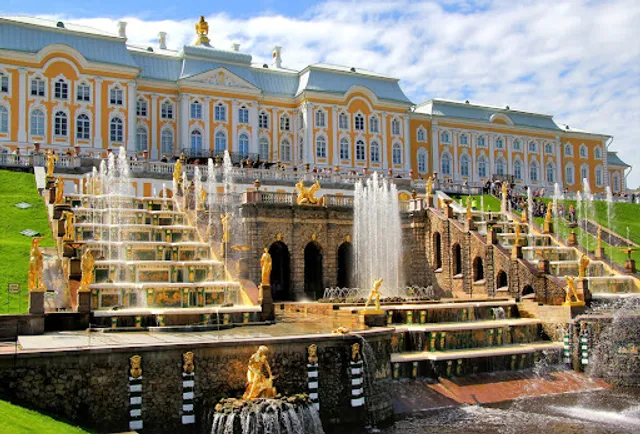
At the centre of the cascade is an artificial grotto with two stories, faced inside and out with hewn brown stone. It currently contains a modest museum of the fountains' history. One of the exhibits is a table carrying a bowl of (artificial) fruit, a replica of a similar table built under Peter's direction. The table is rigged with jets of water that soak visitors when they reach for the fruit, a feature from Mannerist gardens that remained popular in Germany. The grotto is connected to the palace above and behind by a hidden corridor.

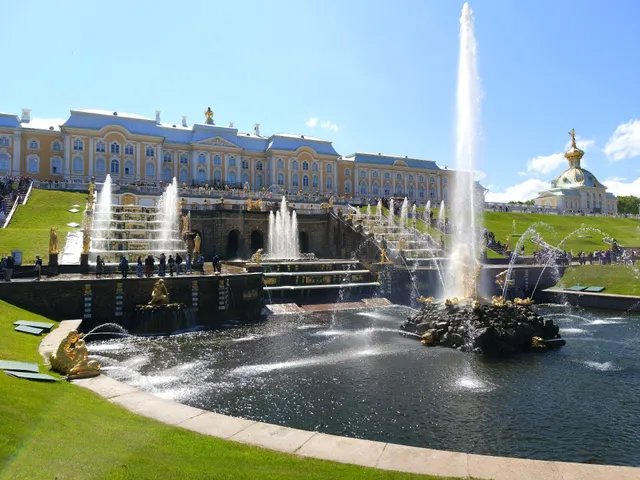
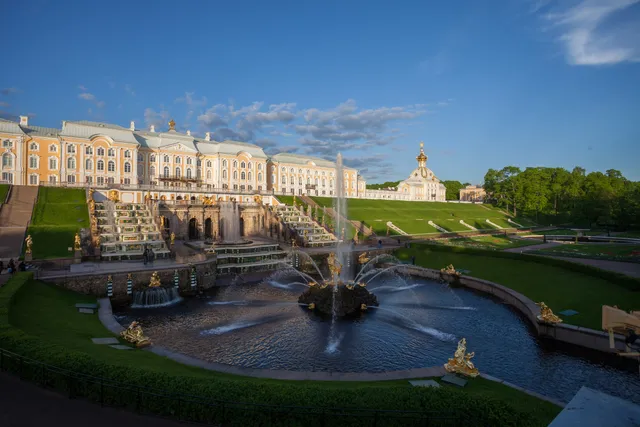
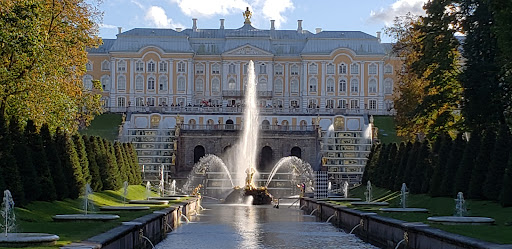
The fountains of the Grand Cascade are located below the grotto and on either side of it. There are 64 fountains.[16] Their waters flow into a semicircular pool, the terminus of the fountain-lined Sea Channel. In the 1730s, the large Samson Fountain was placed in this pool. It depicts the moment when Samson tears open the jaws of a lion, representing Russia's victory over Sweden in the Great Northern War, and is doubly symbolic.[17] The lion is an element of the Swedish coat of arms, and one of the great victories of the war was won on St Sampson's Day. From the lion's mouth shoots a 20-metre-high vertical jet of water, the highest in all of Peterhof. This masterpiece by Mikhail Kozlovsky was looted by the invading Germans during the Second World War; see History below. A replica of the statue was installed in 1947.

Perhaps the greatest technological achievement of Peterhof is that all of the fountains operate without the use of pumps. Water is supplied from natural springs and collects in reservoirs in the Upper Gardens. The elevation difference creates the pressure that drives most of the fountains of the Lower Gardens, including the Grand Cascade. The Samson Fountain is supplied by a special aqueduct, over 4 km in length, drawing water and pressure from a...

   Read more
Page 1 of 7
Previous
Next

Posts

Dr RAGHVENDRA SINGHDr RAGHVENDRA SINGH
The Peterhof Palace (Russian: Петерго́ф, IPA: [pʲɪtʲɪrˈɡof],[1] (an emulation of early modern Dutch "Piterhof", meaning "Peter's Court"),[2] is a series of palaces and gardens located in Petergof, Saint Petersburg, Russia, commissioned by Peter the Great as a direct response to the Palace of Versailles by Louis XIV of France.[3] Originally intending it in 1709 for country habitation, Peter the Great sought to expand the property as a result of his visit to the French royal court in 1717,[3] inspiring the nickname of "The Russian Versailles".[4] The architect between 1714 and 1728 was Domenico Trezzini, and the style he employed became the foundation for the Petrine Baroque style favored throughout Saint Petersburg.[5] Also in 1714, Jean-Baptiste Alexandre Le Blond, likely chosen due to his previous collaborations[6] with Versailles landscaper André Le Nôtre, designed the gardens. Francesco Bartolomeo Rastrelli completed an expansion from 1747 to 1756 for Elizabeth of Russia. The palace-ensemble along with the city center is recognized as a UNESCO World Heritage Site. In the early 1700s, the original Peterhof appeared quite different from today. Many of the fountains had not yet been installed and the entire Alexandrine Park and Upper Gardens did not exist. What is now the Upper Gardens was used to grow vegetables, and its ponds, then numbering only three, for fish. The Samson Fountain and its massive pedestal had not yet been installed in the Sea Channel, and the channel itself was used as a grand marine entrance into the complex. Olgin Pond (1840s), by Yegor Meyer Perhaps the most important change augmenting Peter's design was the elevation of the Grand Palace to central status and prominence. The Grand Palace was originally called simply 'Upper', and was hardly larger than any of the other structures of the complex. The addition of wings, undertaken between 1745 and 1755, was one of the many projects commissioned from the Italian architect Bartolomeo Rastrelli by Elizabeth of Russia.[18] Likewise, the Grand Cascade was more sparsely decorated when initially built. The augmentation of Peterhof's original fountains and the addition of new ones continued well into the 19th century. 1941–Modern Day Edit Peterhof, like Tsarskoye Selo, was captured by German troops in 1941 and held until 1944. In the few months that elapsed between the German invasion of the Soviet Union and the appearance of the German Army, employees were only able to save a portion of the treasures of the palaces and fountains. An attempt was made to dismantle and bury the fountain sculptures, but three quarters, including all of the largest ones, remained in place. Monument of the naval landing in Lower Gardens of Peterhof near the pier. On 23 September 1941 German troops captured Peterhof. Two weeks later, on 5 October 1941, Soviet troops tried to recapture the town and block the highway by naval landing. 510 marines of the Soviet Baltic Fleet landed on the beach of the neighboring park of Alexandria but faced a heavy fire from the Germans. The commander of the operation was killed, all landing troops became disorganised, one landing craft was sunk and another one missed. Despite Soviet attempts to cover the landing forces by coastal artillery from Kronstadt, they were quickly suspended because of lack of connection with the landing troops. Evacuation attempts also failed due to heavy German artillery shelling (only one marine was picked up from the water). The Peterhof landing operation failed and all landing troops were cut off from the shore and surrounded. Some of them reached the Lower Gardens and fought until the bitter end, including hand-to-hand combat. The last pockets of resistance were destroyed on 7 October. Several dozen German Shepherd dogs were released into the gardens to find the hiding marines. Many of the wounded marines were bitten to death and several were captured.[19] In 1980 a memorial was erected near the pier of the Lower Gardens. The occupying forces of the German Army largely destroyed[20] Peterhof. Many of the founta
Vinayak BhardwajVinayak Bhardwaj
Splendid! This place should be in your top 5 must see attractions of Russia. Prepare to walk long distances if you are not used to because one day may not be enough to cover this place. I took the metro and mini bus combo to get here which in itself was an interesting experience as a tourist. Get off at the picturesque Avtovo station on Red line and take some good pics of one of the most picturesque platforms in St. Petersburg. Cross the road using the underpass after the exit and you will see mini vans and big buses that will take you to Peterhof (just ask Fontanov? or memorize the Cyrillic of Peterhof). I took the bus no. K300. The mini bus was packed but most passengers got off at Peterhof and I did not have to shout the stop to the driver. It took me 30 minutes or so from the Metro station. The bus drops you right in front of the upper garden and you can enjoy this part for free. The palace is straight up ahead with ticket offices on both sides of the palace.(I grabbed a bite with some Coffee at the eating place besides the ticket counter but was not happy at all with the level of service. The guy who took my order spoke to me in very fast Russian and kept on adding stuff I did not need to my order perhaps taking advantage of my limitations as a tourist.) After buying the ticket (the price keeps increasing every year), you will enter the lower gardens which has the most impressive fountains with hordes of tourists as well. The trick to get good photos here is to wait until the evening when tourists thin out. The place is quite big and you need a good 4-5 hours or maybe more to cover all the spots. I started at 12 PM and took the 1730 Hydrofoil in the evening. I would recommend getting here earlier to see the palace interiors as well. However, please note that the entrance charges are quite high (1000 Rubles for the main palace museum in addition to the entrance ticket of 900 Rubles). I think that entering from the upper gardens and exit from the lower gardens using the Hydrofoil is perhaps the best option because you can enjoy the upper gardens as well (If you leave the lower garden once, you need to buy another ticket to re-enter). For people with less time, the Hydrofoil option is the best and the least complex option. You can also buy souvenirs inside the Hydrofoil.
Ambar FedorovaAmbar Fedorova
The Grand Cascade is modelled on one constructed for Louis XIV at his Château de Marly,[15] which is likewise memorialised in one of the park's outbuildings. At the centre of the cascade is an artificial grotto with two stories, faced inside and out with hewn brown stone. It currently contains a modest museum of the fountains' history. One of the exhibits is a table carrying a bowl of (artificial) fruit, a replica of a similar table built under Peter's direction. The table is rigged with jets of water that soak visitors when they reach for the fruit, a feature from Mannerist gardens that remained popular in Germany. The grotto is connected to the palace above and behind by a hidden corridor. The fountains of the Grand Cascade are located below the grotto and on either side of it. There are 64 fountains.[16] Their waters flow into a semicircular pool, the terminus of the fountain-lined Sea Channel. In the 1730s, the large Samson Fountain was placed in this pool. It depicts the moment when Samson tears open the jaws of a lion, representing Russia's victory over Sweden in the Great Northern War, and is doubly symbolic.[17] The lion is an element of the Swedish coat of arms, and one of the great victories of the war was won on St Sampson's Day. From the lion's mouth shoots a 20-metre-high vertical jet of water, the highest in all of Peterhof. This masterpiece by Mikhail Kozlovsky was looted by the invading Germans during the Second World War; see History below. A replica of the statue was installed in 1947. Perhaps the greatest technological achievement of Peterhof is that all of the fountains operate without the use of pumps. Water is supplied from natural springs and collects in reservoirs in the Upper Gardens. The elevation difference creates the pressure that drives most of the fountains of the Lower Gardens, including the Grand Cascade. The Samson Fountain is supplied by a special aqueduct, over 4 km in length, drawing water and pressure from a high-elevation source.
See more posts
See more posts
hotel
Find your stay

Pet-friendly Hotels in Peterhof

Find a cozy hotel nearby and make it a full experience.

The Peterhof Palace (Russian: Петерго́ф, IPA: [pʲɪtʲɪrˈɡof],[1] (an emulation of early modern Dutch "Piterhof", meaning "Peter's Court"),[2] is a series of palaces and gardens located in Petergof, Saint Petersburg, Russia, commissioned by Peter the Great as a direct response to the Palace of Versailles by Louis XIV of France.[3] Originally intending it in 1709 for country habitation, Peter the Great sought to expand the property as a result of his visit to the French royal court in 1717,[3] inspiring the nickname of "The Russian Versailles".[4] The architect between 1714 and 1728 was Domenico Trezzini, and the style he employed became the foundation for the Petrine Baroque style favored throughout Saint Petersburg.[5] Also in 1714, Jean-Baptiste Alexandre Le Blond, likely chosen due to his previous collaborations[6] with Versailles landscaper André Le Nôtre, designed the gardens. Francesco Bartolomeo Rastrelli completed an expansion from 1747 to 1756 for Elizabeth of Russia. The palace-ensemble along with the city center is recognized as a UNESCO World Heritage Site. In the early 1700s, the original Peterhof appeared quite different from today. Many of the fountains had not yet been installed and the entire Alexandrine Park and Upper Gardens did not exist. What is now the Upper Gardens was used to grow vegetables, and its ponds, then numbering only three, for fish. The Samson Fountain and its massive pedestal had not yet been installed in the Sea Channel, and the channel itself was used as a grand marine entrance into the complex. Olgin Pond (1840s), by Yegor Meyer Perhaps the most important change augmenting Peter's design was the elevation of the Grand Palace to central status and prominence. The Grand Palace was originally called simply 'Upper', and was hardly larger than any of the other structures of the complex. The addition of wings, undertaken between 1745 and 1755, was one of the many projects commissioned from the Italian architect Bartolomeo Rastrelli by Elizabeth of Russia.[18] Likewise, the Grand Cascade was more sparsely decorated when initially built. The augmentation of Peterhof's original fountains and the addition of new ones continued well into the 19th century. 1941–Modern Day Edit Peterhof, like Tsarskoye Selo, was captured by German troops in 1941 and held until 1944. In the few months that elapsed between the German invasion of the Soviet Union and the appearance of the German Army, employees were only able to save a portion of the treasures of the palaces and fountains. An attempt was made to dismantle and bury the fountain sculptures, but three quarters, including all of the largest ones, remained in place. Monument of the naval landing in Lower Gardens of Peterhof near the pier. On 23 September 1941 German troops captured Peterhof. Two weeks later, on 5 October 1941, Soviet troops tried to recapture the town and block the highway by naval landing. 510 marines of the Soviet Baltic Fleet landed on the beach of the neighboring park of Alexandria but faced a heavy fire from the Germans. The commander of the operation was killed, all landing troops became disorganised, one landing craft was sunk and another one missed. Despite Soviet attempts to cover the landing forces by coastal artillery from Kronstadt, they were quickly suspended because of lack of connection with the landing troops. Evacuation attempts also failed due to heavy German artillery shelling (only one marine was picked up from the water). The Peterhof landing operation failed and all landing troops were cut off from the shore and surrounded. Some of them reached the Lower Gardens and fought until the bitter end, including hand-to-hand combat. The last pockets of resistance were destroyed on 7 October. Several dozen German Shepherd dogs were released into the gardens to find the hiding marines. Many of the wounded marines were bitten to death and several were captured.[19] In 1980 a memorial was erected near the pier of the Lower Gardens. The occupying forces of the German Army largely destroyed[20] Peterhof. Many of the founta
Dr RAGHVENDRA SINGH

Dr RAGHVENDRA SINGH

hotel
Find your stay

Affordable Hotels in Peterhof

Find a cozy hotel nearby and make it a full experience.

Get the Appoverlay
Get the AppOne tap to find yournext favorite spots!
Splendid! This place should be in your top 5 must see attractions of Russia. Prepare to walk long distances if you are not used to because one day may not be enough to cover this place. I took the metro and mini bus combo to get here which in itself was an interesting experience as a tourist. Get off at the picturesque Avtovo station on Red line and take some good pics of one of the most picturesque platforms in St. Petersburg. Cross the road using the underpass after the exit and you will see mini vans and big buses that will take you to Peterhof (just ask Fontanov? or memorize the Cyrillic of Peterhof). I took the bus no. K300. The mini bus was packed but most passengers got off at Peterhof and I did not have to shout the stop to the driver. It took me 30 minutes or so from the Metro station. The bus drops you right in front of the upper garden and you can enjoy this part for free. The palace is straight up ahead with ticket offices on both sides of the palace.(I grabbed a bite with some Coffee at the eating place besides the ticket counter but was not happy at all with the level of service. The guy who took my order spoke to me in very fast Russian and kept on adding stuff I did not need to my order perhaps taking advantage of my limitations as a tourist.) After buying the ticket (the price keeps increasing every year), you will enter the lower gardens which has the most impressive fountains with hordes of tourists as well. The trick to get good photos here is to wait until the evening when tourists thin out. The place is quite big and you need a good 4-5 hours or maybe more to cover all the spots. I started at 12 PM and took the 1730 Hydrofoil in the evening. I would recommend getting here earlier to see the palace interiors as well. However, please note that the entrance charges are quite high (1000 Rubles for the main palace museum in addition to the entrance ticket of 900 Rubles). I think that entering from the upper gardens and exit from the lower gardens using the Hydrofoil is perhaps the best option because you can enjoy the upper gardens as well (If you leave the lower garden once, you need to buy another ticket to re-enter). For people with less time, the Hydrofoil option is the best and the least complex option. You can also buy souvenirs inside the Hydrofoil.
Vinayak Bhardwaj

Vinayak Bhardwaj

hotel
Find your stay

The Coolest Hotels You Haven't Heard Of (Yet)

Find a cozy hotel nearby and make it a full experience.

hotel
Find your stay

Trending Stays Worth the Hype in Peterhof

Find a cozy hotel nearby and make it a full experience.

The Grand Cascade is modelled on one constructed for Louis XIV at his Château de Marly,[15] which is likewise memorialised in one of the park's outbuildings. At the centre of the cascade is an artificial grotto with two stories, faced inside and out with hewn brown stone. It currently contains a modest museum of the fountains' history. One of the exhibits is a table carrying a bowl of (artificial) fruit, a replica of a similar table built under Peter's direction. The table is rigged with jets of water that soak visitors when they reach for the fruit, a feature from Mannerist gardens that remained popular in Germany. The grotto is connected to the palace above and behind by a hidden corridor. The fountains of the Grand Cascade are located below the grotto and on either side of it. There are 64 fountains.[16] Their waters flow into a semicircular pool, the terminus of the fountain-lined Sea Channel. In the 1730s, the large Samson Fountain was placed in this pool. It depicts the moment when Samson tears open the jaws of a lion, representing Russia's victory over Sweden in the Great Northern War, and is doubly symbolic.[17] The lion is an element of the Swedish coat of arms, and one of the great victories of the war was won on St Sampson's Day. From the lion's mouth shoots a 20-metre-high vertical jet of water, the highest in all of Peterhof. This masterpiece by Mikhail Kozlovsky was looted by the invading Germans during the Second World War; see History below. A replica of the statue was installed in 1947. Perhaps the greatest technological achievement of Peterhof is that all of the fountains operate without the use of pumps. Water is supplied from natural springs and collects in reservoirs in the Upper Gardens. The elevation difference creates the pressure that drives most of the fountains of the Lower Gardens, including the Grand Cascade. The Samson Fountain is supplied by a special aqueduct, over 4 km in length, drawing water and pressure from a high-elevation source.
Ambar Fedorova

Ambar Fedorova

See more posts
See more posts