It’s astonishing to witness the blatant disregard for implementing an efficient route to & from south county. These areas remain starkly neglected, despite persistent appeals for more expedient transportation options. The proposed system, which serves a few bus stops — 1 in Gilroy, 1 in Morgan Hill, & potentially another in South San Jose—would connect a lot quicker to Diridon Station, but the current system, with several bus stops along Monterey Rd without ever going in the freeway, fails to quickly connect to Diridon Station for Caltrain. This oversight particularly affects those living just south of the Caltrain service cutoff during off-peak hours. Moreover, the notion of a separate route connecting to the North San Jose/Berryessa BART Station remains a distant dream.
The insistence that the Rapid 568 is sufficient simply because it bears the label “rapid” is both misleading & disheartening. Residents of Morgan Hill & Gilroy have expressed that these services are far too slow, which takes over 2 times or even 3 or 4 times as long as a car ride. The reality is stark: driving from Morgan Hill to Diridon Station takes around 25 minutes, while the so-called “Rapid 568” drags on for over 50 minutes. One could just as easily rename it the “Less Slow 568.” The route’s failure to utilize the freeway for faster transit is baffling.
Is it too much to ask for a direct bus route that connects Gilroy to Diridon Station with minimal stops near the freeway? The alternatives are hardly feasible. For those considering rideshare options like Lyft or Uber, the financial burden is staggering—always over $30 or even often over $40 for a one-way trip, not to mention the expectation of tipping the driver. This scenario is not sustainable for daily commutes, especially for those in Morgan Hill or Gilroy who lack access to a car.
A former VTA employee I spoke with expressed dismay at the apparent apathy within route management. He remarked that many of the staff seem to go to work just for a paycheck, a troubling indictment of a system that should prioritize the needs of its community. Imagine the transformation that could occur if these decision-makers were to relocate to Morgan Hill or Gilroy & rely on public transportation for their daily commutes. Their perspective would undoubtedly shift, catalyzing much-needed improvements in service.
Unfortunately, the prevailing reality is that public transportation is not serving the people effectively. While there may be lofty goals to encourage a shift away from personal vehicles, such aspirations falter when faced with the prospect of sacrificing over 1 hour of commuting time for a 1 way trip, which means well over 2 hours in total daily commute when going to work only to much of San Jose & especially Santa Clara, especially if it means sacrificing almost half of normal sleep time just to take public transportation. This isn’t merely conjecture; it’s a palpable truth that drives individuals back to their cars, seeking convenience over inconvenience.
The cycle is self-perpetuating. As more individuals opt for personal vehicles due to the inefficiencies of public transport, the ridership declines, leading to dwindling revenue for the very services that should be thriving. When I finally buy my own car, I won’t miss public transportation in the slightest. I will relish the freedom it provides, & I can only predict that my experience will mirror that of countless others who find themselves in the same position.
Ultimately, the message is clear: you reap what you sow. If public transportation continues on this path of neglect & inefficiency, it risks becoming obsolete. Change won’t come from mere wishful thinking; it must be driven by the voices of those who demand better. Only through active engagement & persistent requests & having the city or county to put more serious people who won’t be spending tax money unwisely but rather wisely to put more efficient route to work can we hope to create a transportation system that truly serves...
Read moreVTA is poorly managed & run organization. What disappoints me after paying them through various taxes & ride fare are below
Dirty, smelly & unsafe stops(just visit any VTA light rain station after Milpitas towards Alum rock) I am really tired of drug addicts, homeless & mentally sick on public spaces. They are destroying what is built others tax money
Free riders - their ticket inspectors don't do random checks. Even when they do, the first offender is where it stops. In light rail, at least 25% don't pay. It's unfair I pay both taxes & fare
On time rides - they randomly cancel the light rail. Eg: 8:00am from Alum Rock on Tue don't show up consistently. I take train to reduce traffic congestion & reliability. How can I depend on them?
Whole ticketing & getting onboard is a mess. If I am late(or train is early) & I see train on platform, by the time I tag clipper card & go to boarding, the train leaves. There are very few considerate operators who hold. Most are insensitive. Countless times this has happened so far.
They don't clean both platforms & trains regularly. It smells like thrash & I have to deal with that for two hours everyday. Feels like a 3rd world developing country.
It seems like most operators have their union to rip the tax payers off, doing minimal amount of work. This whole establishment runs on funds & taxes(and not just fares) and VTA operators needs to understand this. I will support any measure that will defund them from my property taxes, so that we can free up the roads from buses. Or do your job well for the pay you are...
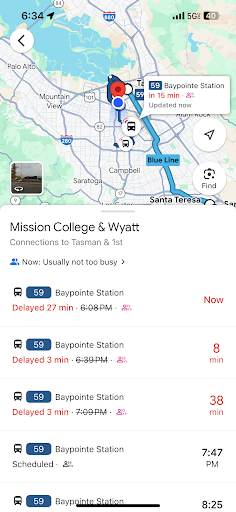
Read morePros: Clipper integration made getting around in terms of fares very easy. Live updates on Google Maps for route planning. Light rail is easy to navigate. Cons: Passenger safety seems to be a secondary concern of bus drivers given the violent driving style I experienced on board a city bus from the Rose Garden to Berryessa BART station. HVAC systems are not showing signs of regular cleaning, with visible particulates and dirt near air vents that should at least be wiped down. Both buses were very late, the first being over 30...
Read more