Andhar Bavadi
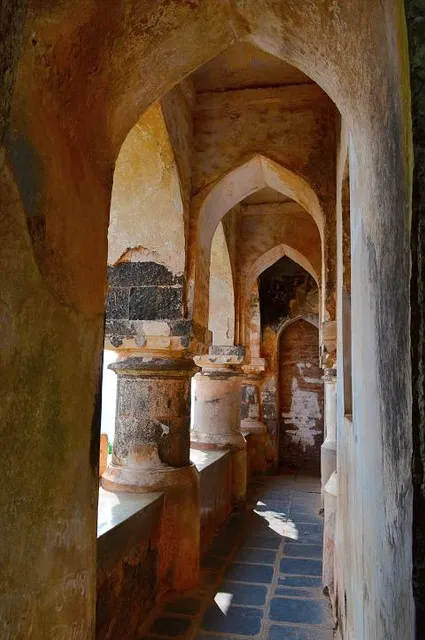
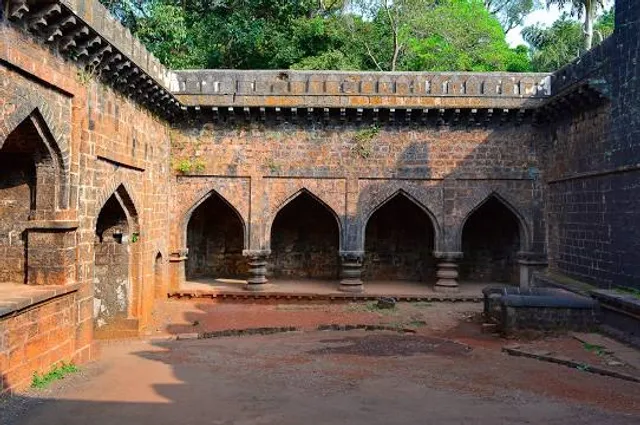
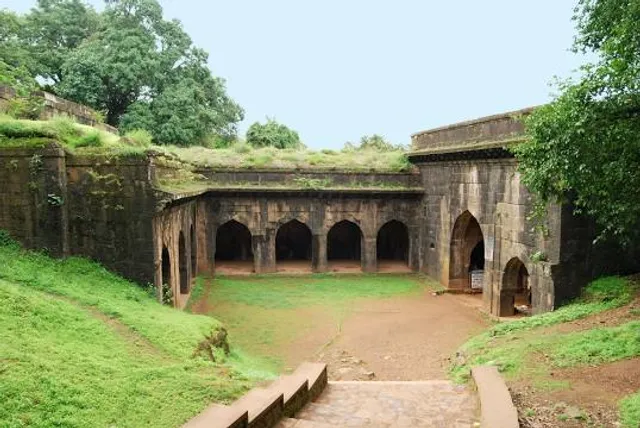
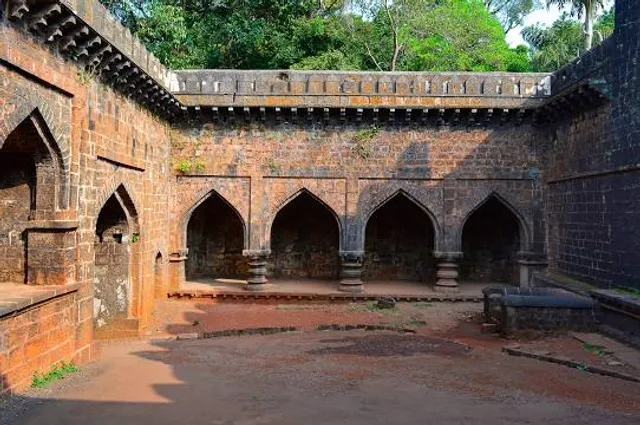
Whenever an army besieged a fort, their first action was to poison the main water source of the fort. To counter this, Adil Shah commissioned the building of the Andhar Bavadi (Hidden Well).This is a three-storey structurewith winding staircases that conceal the well which was the main water source for Panhala fort. There are recesses in the wall so that soldiers can be permanently stationed. Several hidden escape routes in the Andhar Bavai lead outside the fort. With its own water source, living quarters and its own exit routes, likely this structure was designed like a fort within a fort with the intention of making it an emergency shelter in case the main fort fell.
Kalavanticha Mahal
Kalvanticha Mahal (The courtesan's palace)
The name of this building, which is also called Nayakini Sajja, literally means "Courtesans' Terrace room". It stands on the east side of the fort close to the rampart. By 1886, it had become a complete wreck with only traces of ornamental work on the ceiling.This was used during the occupation of the fort by the Bahmani Sultanate as a Rang Mahal(residences for the ladies of the court)
Ambarkhana
The Amberkhana, situated in the center of the fort, were three granaries built in the Bijapuri style of architecture. They enabled Shivaji to withstand a 5-month siege by Siddhi Johar.It consists of three buildings called the Ganga, Yamuna and Saraswati Kothis. The Ganga kothi, which was the largest, had a capacity of 25,000 khandis (with one khandi being 650 lbs). It covers an area of 950 sq m and is 10.5 m high.Rice, nachni and warai were the major provisions stored.Stairs on both sides lead the top of the buildings. It has sixteen bays each with its own flat vault with a hole on top through which grain used to be passed. The eastern entrance has a domed chamber with a balconey and plasterwork of the Bijapuri style.
Dharma Kothi
This was an additional granary next to the three granaries that constituted the Amberkhana. It was a stone building 55 feet by 48 feet by 35 feet high. This has an entrance and a staircase that leads to the terrace.Grain was distributed from here to the needy.
Sajja Kothi
Sajja Kothi is a one-storey structure built by Ibrahim Adil Shah in 1500 CE. It is also built in the Bijapuri style. Sajja Kothi was constructed as a viewing pavilion looking over the valley below. The domed upper chambers have facetedpendentives with the balconies hanging over the ramparts of the fort.This is where Shivaji imprisoned his son, Sambhaji,when he threatened to defect to Aurangzeb.
Inner gate of Teen darwaza
Teen Darwaza
The Teen Darwaza was one of the three double gateways of the fort - the others being the Char Darwaja and Wagh Darwaja.The Char Darwaza was destroyed when during the British siege. The Teen Darwaja gate which is the main entrance to the fort is located north of the Andhar Bavai on the West side of the fort. It is a double gate with a court in between that hasarcades. The outer gate has an ornate chamber on top with decorated eaves. The inner gate from the court is highly decorated with the lintel having finely carved motifs, including one ofGanesh. The latter has been placed by the Marathas during their occupation of the fort.There are three Persian inscriptions—one on top and one each on either side. All three declare that the gate "was built in the reign of Ibrahim Adil Shah I by Malik Daud Aki son of Minister Ahmed" in 954 AH (1534 CE).
Wagh Darwaza
This was another entrance to the fort. It was designed to elude invaders such that they would get trapped into a small courtyard and could then be easily neutralized. It has an elaborate Ganeshmotif at the entrance.
Rajdindi bastion
The Rajdindi bastion was one of the hidden exits of the fort to be used in times of an emergency. It was used by Shivaji to escape to Vishalgad during theBattle of Pavan Khind. Rajdindi is...
Read morePanhala fort, there are couples of forts around Kolhapur like Panhala, Vishalgad, Mahipalgad, Kalanandigad. Panhala, where you can yet view three large buildings called the Amberkhana – a granary with the capacity to store 50,000 pounds of corn – is now a hill-station. Panhala is situated 20 km from the industrial city of Kolhapur. Panhala is a charming hill resort Situated at an altitude of 977.2 m. which makes for a complete holiday. With its hoary heritage, Panhala provides the right locale.It was built by King Bhoja between 1178-1209 and is the largest of all Deccan forts. The innermost citadel is enclosed by a strong wall over 7 Km in length fortified by bastions.
Panhala’s historic fort throws up memories of Chhatrapati Shivaji, It was from here that Shivaji beleaguered for over four months, escaped one rainy night to Vishalgad, while his faithful general Baji Prabhu Deshpande laid down his life holding down the forces of Siddi Johar at a narrow pass, since christened Pavankhind. It was here in the same building, Sajja Kothi, built by Ibrahim Adil-Shah in 1500 AD, that Shivaji imprisoned his errant son Sambhaji who escaped… right into the arms of his father’s foes.
Today it is redolent with memories of Shivaji. Not surprising, though, considering that barring his capitals at Rajgad and later Raigad, and Shivneri, where he spent his childhood, Panhala is the only fort where Shivaji spent more than 500 days. It was Maratha State capital until 1782 and in 1827 it went to the British.Besides, there’s the Sambhaji temple Someshwar temple, Teen Darwaza, Raj Dindi. This imposing fort, 20km northwest of Kolhapur, is built on an outlying spur of the Sahyadris, rising more than 400m above plain. The strategic importance of Panhala, guarding one of the principal routes through the Western Ghat, can be judged from its long and varied history. After serving as the headquarter of the Shilahara ruler Bhoja II (1178-1209), the site subsequently passed into hands of Yadavas. It was favorite outpost of the Bahamanis of Bidar ; Mahmud Gawan, the powerful Prime Minister, encamped here during the rainy season of 1469. By the beginning of the 16c Panhala was absorbed into the kingdom of Bijapur.The Adil Shahis were responsible for strengthening and rebuilding the ramparts and Gateways.The fort was raided by Shivaji in 1659, but it was not until 1673 that he was able to occupy it permanently.
In 1701 Panhala surrendered to Auragzeb, and it was here that the Mughal Emperor recieved the English Ambassador, Sir WilliamNorris. Within a few months the fort was retaken by the the Maratha forces under Pant Amatya Ramachandra, who asserted his autonomy by founding an independent dynasty.In1782 these rulers shifted their headquarters to Kolhapur. After a local rebellion in 1844, Panhala was taken by the British. More than 7km of Fortifications define the approximently triangular zone of Panhala fort. The walls are protected for long sections by steep escarpments, reinforced by a parapet with slit holes. The remaining sections have 5-9m high ramparts, strengthened by round bastions. Unfortunately, the East Gate called Char Darawaja, through which the road passes on arrival at fort, was demolished by the British.
A green-and-white-painted Dargah overlooking a tank is seen to the left of the entrance. The road continues west about 400m until it arrives at the Tin Darawaja, or Triple Gate. This elaborate example of military architecture is assigned to the Adil Shahi era. The innermost entrance displays an arched recess framing a lobed arch. A nine-domed chamber gives access to an rectangular court lined with arcades. The intermediate entrance is topped with a lintel set within a lobed arch. This frames a plaster composition with lions and an Image of Ganesha, addition of 19c.The side panels have intricately etched patterns of interlocking battlement and...
Read morePanahala fort was built between 1178 and 1209 CE, one of 15 forts (others including Bavda, Bhudargad, Satara, and Vishalgad) built by the Shilahara ruler Bhoja ll. It is said that aphorism Kahaan raja Bhoj, kahan Gangu Teli is associated with this fort. A copper plate found in Satara shows that Raja Bhoja held court at Panhala from 1191–1192 CE. About 1209–10, Bhoja Raja was defeated by Singhana (1209–1247), the most powerful of the Devgiri Yadavas , and the fort subsequently passed into the hands of the Yadavas. Apparently it was not well looked after and it passed through several local chiefs. In 1376 inscriptions record the settlement of Nabhapur to the south-east of the fort.
It was an outpost of the Bahamanis of Bidar. Mahmud Gawan, an influential prime minister, encamped here during the rainy season of 1469. On the establishment of the Adil Shahi dynasty of Bijapur in 1489, Panhala came under Bijapur and was fortified extensively. They built the strong ramparts and gateways of the fort which, according to tradition, took a hundred years to build. Numerous inscriptions in the fort refer to the reign of Ibrahim Adil Shah, probably Ibrahim I (1534–1557)
Pusati Buruj(bastion) – An ancient time Pusati Buruj was a place of soldiers to keep an eye on enemies movement and prevent the attack for him. Its shows a beautiful natural view on Masai Pathar. 2. Teen Darwaja (Three Gates) – Teen Darwaja was a one of the fully secure entrance to fort an ancient time. 3. Ambarkhana –It’s also called at “Dhanya Kothar”. It’s an administrative division as well as storage place, the Mint, and the granaries for the armies. There are three buildings titled Ganga, Jamuna, and Saraswati, the granaries could store as much as 25,000 Khandis of grain. 4. Tabak Udyan –Garden & Snake museum. 5. Veer Baji Prabhu Deshpande –The great worrier who sacrifices of one’s life for Chh. Shivaji Maharaja. 6. Char Darwaja –This was a main entrance for Fort but unfortunately now these all are not exist. 7. Someshwar Lake & Temple – One of the lake and Shiva’s Temple on Panhala fort. 8. Veer Shiva Kahshid –The great worrier who sacrifice of one’s life for Chh. Shivaji Maharaja. 9. Sajja Kothi –Sajja Kothi offers a gorgeous view of Warana Valley below. Sajja Kothi is a three-storied building built by the Mohammedan. 10. Andhar Baav –Baav means Well. It’s famous for ancient Architecture. 11. Naykinicha Sajja – Ancient time dancing and singing entertainment place. It’s also called as Kalavantinicha Sajja. 12. Nagzhari –Lake of...
Read more