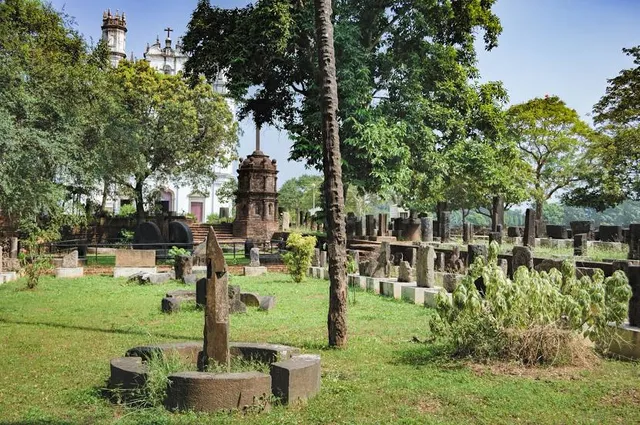
Churches and Convents of Goa is the name given by UNESCO to a set of religious monuments located in Goa Velha (or Old Goa), in the state of Goa, India, which were declared a World Heritage Site in 1986. Goa Churches and Convents of Goa is the name given by UNESCO to a set of religious monuments located in Goa Velha (or Old Goa), in the state of Goa, India, which were declared a in 1986.was the capital of Portuguese India and Asia and an evangelization center from the sixteenth century. The justifications1] for the inclusion of religious monuments in Goa in the World Heritage List are: 1) the influence of the monuments in the dissemination of Western art forms – the Manueline styles, Mannerist and Baroque – throughout Asia where Catholic missions were established; 2) the value of the set of monuments of Goa as an exceptional example that illustrates the work of evangelization and 3) the specific value of presence in the Basilica of Bom Jesus of the tomb of Francisco Xavier, which illustrates a major world event: the influence of the Catholic religion in Asia in the modern era. History
The city of Goa was founded in the fifteenth century by the Muslim Sultanate of Bijapur as a port on the banks of the Mandovi river. The city was taken in 1510 by Afonso de Albuquerque with the help of the Goan Hindu privateer Timoja, remaining continuously under Portuguese rule until the twentieth century. The city was recorded as having over 200,000 inhabitants at its peak and was known by the title 'Rome of the East', specifically for its splendid and numerous Catholic religious buildings. Monuments Edit Igreja de Nossa Senhora do Rosário Edit Main article: Church of Our Lady of the Rosary (Goa) The Church of Our Lady of the Rosary, built in 1543, is the oldest of the Old Goa churches still standing. Initially, it was a parish church, then collegial. On the outside, the church looks like a small fortress; the entrance porch flanked by small cylindrical towers with cupolas is typical of late-Gothic and Manueline Portugal, particularly in the Alentejo region.[6] Inside, it highlights the Manueline vaults of the chapels. In the chancel, besides the altarpiece dedicated to Our Lady of the Rosary, there on the wall a carved alabaster cenotaph in Persian or Indian style, with the inscription: "Aqui jaz Dona Catarina, mulher de Garcia de Sa, a qual pede a quem isto ler que peça misericórida a Deus para sua alma"[8 The floor below is the grave of Garcia de Sá (died in 1549), João de Castro's successor as Governor of India.8
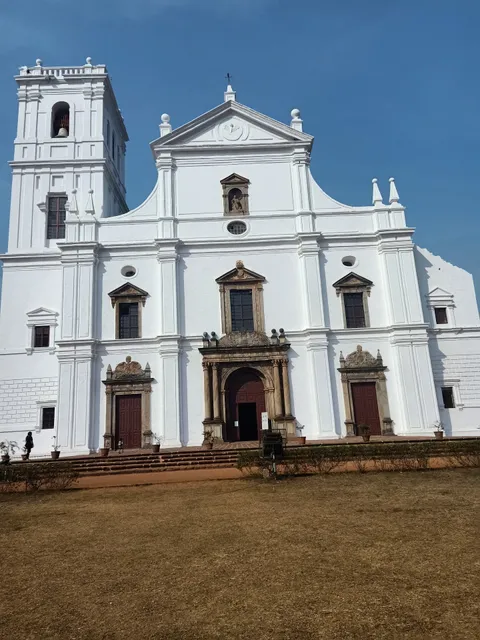
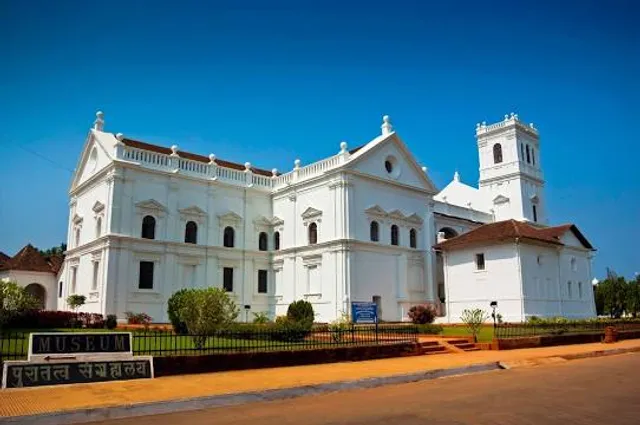
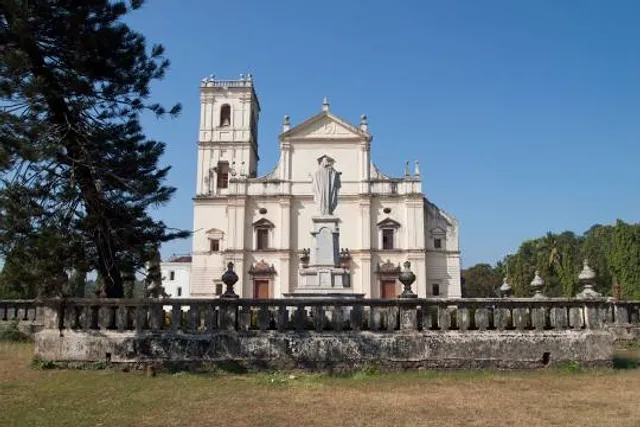
Sé Catedral of Goa Edit Main article: Se Cathedral Goa was elevated to the seat of a bishopric in 1534 by Pope Paul III, and a towering cathedral church dedicated to Catherine of Alexandria was built in the first decades of colonization.[8] This small church, insufficient to meet the faithful, was rebuilt from 1562,[6] during the administration of Viceroy Dom Francisco Coutinho. The construction was extremely slow, since in 1619 only the body of the church was complete, with the missing facade completed in 1631.[8]
The See of Goa is the largest building built by the Portuguese in Asia,[6] 91 meters long and very wide, which probably contributed to the slow pace of works.[8] The church has three naves of equal height, shaped hall-church, as do other Portuguese cathedrals of time as the Sees of Miranda do Douro (begun in 1552), Leiria (begun in 1559) and Portalegre (begun in 1556).[10] The severe façade with three portals, has one tower: the right was destroyed during a storm in 1766.[6] The church naves are vaulted and separated by two rows of pillars. Interior decoration stands out the magnificent altarpiece of the...
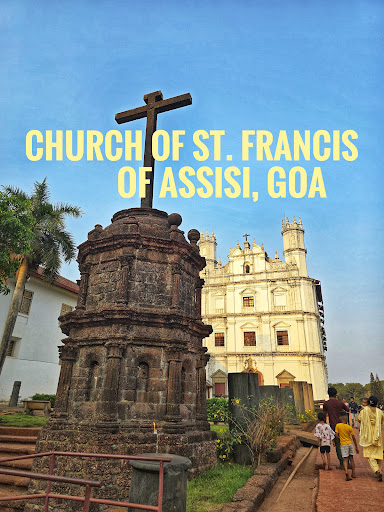
Read moreSt. Francis of Assisi church, Goa The Church of St. Francis of Assisi was built in 1661 by the Portuguese in the Portuguese Viceroyalty of India.1] The Church of St. Francis of Assisi, together with a convent, was established by eight Portuguese Franciscan friars who landed in Goa in 1517.[2[4] Church of St. Francis of Assisi Igreja de São Francisco de Assis
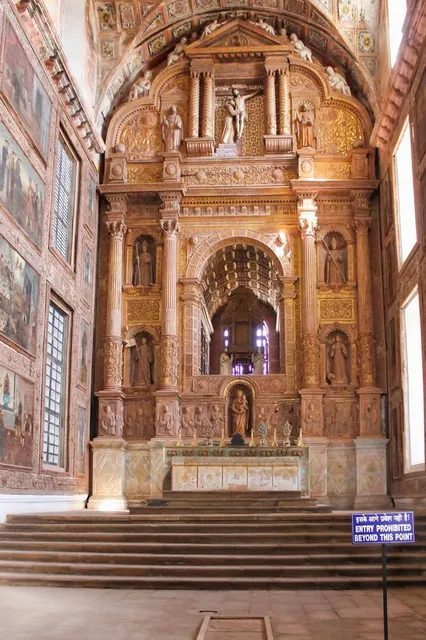
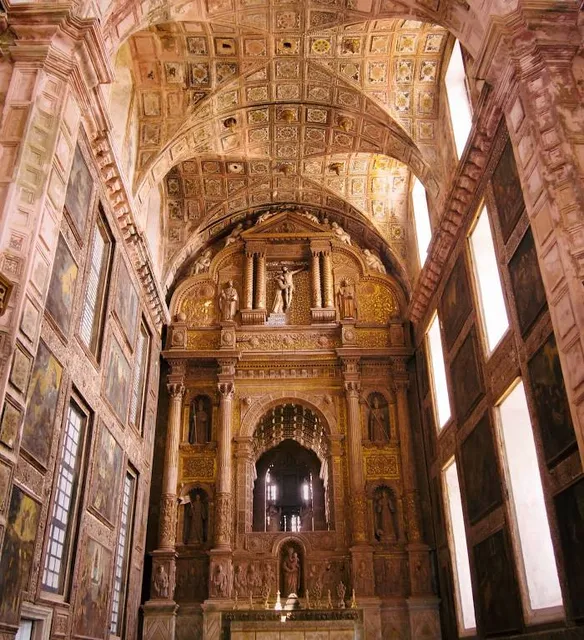
Church of St. Francis of Assisi 15°30′11.60″N 73°54′40.60″E / 15.5032222°N 73.9112778°E Location Velha Goa Country India Denomination Roman Catholic History Founded 1661; 357 years ago The Structure The following is the information as seen on the plaque beside the Church of St. Francis of Assisi. "The three tier facade have octagonal towers on each side and in the central niche there is a statue of St. Michael. The main entrance is decorated with circular pilasters and rosette band. The central nave is barrel-vaulted while the crossing is rib-vaulted which supports the choir. The internal buttress walls, separating the chapels and supporting the gallery on top, have frescoes showing floral designs. Above the tabernacle in the main altar is a large statue of St. Francis of Assisi and Jesus on the cross, statues of St. Peter and St. Paul are seen below. The adjoining walls of nave retain painted panels depicting scenes from the life of St Francis of Assisi."
Construction work on the church began in 1594. The church was consecrated in May 1605 by the archbishop, Dom Fr. Aleixo de Menezes. This world heritage monument has emerged as a landmark in the history of Christianity. It contains the body of St. Francis Xavier, a very close friend of St. Ignatius Loyola with whom he founded the Society of Jesus (the Jesuits). Francis Xavier died on Sancian Island while en route to continental China on (December 13, 1552). The body of Francis Xavier was first taken to Portuguese Malacca and two years later shipped back to Goa. It is said that the saint's body was as fresh as the day it was buried.[5] The remains of the saint still attract a huge number of tourists (Christian and non-Christian alike) from all over the world, especially during the public viewing of his body every ten years (last held in 2014). The saint is said to have miraculous powers of healing. This is one of the oldest churches in Goa and in India. The floor is of marble inlaid with precious stones. Apart from the elaborate gilded altars, the interior of the church is simple. The main altar holds a large statue of St. Ignatius of Loyola, the founder of the Society of Jesus (Jesuits), and one of Francis Xavier's companions whose words drew him to a reformed life. "What does it profit a man," Ignatius had asked Francis, “if he gains the whole world and loses his soul?"
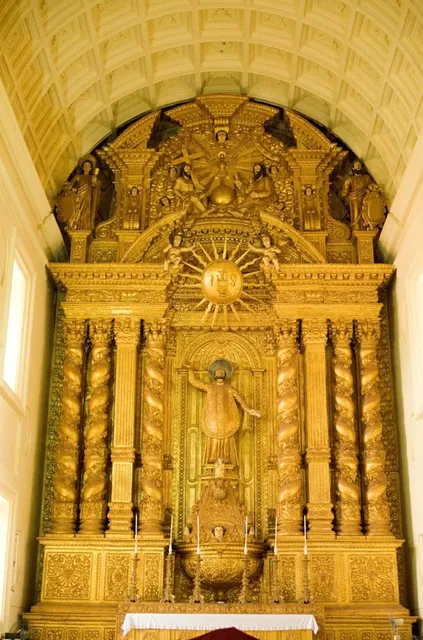
The Baroque style main altar is gilded and bears the statue of Ignatius of Loyola standing between Solomonic pillars above which is the name of Jesus in the IHS monogram and the Holy Trinity The gaze of the gilded statue of Ignatius of Loyola is fixed upwards in awe at the name of Jesus (IHS) on the gilded emblem of the Jesuits, encircled in radiant rays. Over the emblem, is the Holy Trinity -Father, Son and Spirit - the ultimate muse and focus of the pious Christian. The altar table which is used in Holy mass is gilded and adorned with the figures of Christ and his apostles at the Last Supper, along with the words "Hi Mhoji Kudd", which in Konkani means "This is my Body", from the...
Read moreA Journey Through Time: The Enchanting Church of St. Francis of Assisi
As a local guide, I can confidently say that the Church of St. Francis of Assisi is an absolute must-visit in Old Goa. It's more than just a church; it's a captivating journey through history, art, and architecture. Here's why it deserves a spot on your Goa itinerary: A Legacy Etched in Stone (5 stars): Step back in time as you explore this grand church, built in the early 16th century by Franciscan friars. The story goes back even further, with the site initially housing a small chapel in 1517. Witness the architectural evolution over centuries, starting with the current structure's simple laterite exterior, a signature of Goan churches. Step inside, and prepare to be dazzled by the dramatic shift – a testament to the opulent Baroque style. The intricate details, sculpted flourishes, and the play of light and shadow will leave you speechless. A Feast for the Senses (5 stars): The awe-inspiring interiors are a true feast for the senses. Look up and admire the Corinthian influences adorning the walls and the grand main altar. This centerpiece houses a majestic statue of St. Francis himself, flanked by paintings that narrate his life story. Each element, from the gilded accents to the meticulously crafted woodwork, contributes to the church's overwhelming beauty. A Hidden Treasure (4 stars): Don't miss the adjoining Archaeological Survey of India Museum, housed within the former convent building. This treasure trove offers a fascinating window into Goa's rich past. Explore a collection of artifacts, sculptures, and paintings that unveil the cultural tapestry of the region. Local’s Tips:
As a place of worship, dressing modestly is recommended.
Enhance your experience with a guided tour to delve deeper into the church's history and symbolism.
Make a day of it! Combine your visit with other historical gems of Old Goa, like the Se Cathedral and the Basilica of Bom Jesus.
The Church of St. Francis of Assisi is more than just a religious landmark; it's a captivating blend of history, artistry, and cultural heritage. It's a place that will stay with you long...
Read more