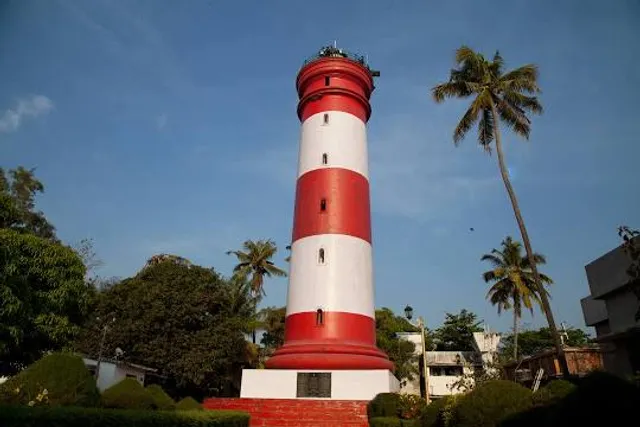
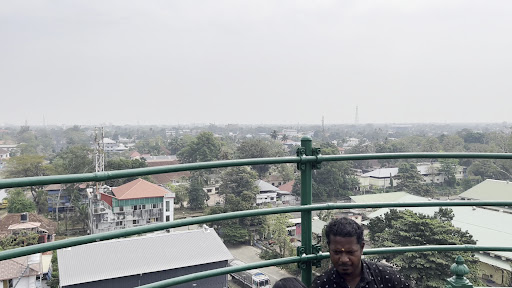
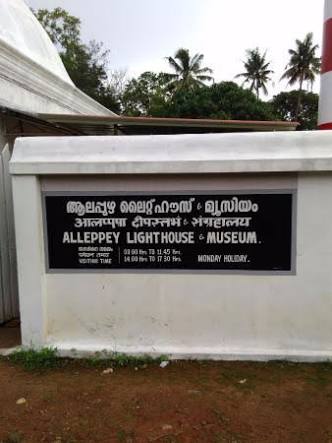
This is the first light house in Kerala used to help the ships navigate. It’s a beautiful monolith that feels like a structural footing upon close view. Just for a scale the plinth for the lighthouse is almost 2 mtrs while in residences we provide maximum of 60cm. The stairs are so steep and has almost 5 flights in which an average healthy man would be dead by the time he reaches the 3 flight. Don’t even think about taking it in a stretch believe me u will be dead. It would be a great help if they opened the landings until 4th flight (as fifth landing is kind of an electrical store room)so that the people can wait there and catch some breath rather than falling down without air. The total number of steps is around 110 and is well maintained. The wood used in the stair definitely tell its age and the girders or supports used for the landings are very huge. Safety assured. Still the final flight is a narrow one so kindly go without any bags of tight uncomfortable denim or anything else. The view is spectacular and i don’t thinks there is any other better sunset point on ground. The nee bypass kinda obstructs the view but the tire noise from those vehicles are very distinguishable. For all the train buffs out there like me there is a railway crossing which gives beautiful view of the trains passing by in a Birds Eye viewpoint.
Note:The entry fee is Rs 20 with an additional 10 rupee if you like to take photographs of it. For NRIs the pricing is a bit different but nothing drastic.
Now it’s history time!!!! Alappuzha, the place where India's Alleppey Lighthouse stands, was one of the busiest ports and trade centres of Kerala. Alappuzha, a part of Travancore, was ruled by Rajas of Erstwhile Travancore before India's independence. After the arrival of the Portuguese, Dutch and English traders, Vizhinjam, Kollam, Travancore and Purakad were the main ports of Erstwhile Travancore through which foreign trade flourished.
The decline of the Port of Purakkad necessitated the rehabilitation of the traders for which Alappuzha was selected as a port and infrastructure was developed. The port was opened to foreign traders in 1792. There was no regular lighthouse provided in the 18th century, only a light on the pier head served the mariners.
As port activities increased, the authorities had to provide for a lighthouse. The construction of the present lighthouse began in the reign of His Highness Marthanda Varma-II Maharaja (ruler of Travancore) and was completed during the reign of His Highness Rama Varma Maharaja of Travancore. The first stone was laid by Mrs Mough Crawford on 26 April 1860.
The 27 m high lighthouse has a teak spiral staircase. A piece of first-order optical equipment with coconut oil double wick lamp light-source supplied by M/s. Chance Bros., Birmingham, was installed and commissioned into service on 28 March 1862. The same equipment continued to serve till 1952 when it was replaced by 500 mm drum optic and DA gas flasher of AGA make.
The current 4th order optic with a 1000 watt electric lamp was installed in 1960. The mains supply was extended to the station in 1960, this enabled the installation of an electrically operated 4th order revolving optic system supplied by M/s BBT, Paris, this replaced the old equipment and was commissioned on 4 August 1960.
The direct drive system was incorporated on 8 April 1998, and a separate emergency light in the 300 mm lantern on 30 December 1998. The incandescent lamp was replaced by 230 V 150 W Metal halide lamp on 28 February 1999.
The lighthouse is still a staffed station. Originally painted plain white, it was repainted in red and white...
Read moreAlappuzha Lighthouse, located in the coastal town of Alappuzha (formerly known as Alleppey) in Kerala, is one of the oldest and most iconic lighthouses on India’s southwestern coast. Built in 1862 during the reign of the Maharajas of Travancore, this lighthouse stands as a prominent historical and maritime landmark, offering visitors a unique blend of architectural charm, coastal history, and panoramic sea views.
History and Architecture The Alappuzha Lighthouse was constructed to guide ships safely into one of the busiest ports on the Kerala coast during that era. It was built after the decline of the nearby Purakkad port, with Alappuzha being developed as a major trading hub under the leadership of Raja Kesavadas, the prime minister of Travancore who envisioned it as an important port for spice and other trade routes. The lighthouse's construction began in 1860 and was completed by 1862. The first stone was laid by Mrs. Mary Anne Crawford, the wife of the Port Officer H. Crawford.
The lighthouse stands 27 meters (around 90 feet) tall and is made of laterite stones and teak wood. Its distinctive red and white striped cylindrical tower, combined with a teak spiral staircase inside, adds to its vintage appeal. Originally, the lighthouse used a coconut oil lamp with a double wick, which was later upgraded multiple times to modern lighting apparatus, finally using a 1000-watt electric lamp from 1960 onwards.
Visitor Experience Visitors to Alappuzha Lighthouse can climb the spiral staircase to the top, which offers a breathtaking 360-degree panoramic view of the Arabian Sea, the golden sandy beach, and the town of Alappuzha itself. The platform at the top comfortably accommodates 20 to 25 people, making it perfect for friends and families to share the view.
The lighthouse operates for public visits between 3 PM and 5 PM on weekdays, with a nominal entry fee for Indian citizens and slightly higher charges for foreign tourists. This short visiting window makes the lighthouse an exclusive experience for those wanting to witness sunset hues over the sea.
Maritime Significance Alappuzha was historically a major maritime hub, serving as a vital link for spice trade and other coastal commerce in Kerala. The lighthouse played a crucial role in ensuring safe navigation for ships entering the Alappuzha port and remains symbolic of the region's rich nautical heritage. It is also a testament to engineering and architectural innovation during the Travancore era.
Attractions and Surroundings Near the lighthouse, visitors can also enjoy the scenic Alappuzha Beach, which is a perfect spot for a leisurely stroll or to witness the changing tides against a backdrop of mesmerizing sunsets. The vibrant local market, traditional houseboats, and the famed backwaters of Kerala are all nearby, making Alappuzha Lighthouse a focal point for a comprehensive cultural and natural experience.
The lighthouse is well-preserved and was repainted in striking red and white bands in 2000, retaining its status as a visually captivating landmark. The place also hosts a small museum that displays old lighthouse equipment and details the history of maritime navigation...
Read moreThe Alappuzha Lighthouse is situated in the coastal town of Alappuzha, Kerala. It was built in 1862 and is a major tourist attraction. Visitors are allowed between 1500 hours and 1630 hours on every weekday at an admission fee of ten rupees. This is not the first of its kind in the arabian sea coast of India, thalassery light house built in 1835 is the first light house of Kerala Alappuzha, the place where India's Alleppey Lighthouse stands, was one of the busiest ports and trade centers of Kerala. Alappuzha, a part of Travancore, was ruled by Rajas of Erstwhile Travancore before India's independence. After the arrival of the Portuguese, Dutch and English traders, Vizhinjam, Kollam, Travancore and Purakad were the main ports of Erstwhile Travancore through which foreign trade flourished. The decline of the Port of Purakkad necessitated the rehabilitation of the traders for which Alappuzha was selected as a port and an infrastructure was developed. The port was opened to foreign traders in 1792. There was no regular lighthouse provided in the 18th century-only a light, provided on the pier head served the mariners. As port activities increased, the authorities had to provide for a lighthouse. The construction of the present lighthouse began in the reign of His Highness Marthanda Varma-II Maharaja (ruler of Travancore) and was completed during the reign of His Highness Rama Varma Maharaja of Travancore. The first stone was laid by Mrs. Mough Crawford on April 26, 1860. The 30' high lighthouse has a teak spiral staircase. A 1st order optical equipment with coconut oil double wick lamp light-source supplied by M/s. Chance Bros. Birmingham was installed and commissioned into service on 28 March 1862. The same equipment continued to serve till 1952 when it was replaced by 500 mm drum optic and DA gas flasher of AGA make. The current 4th order optic with a 1000 watt electric lamp was installed in 1960. The mains supply was extended to the station in 1960, this enabled the installation of an electrically operated 4th order revolving optic system supplied by M/s BBT, Paris, this replaced the old equipment and was commissioned on 4 August 1960. The direct drive system was incorporated on 8 April 1998 and a separate emergency light in 300 mm lantern on 30 December 1998. The incandescent lamp was replaced by 230V 150W Metal halide lamp on 28 February 1999. The lighthouse is still a manned station.and
The lighthouse, which was painted plain white, was repainted in red and white...
Read more