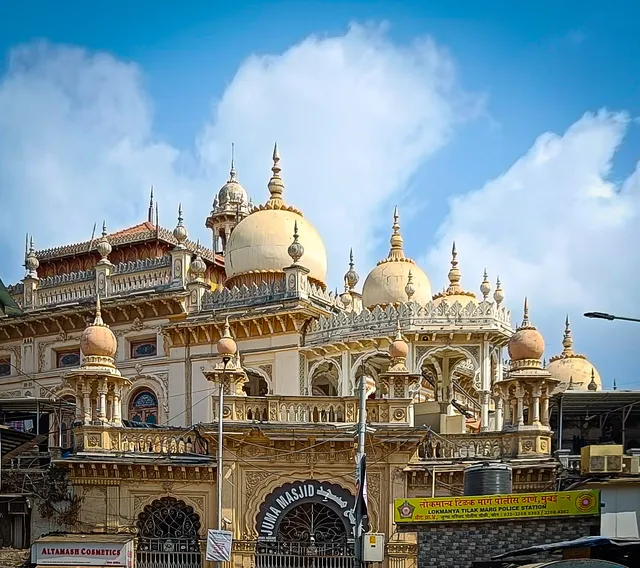
The Jama Masjid, located in the heart of Mumbai near Crawford Market, stands as one of the oldest mosques in the city, steeped in cultural, religious, and architectural significance.
Historical Significance
The history of the Jama Masjid dates back to the late 18th century when the original mosque in Dongri was demolished by British Governor William Hornby in 1770. The mosque was then relocated and constructed on its current site by 1802, on land owned by a Konkani Muslim merchant. Interestingly, the owner stipulated that the mosque be built around a large water tank, preserving its original structure.
Architectural Marvel
Architecturally, the Jama Masjid is a quadrangular structure that exhibits a seamless blend of Mughal and vernacular design elements. It is uniquely built on a raised platform above a water tank filled with clear spring-fed water, symbolizing purification and tranquility. The mosque is supported by:
16 black stone arches, dating back to 1874, rising directly from the tank.
An upper story upheld by intricately carved wooden pillars, adding an elegant traditional touch.
The tank, a central feature, contains goldfish, silverfish, and turtles, enhancing the serene ambiance. The interior of the mosque features chambers and niches for Quranic manuscripts, offering visitors a spiritual and reflective atmosphere.
Religious and Cultural Hub
The Jama Masjid is not only a place of worship but also a vital cultural hub for Mumbai's Muslim community. It is particularly vibrant during Fridays and the month of Ramadan, drawing large congregations for prayers and iftar gatherings. The azaan (call to prayer) reverberates across the vicinity, reminding both locals and visitors of the spiritual essence of the area.
Sheikh Memon Street: A Neighboring Market Scene
Adjacent to the mosque is Sheikh Memon Street, famous for its bustling wholesale markets. This area is home to:
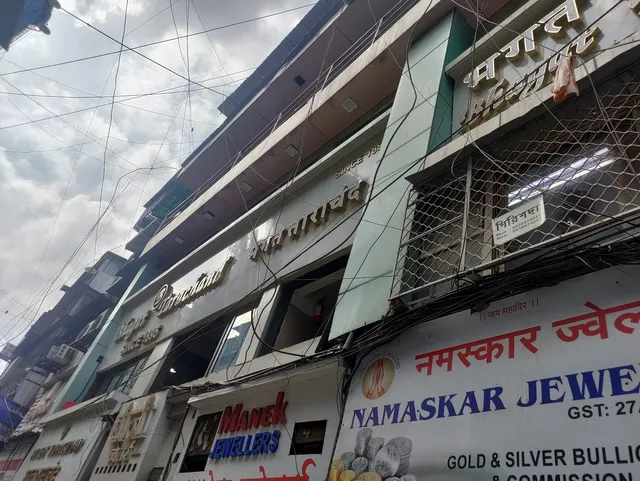
Zaveri Bazaar, a renowned jewelry market.
A diverse collection of wholesale vendors selling textiles, spices, and kitchenware.
The street buzzes with energy, offering a stark contrast to the tranquility of the mosque. The market and mosque together capture the spirit of Mumbai—a city of contrasts, where history, commerce, and faith coexist.
Personal Reflections from Visitors
Many visitors describe the mosque as a serene oasis amid the chaotic life of the surrounding market streets. Some reviews highlight:
The spiritual ambiance of the mosque.
The well-preserved historic tank, which adds a unique charm.
The inclusive and welcoming environment for people of all faiths.
Geographic and Symbolic Relevance
Geographically, the mosque's central location near Crawford Market makes it easily accessible for locals and tourists alike. Symbolically, Jama Masjid represents the resilience and adaptability of Mumbai's diverse communities.
In conclusion, Jama Masjid is more than just an architectural wonder; it is a living testament to Mumbai's rich cultural tapestry. Whether one visits for prayer, history, or curiosity, the mosque leaves an indelible mark on its visitors, symbolizing peace and unity amid the...
Read moreIn the eighteenth century, a large tank (water reservoir) was situated at this site in the midst of gardens and open land and belonged to a Konkani Muslim merchant trading in Goa and Calicut, who in about 1775, agreed to the erection of a mosque at this site on condition that the tank was preserved intact.
The construction started initially in 1775 with raising of foundations on the tank. Objections were raised by neighbours that delayed construction until 1778. More disputes arose with illegal construction activities to its west and south. Finally the erstwhile governor of Bombay, Sir Meadows Taylor decided in favour of the mosque authorities. The date of its completion (AD 1802)/(AH 1217) is derivable from the chronogram Jahaz-i- Akhirat, "The ship of the world to come" which contains an allusion to the fact that it was constructed on the tank.
A one-story building was therefore erected over the tank and formed the original nucleus of the present Jama Mosque. A top floor was added with the munificence of a prominent konkani merchant Mohammad Ali Roghay in 1814.
The Jama Mosque is a quadrangular structure of brick and stone, encircled by a ring of terrace roofed and double storeyed buildings, the ground floors of which are let out as shops. The chief or eastern gate of the mosque leads directly across an open courtyard to the ancient tank, which is now furnished with masonry steps and embankments, built in 1893, and contain about ten feet of water fed by springs at the bottom, that contains gold and silver fish and few turtles. This is used for ritual ablutions (wudu), however modern facilities are also available for this purpose.
From the depth of the tank rise sixteen black stone arches, constructed in 1874, which support the whole fabric of the mosque, the upper story being upheld by five rows of wooden pillars, each of which contains a receptacle for sacred books. The arches in the tank were built in 1874 at a cost of Rs. 75000/- while other noteworthy additions to the premises are the large windows in the north, east, and south sides constructed in 1898, and the school building Rs....
Read moreThe Jama Masjid in Mumbai, also known as the Jama Mosque, is one of the city’s most historic and architecturally significant mosques. Situated in the Kalbadevi neighborhood near Crawford Market, it serves as a central place of worship for the Sunni Muslim community. 
⸻
🕌 Historical Background
Construction of the mosque began in 1775 on land owned by a Konkani Muslim merchant. A notable feature of the site is a large water reservoir, which the merchant agreed to preserve as a condition for building the mosque. The mosque was completed in stages, with the reservoir finished in 1802 and the main mosque structure completed in 1874.   
⸻
🏛️ Architectural Highlights
The Jama Masjid showcases Indo-Islamic architectural style. It is a two-storey quadrangular structure built over a tank, supported by sixteen black stone arches. The mosque features a spacious courtyard, a prayer hall upheld by wooden pillars, and a digitized library housing rare manuscripts from as early as the 1890s. 
⸻
📍 Location & Accessibility • Address: Jama Masjid Building, Nagdevi Street, Lohar Chawl, Kalbadevi, Mumbai, Maharashtra 400003 • Nearest Railway Stations: Mumbai Central and Masjid Bunder • Nearby Landmarks: Crawford Market, Zaveri Bazaar, Abdul Rehman Street  
⸻
🕰️ Visiting Hours & Entry • Timings: 5:00 AM to 9:00 PM daily • Entry Fee: Free • Prayer Times: • Fajr: 5:30 AM • Dhuhr: 1:15 PM • Asr: 4:30 PM • Maghrib: 6:15 PM • Isha: 8:00 PM  
⸻
🧭 Visitor Tips • Best Time to Visit: Early mornings or late afternoons to avoid crowds. • Facilities: Wudu (ablution) facilities, restrooms, and separate prayer areas for women are available. • Accessibility: The mosque is not wheelchair accessible. • Etiquette: Modest attire is recommended. Non-Muslim visitors are welcome but should avoid visiting during...
Read more