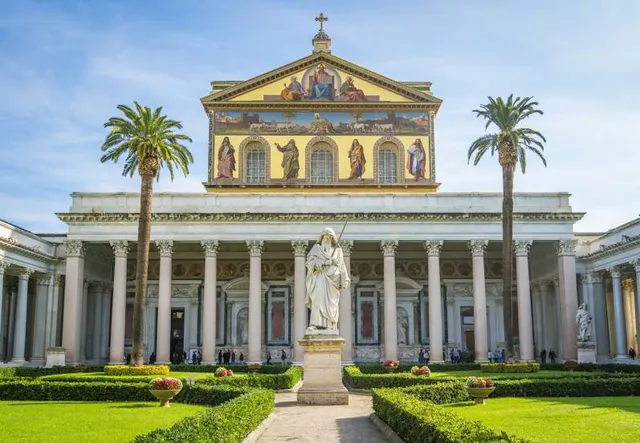
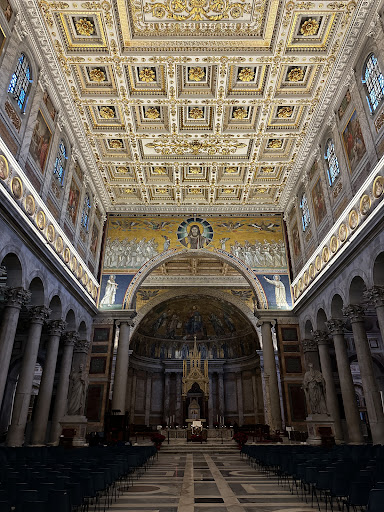
With its imposing structure, the Basilica of St. Paul Outside the Walls is one of the four papal basilicas of Rome, the second largest basilica after St. Peter’s.According to tradition, the church lies on the site where the Apostle Paul was buried; here the Christians erected a sepulchral chapel, namely a memorial, later transformed into a basilica by the Emperor Constantine and consecrated in 394 by Pope Sylvester.The works to expand the temple began in 385 and were completed in 395 by Emperor Honorius. Soon one of the most important stops of the pilgrimage route in Rome, it was Pasquale Belli, collaborating with other architects, who rebuilt it between 1825 and 1854, after the devastating fire in 1823.Luigi Poletti decorated the upper band of the facade with 17th-century mosaics, and made the bell tower and the pronaos on the north side, redeploying twelve columns already in the nave of the previous church. The facade is preceded by a large quadriportico, designed at the end of the last century by Virgilio Vespignani, with the statue of St. Paul by Giuseppe Obici.The interior is divided into five naves by eighty monolithic granite columns: the six ones of the entrance wall are the most remarkable, donated by the Viceroy of Egypt to Gregory XVI. The central nave, wider than others, has mosaics on the walls with portraits of popes, also present in the aisles, and frescoes with stories from the life of St. Paul.The central altar, above the Altars of Confession and Apostle’s tomb, is surmounted by the famous Gothic ciborium by Arnolfo di Cambio (1285); on the right of the altar it lies the large candelabrum for the Easter candle made of marble, created by Nicola D'Angelo and Pietro Vassalletto in 1170.The apse is dominated by the majestic mosaic, commissioned by Innocent III (1198-1216) and completed by Honorius III. Numerous architectural fragments from the ancient basilica and archaeological finds from the nearby Ostian burial ground, are preserved in the cloister.The cloister of the basilica, the work of Jacopo and Pietro Vassalletto, from which it takes its name, is one of the wonders of 13th-century Rome. It has columns of different types and shapes, decorated with mosaics and colored marbles. They support the arches on which stands the epistyle adorned with magnificent mosaics and limited at the top by a white marble frame with the heads of lions, oxen, goats, and other animals, from whose mouths rainwater flows.The Benedictine monks of the Abbey of San Paolo, who for centuries have been the custodians of the tomb of the Apostle Paul, created the monastic garden. Here, they grow herbs and trees mentioned in the Bible. It is a splendid oasis that ideally reproduces the biblical Eden, a timeless place in which to meditate and reflect on the Christian and monastic vision of nature, immersed in an eternal spring. A botanical-scientific path but also a theological, philosophical, and literary one, where you can also admire the Giardino dei Semplici (the Hortus simplicium). Here, according to the millenary Benedictine tradition, the monks grow the medical plants used in the making of the herbal remedies available at the...
Read moreThe Basilica of Saint Paul Outside the Walls(Basilica di San Paolo fuori le Mura) is one of the five major basilicas of Rome, Italy.
Originally founded by Emperor Constantine in the 4th century, the Basilica di San Paolo is the burial place of Saint Paul the Apostle. It features a fascinating array of historical, religious and artistic sights to explore.
It is one of the seven pilgrimage churches in the Eternal City.
The main door, of bronze with inlaid silver, is modern, made 1929-1931 by Antonio Maraini after the old door had been damaged in the fire of 1823. The original door was a gift from Pope Gregory VII, set up in 1070, and was made of the same materials. It can be seen, restored, on the inside of the basilica.
The reliefs on the door show scenes from the lives of Sts Peter and Paul. Apart from the two central scenes, all of the events depicted took place in Rome. Flanking the main door are 19th-century statues of Saints Peter and Paul by Gregorio Zappalà.
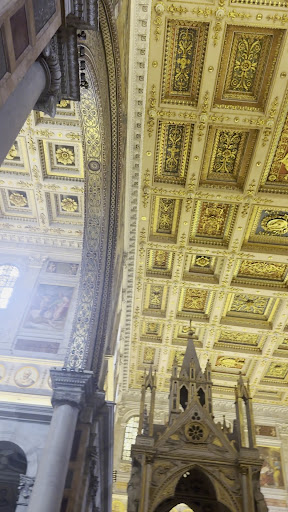
The nave and ornate ceiling date from the 19th century, but the triumphal arch mosaic survives from the 5th century. Its inscription dates it to the time of Leo I (440-61). The theme of the mosaic is the Apocalypse: the 24 Elders of the Apocalypse flank a bust of Christ with the symbols of the Four Evangelists.
All that remains of the medieval basilica is the 13th-century apse mosaic, created by Venetian artists. The mosaic centers on Christ flanked by the Apostles Peter, Paul, Andrew and Luke. In the lower zone are Apostles carrying scrolls with the text of Gloria in excelsis. Beneath Christ is a throne with the instruments of the Passion and a cross. In the center of the cross is another depiction of the Teaching Christ. The figure near Christ's feet is Pope Honorius III (1216-1227), who ordered the mosaic.
One of the basilica's most important artworks is a 12th-century candelabra by Vassalletto, who's also responsible for the remarkable cloisters, containing twisted pairs of columns enclosing a rose garden.
Also notable is the baldachino (richly embroidered fabric of silk and gold, draped over an important person or sacred object) of Arnolf di Cambio, dated 1285, which also was spared by the fire.
The cloisters were built between 1208 and 1235. The inscription in the mosaics is a poem describing the importance of cloisters in the life of a monk and the use of the cloisters as a place of meditation and study. The sacristy of the cloisters contains a fine statue of Pope Boniface IX.
The chapel of relics has numerous relics, the most notable of which are a set of chains said to be the prison chains of St Paul, used in the last days before his execution. They are exposed in the church on his feast days.
In the gift shop, monks and students sell a fine collection of souvenirs, rosaries, and bottles of Benedictine wine every day except Sunday and...
Read moreA Profound Experience Especially in This Jubilee Year
Visiting the Basilica of St. Paul Outside the Walls in this Jubilee Year 2025 was truly one of the most meaningful moments of my time in Rome. As one of the four major papal basilicas, this site is not only architecturally magnificent but also spiritually powerful and it holds special significance during the Jubilee.
Built over the tomb of St. Paul the Apostle, the basilica is massive, peaceful, and beautifully preserved. The vast nave, impressive marble columns, golden mosaics, and tranquil cloister make it feel both majestic and serene. It's far less crowded than St. Peter’s, which gives you space to reflect and take it all in.
Jubilee Year Highlight: The Holy Door As part of the Jubilee tradition, the Holy Door at St. Paul Outside the Walls is open throughout 2025 for pilgrims. You'll find it to the right of the main entrance (facing the basilica façade). Walking through the Holy Door is a deeply symbolic act and part of the spiritual pilgrimage and an opportunity for renewal, grace, and indulgence as part of the Church's Jubilee offerings.
It’s incredibly moving to follow in the footsteps of pilgrims who have entered through this door during holy years for centuries.
What to See:
Practical Tips:
This is one of Rome’s true spiritual treasures and during the Jubilee Year, it takes on even greater meaning. Whether you're making a pilgrimage or simply exploring Rome’s religious heritage, St. Paul Outside the Walls is an...
Read more