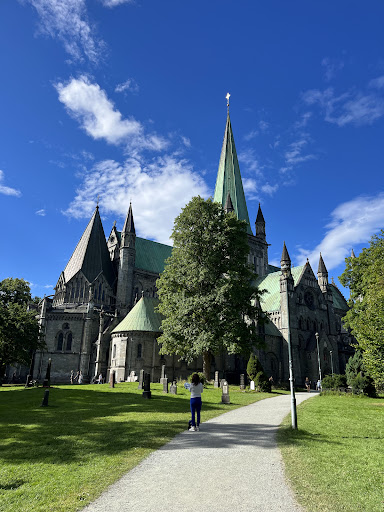
Nidaros Cathedral is
Norway's national sanctuary, Nidaros Cathedral was built over the grave of St. Olav, Norway's patron saint whose reputation shone far beyond the borders of his country.
Construction started in 1070, but the oldest parts still in existence are from the middle of the 12th century. Ravaged by fire on several occasions, the church was rebuilt each time - mainly in the Gothic style, but the oldest parts around the transept reflect the Roman style.
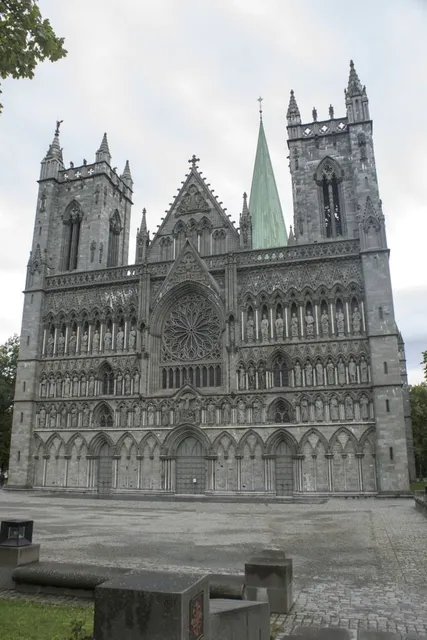
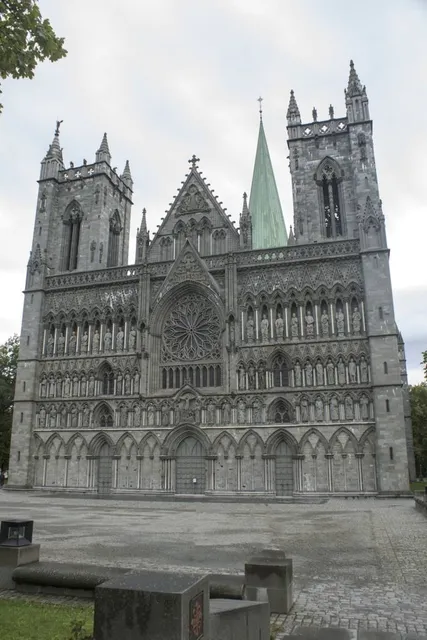
The west wall is the main façade of the church. The axis of the wall shows the crucified Christ in judgement; at the top, Christ enthroned in glory - the church was dedicated to Christ in medieval times, and was called the Church of Christ (Kristkirken in Norwegian). It is richly ornamented in stone, with magnificent stained glass windows from the 20th century.
From the 11th century until the Reformation this cathedral was an important destination for pilgrims. This tradition has been revived with the opening of the pilgrim way in 1997.
From 20 June to 20 August: Evening mass. The mass features a great deal of music, and is intended especially for travellers visiting Trondheim.
The Nidaros Cathedral West Front (Nidarosdomens Vestfront), which includes multiple sculptures, was the final portion of the Nidaros Cathedral in Trondheim, Norway that was restored. Nidaros Cathedral is the world's northernmost medieval cathedral and Norway's national sanctuary. The West Front is the cathedral's main facade and one of the most beautiful and ornate portions of the church. The restoration of the West Front took from 1905 to 1983 and was worked on by a large number of sculptors. In 1869, the Nidaros Cathedral Restoration Workshop was founded with the purpose of restoring the Cathedral, and celebrated a 150 years Anniversary in 2019.
shows extensive deterioration, with only the bottom sections left standing. Only five statues from the Middle Ages have survived. The restoration of the West Front took from 1905 to 1983 and was worked on by a large number of sculptors.
The largest church bell in Norway hangs in the West Front's north tower. Installed in 1964, it weighs 2,400 kg, and people say that it can be heard in Melhus, all of 30 km away, when the wind is in the right direction. The church has three bells. The 'Great Bell' is the oldest and was cast in Hoorn in the Netherlands in 1751.
This part of the church is also the most recent of the original cathedral constructions; archbishop Sigurd Eindrideson laid the cornerstone for the west front in 1248. The construction was not yet complete when the church was burnt in 1328. The original design for the west face is not known, but one can assume that it was never built to those original plans; it is reasonable to assume that a screen front similar to that used elsewhere was planned on the west. Screen fronts were often rectangular and served as a cover to conceal the rest of the church. English cathedrals from the same period, among others Lincoln Cathedral, Wells Cathedral and Salisbury Cathedral, had similar fronts. The west front had three entrances and is flanked by two smaller towers on each side of...
Read moreNidaros Cathedral is a priceless work of art. It has thousands and thousands of visitors every year, which creates a lot of wear and tear. For those who complain that there is a ticket to buy for entrance, consider the cost of maintaining this medieval gem. Catholics who are there to worship do not pay the ticket fee. We are not Catholic and were there strictly to see this masterpiece, so we bought a combination ticket for the Cathedral, the Arch Bishop's Palace, and the Crown Jewels museum. This is well worth the cost and the time, especially if you are a history lover. The tour of the Arch Bishop's Palace is fascinating. Anyway, back to the Cathedral. The inside is stunningly beautiful. There are no photos allowed inside except from one of the upper galleries. I was slightly bothered by that for a few moments until I realized that this is their way of maintaining reverence in a house of worship. They have three different organs, and have organists perform at various times during the day. We heard a recital on the Baroque organ (the organist played several Bach pieces, including Toccata and Fugue in D minor - the organ is a treasure!), and after we had toured the other museums on site, we came back and heard a gorgeous recital of contemporary organ pieces on the new organ in the front of the cathedral. This organ is stunning to look at and even better to hear. The recital was a highlight of our vacation. We also paid a small fee to climb 178 steps up a tower to the top of the cathedral. The view was well worth the ticket and the climb! It also motivated me to get in better shape before I try something like this again. ;) There is also a crypt under the church that is open to anyone who is touring the church. Some of the stones are really ancient. There is a beautiful tribute inscribed on one coffin cover written by a husband to his wife who had died. It was touching to read.
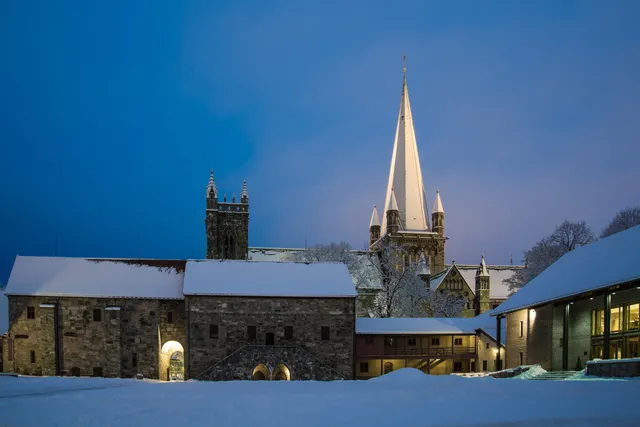
The Arch Bishop's Palace was a fascinating tour. They also offer the tour in English, German, and French, so be sure to check with the front desk to see when a tour in your language will start. Our tour guide was very cute and engaging. She taught us with humor and insight and made it a very fun and informative experience. You learn quite a bit of Norwegian history on the tour and see a lot of things recovered in archeological digs on the site. The palace and the adjoining buildings were used for many different things over the years, and it was almost forgotten what the palace had been.
If you're planning to make a day of this place as we did, there is also a little cafe/coffee shop in the gift shop where you can get sandwiches, pastries and drinks.
The whole experience was wonderful and enlightening. We felt peace and love in the cathedral, learned more about Norway in the museums, and found plenty of interesting books in the gift shop. We will be back in a few years to enjoy this lovely...
Read moreThis exquisite cathedral which dates back to 1070 is also the burial place of the Viking, King OlavTryggvason. The Gothic Architecture is incredible and you only really "feel" the size of this structure to some extent, once you are inside. The Cathedral is currently undergoing repairs and maintenance, this however does not deter from the beauty and incredible workmanship that can be seen everywhere. Of course over the centuries there have been additions and annexes added to the structure which in my humble opinion makes it even more interesting. There is ample room outside to wander and take pictures right around this incredible piece of Viking history. Very important is to note that no cameras or videos are to be used inside, the main reason being, preservation of this structure, for generations to come. Most people respect and understand this rule, however, there is always one! A tourist who does not really care about history, preservation or even generations to come. They will take pictures, just to be able to say "I was there". Shame on them! This is exactly what an Italian Tourist was doing when we all arrived. Some people asked her to stop but she pretended not to hear and then not to understand and although it was blatantly obvious in the signage everywhere and the fact that nobody else was"pointing and shooting", she continued. It was only when she realised that she was upsetting everyone that she left the building. This is unacceptable behaviour, being disrespectful with no regard for history and art, not to mention the heritage of an entire nation. There is also an excellent viewing station inside the Cathedral , with many interesting facts and all you would like to know which you can scroll through quite easily, the screens large enough for most and the writing size is legible. If there is one place to see in Trondheim that will take your breath away, it is the...
Read more