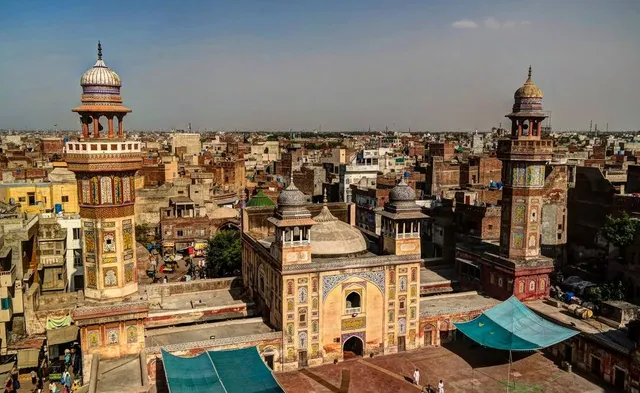
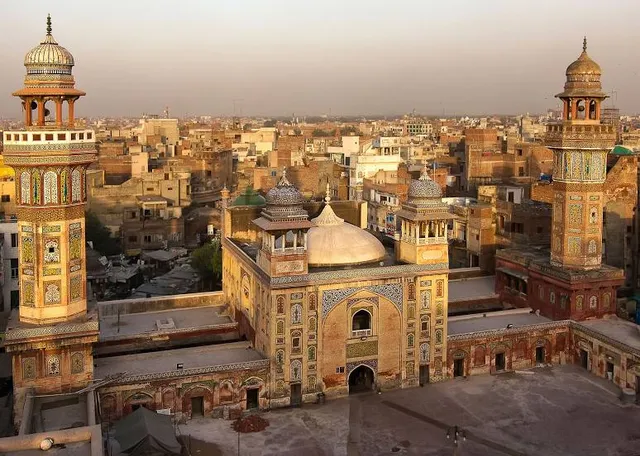
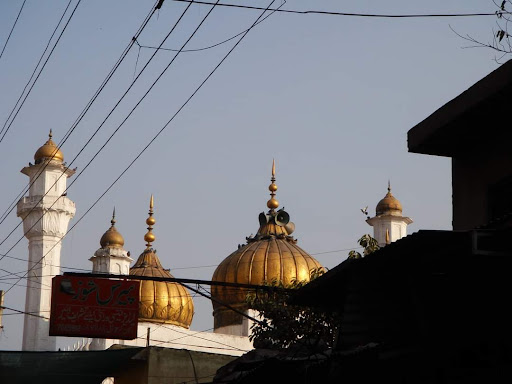
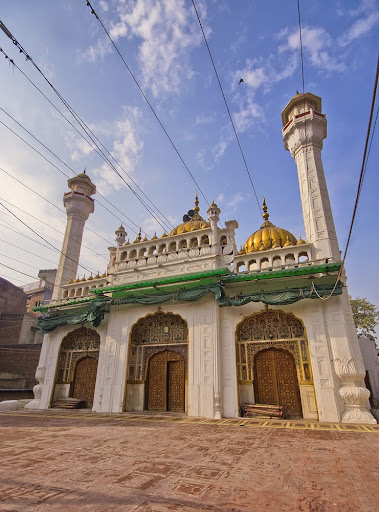
Distant view of the golden domes of Sonheri Mosque. Sonehri Mosque, also known as Masjid Talai (Talai=sonehri or golden), is a late-Mughal structure built by Nawab Bhikari Khan, son of Raushauddawla Turrabbaz Khan, Governor of Lahore during the viceroyalty of Mir Moin-ul-Mulk or Mir Mannu (d. 1753), well known for his victorious battle with Ahmad Shah Durrani in Sirhind (1748).
Bhikari Khan himself acted as confidante of Mir Mannu's wife, who, on the death of her husband, acted as regent for her infant son. Known for his piety, Bhikari Khan constructed his mosque in Chowk Kashmiri Bazaar. According to epigraphical evidence provided on the facade of the prayer chamber, the mosque was built in 1749. The somewhat irregular plan of the mosque and necessity of providing two access staircases was due to the constrained site conditions. Although he was permitted to occupy an open space in the chowk (square) he could not persuade the religious authorities to allow incorporation of an existing small mosque into the new structure. Historian and Engineer Kanhaiya Lal credits Deputy Commissioner Lahore, Captain Nisbet in bringing Bhikari Khan's concept to fruition one hundred years later, by demolishing the small mosque in question and incorporating the space within Sonehri Mosque compound.
Built on a raised vaulted platform about 11 feet above the surrounding level, the structure covers a rectangular area measuring 102 feet by 45 feet. The basement is composed of deep, narrow cells. A flight of sixteen steps has been provided against a small entrance gate on the east. An open courtyard measuring 65 feet by 43 feet, with an ablution tank 25 feet by 27 feet, has been provided in front of the prayer chamber, measuring 40 feet by 16 feet. The northeast and southeast corners of the prayer chamber have minarets which rise 46 feet 9 inches, crowned with blind pavilions. The eastern facade of the prayer chamber, including the corner minarets, is lime-plastered, with panels of various sizes which originally had fresco decoration.
The prayer chamber is a single-aisle 3-bay structure, surmounted by 3 distinctive copper domes carrying polished gilding, which due to its shine, is visible from a great distance. Its four minarets marking the four extremities are also capped by golden cupolas, and are a reconstruction since their collapse in the earthquake of 1905.
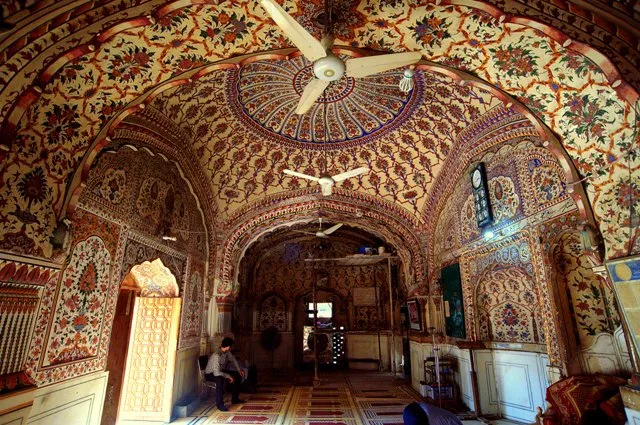
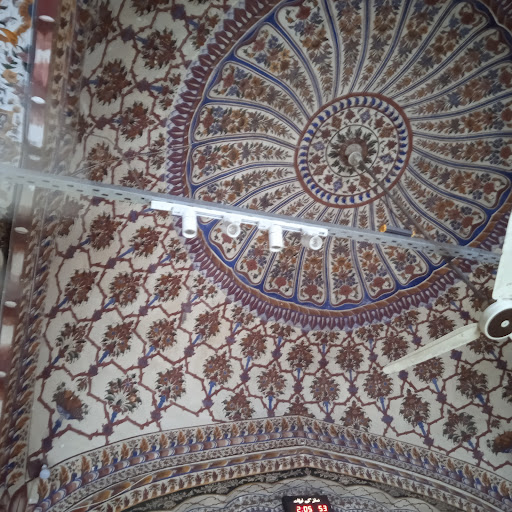
The prayer chamber is divided into three compartments by four centered cusped arches carried on jambs nearly three feet thick. The central bay, nearly square and measuring around 15 feet, is bigger than those flanking it. In the centre of the western wall is the mihrab, balanced by similar niches in each of the two side bays. Pointed arched openings are provided in the eastern facade. The entire interim is decorated with frescos work. However, much of it was badly repainted later.
The roof of the mosque carries double bulbous domes with a high neck at the springing level, on which there is a row of pseudo-acanthus leaves. The domes are crowned with pinnacles and gilded. The core of each dome is of masonry, over which a casing of wood has been applied. Copper plates have been fixed over the wooden casing. The central dome is the largest.
The foresight of Bhikari Khan in elevating the mosque above shops—the rent from shops providing a source of revenue—ensured the upkeep of the mosque even during most of the Sikh rule. It was only when the Garanth Sahib (Sikh Holy Book) was placed in the adjacent baoli (stepped well) of Ranjit Singh, that complaints of disturbance from the azan (Muslim call for prayers) began to be voiced by the Sikh community. The orders of Ranjit Singh for dispossessing the imam (the custodian of the mosque) and placing the Garanth in the mosque were received with dismay by the Muslim populace. According to Kanhaiya Lal it was the efforts of Fakir Aziz-ud-Din and Noor-ud-Din in enlisting support of Gullu Mashki (the watercarrier in high favour with Mahrani Jindan), to influence Ranjit Singh that resulted in the reversal of the Sikh ruler's...
Read moreSonehri Mosque, also known as Masjid Talai (Talai=sonehri or golden), is a late-Mughal structure built by Nawab Bhikari Khan, son of Raushauddawla Turrabbaz Khan, Governor of Lahore during the viceroyalty of Mir Moin-ul-Mulk or Mir Mannu (d. 1753), well known for his victorious battle with Ahmad Shah Durrani in Sirhind (1748).
Bhikari Khan himself acted as confidante of Mir Mannu's wife, who, on the death of her husband, acted as regent for her infant son. Known for his piety, Bhikari Khan constructed his mosque in Chowk Kashmiri Bazaar. According to epigraphical evidence provided on the facade of the prayer chamber, the mosque was built in 1749. The somewhat irregular plan of the mosque and necessity of providing two access staircases was due to the constrained site conditions. Although he was permitted to occupy an open space in the chowk (square) he could not persuade the religious authorities to allow incorporation of an existing small mosque into the new structure. Historian and Engineer Kanhaiya Lal credits Deputy Commissioner Lahore, Captain Nisbet in bringing Bhikari Khan's concept to fruition one hundred years later, by demolishing the small mosque in question and incorporating the space within Sonehri Mosque compound. Built on a raised vaulted platform about 11 feet above the surrounding level, the structure covers a rectangular area measuring 102 feet by 45 feet. The basement is composed of deep, narrow cells. A flight of sixteen steps has been provided against a small entrance gate on the east. An open courtyard measuring 65 feet by 43 feet, with an ablution tank 25 feet by 27 feet, has been provided in front of the prayer chamber, measuring 40 feet by 16 feet. The northeast and southeast corners of the prayer chamber have minarets which rise 46 feet 9 inches, crowned with blind pavilions. The eastern facade of the prayer chamber, including the corner minarets, is lime-plastered, with panels of various sizes which originally had fresco decoration. The prayer chamber is a single-aisle 3-bay structure, surmounted by 3 distinctive copper domes carrying polished gilding, which due to its shine, is visible from a great distance. Its four minarets marking the four extremities are also capped by golden cupolas, and are a reconstruction since their collapse in the earthquake of 1905. The prayer chamber is divided into three compartments by four centered cusped arches carried on jambs nearly three feet thick. The central bay, nearly square and measuring around 15 feet, is bigger than those flanking it. In the centre of the western wall is the mihrab, balanced by similar niches in each of the two side bays. Pointed arched openings are provided in the eastern facade. The entire interim is decorated with frescos work. However, much of it was badly repainted later. The roof of the mosque carries double bulbous domes with a high neck at the springing level, on which there is a row of pseudo-acanthus leaves. The domes are crowned with pinnacles and gilded. The core of each dome is of masonry, over which a casing of wood has been applied. Copper plates have been fixed over the wooden casing. The central dome is the largest. The foresight of Bhikari Khan in elevating the mosque above shops—the rent from shops providing a source of revenue—ensured the upkeep of the mosque even during most of the Sikh rule. It was only when the Garanth Sahib (Sikh Holy Book) was placed in the adjacent baoli (stepped well) of Ranjit Singh, that complaints of disturbance from the azan (Muslim call for prayers) began to be voiced by the Sikh community. The orders of Ranjit Singh for dispossessing the imam (the custodian of the mosque) and placing the Garanth in the mosque were received with dismay by the Muslim populace. According to Kanhaiya Lal it was the efforts of Fakir Aziz-ud-Din and Noor-ud-Din in enlisting support of Gullu Mashki (the watercarrier in high favour with Mahrani Jindan), to influence Ranjit Singh that resulted in the reversal of the Sikh ruler's decision. The undertaking given by the imam...
Read moreThe Sunehri Masjid of Lahore
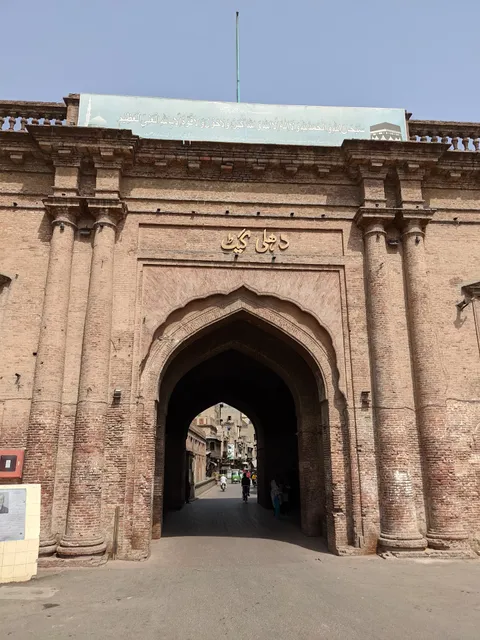
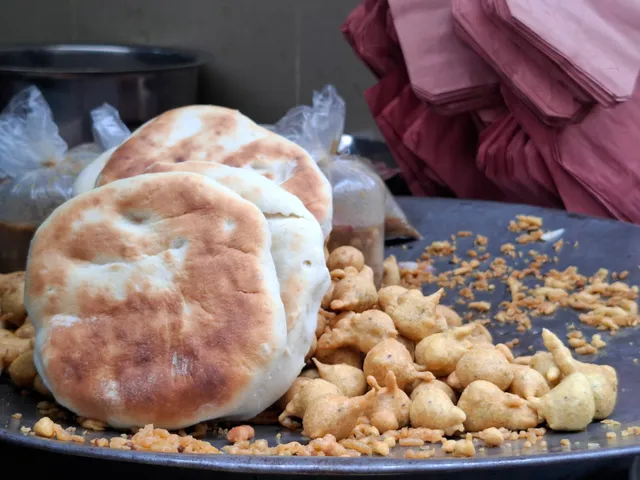
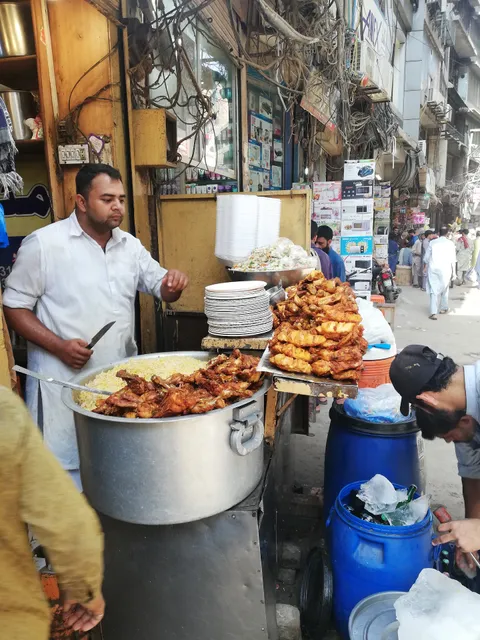
National heritage left to decay In the hustle and bustle of the dazzling Kashmiri Bazaar one cannot ignore the majestic, glittering monument the Sunehri Masjid or the Golden Mosque standing on the masonry platform, about one storey above street level. It is a small mosque but a remarkably handsome building, and combines perfect symmetry of form. The mosque has three gilded domes (golden domes) which are the key features and main focus point. They also make it unique inside the Walled City of Lahore. Due to its gilded domes this mosque is named Sunehri or Golden Mosque. The inner prayer hall is decorated with pulsating fresco work and floral designs. On the north and south of the mosque, small white dome-lets are seen, which give a fine-looking border to the site. Four tall minarets add to the exquisiteness of this mosque. At present, the area near the mosque is the busiest inside the Walled City of Lahore. The Waan Market (known for handmade twisted twine furniture) is located outside the mosque. The bazaar is extremely colourful and gives one the typical feel of the vibrant Walled City. The mosque is also part of the Royal Trail that starts from Delhi Gate. Temporary stalls are also located outside the mosque. Dahi Bhalay and Laddo Pithi Walay (local foodstuff) of this area are considered among famous eateries. The mosque was built in 1749-53 AD by Nawab Mir Syed Bhakri Khan, the Naib Subedar of Lahore at the time when Mir Moin-ul-Mulk was the Subedar during the reign of the Emperor Mohammad Shah. Syed Bhakri was a simple Sufi and religious minded person interested in literature and fine arts. The mosque was built amid much controversy. The locals of the area resisted the construction of mosque in a central crossing place of Rang Mahal and Kashmiri Bazaar, thinking it would hinder the locals and traffic movement. According to various historic accounts, another controversy over the construction of the mosque was an already existing mosque nearby. The mosque was built after a “Fatwa” from Islamic scholars of the area, who declared that all land belongs to Allah and there is no harm if a mosque is constructed near another one. During the Sikh rule, the mosque was used for different activities. The floor was plastered with different filthy materials which were against the sanctity of the mosque. Later, the Sikh Holy Book was also placed inside the mosque and it was turned into their worship place. The Muslims at that time were offended and dejected over the misuse. The Mohammedans in Lahore during the same period requested the influential Muslim families the Faqirs, Aziz Uddin and Noor Uddin, to approach the Maharaja for restoring the mosque and handing it back to the Muslims. After many negotiations the mosque was handed over to the Muslims but the shops outside remained an issue. The Sikhs demanded that the call for prayers or “Azan” should not be made loudly. The Muslims, to save the sanctity of the mosque, agreed to it. When the British took over Punjab, they handed over the shops to the Muslims and restored the mosque again. It was restored by USAID in 2012 but unfortunately not much is maintained now. It is not as well kept as Wazir Khan Mosque. The mosque is not accessible to tourists as most of the time (other than prayers) it is locked. It is no doubt a heritage and must be kept open for tourists and the...
Read more