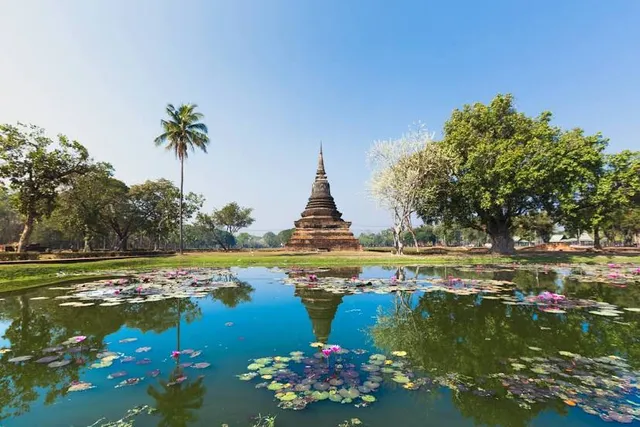
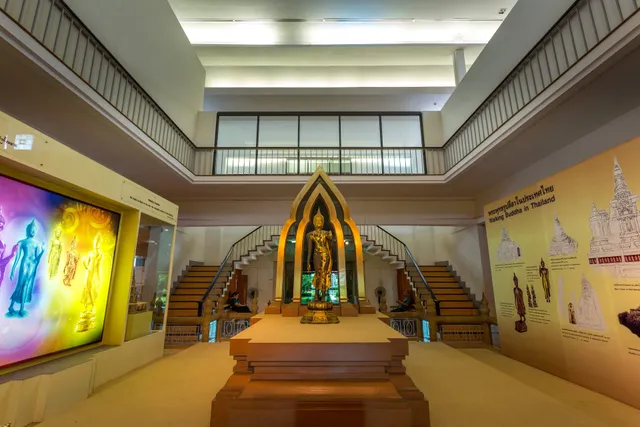
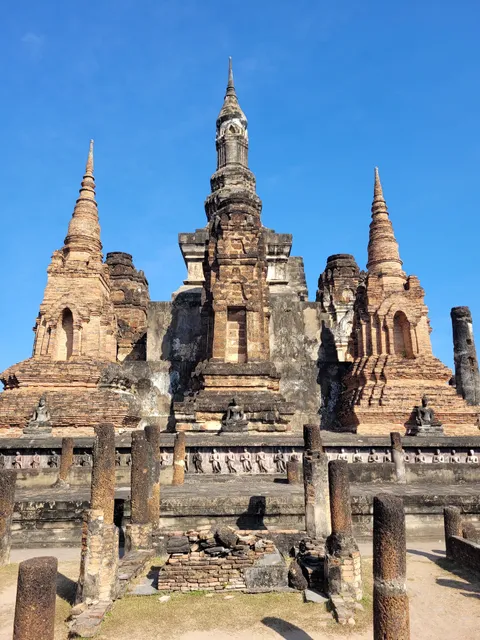
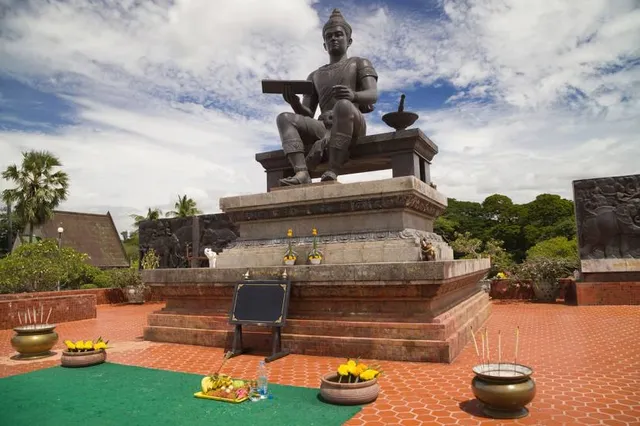
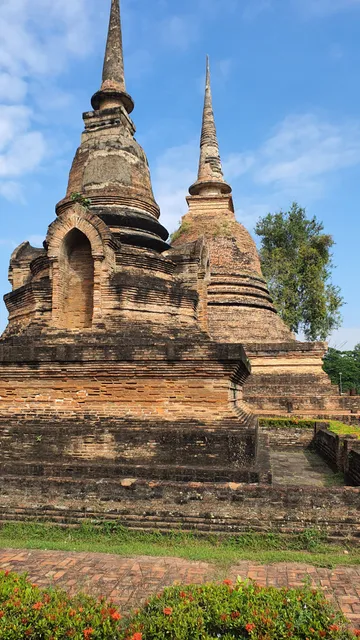
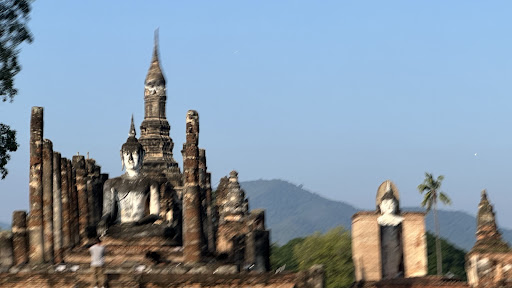
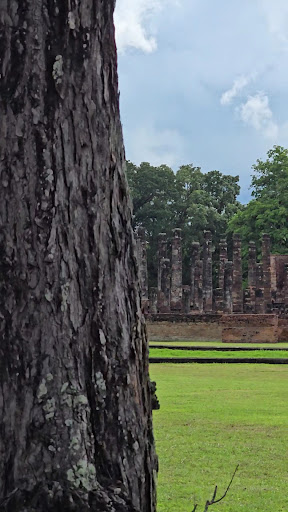
Sukhothai is the very first capital City of Thailand. In the golden time of this city it is a center of everything on this south-east Asia. Now a day the ruin from that glorious time a left behind for people of this generation to study story about one of the ancient city that accept by United Nation Educational Scientific and Cultural Organization (UNESCO) to be World Heritage. Sukhothai Historical Park location's is at the opposite of Ramkhamhaeng National Museum. There a lot of interesting place inside this area. Wat Maha That. This temple is a center of the historical park. Inside the temple is the grand pagoda that surround by another 8 pagodas as if they are a lotus. Front gate of the temple has a Buddha statue called Phra Atha Ros. The King Ramkhamhaeng monument. This monument can be found at the end of Jarod Vitee Tong road on the north side of Wat Maha That. Sukhothai city's defensive wall. It a two layer wall that use to defense the city. Inner layer is built on upper ground and use laterite as a material. Outer layer is a canal switch with a slit wall. Between two layer there city gate and defensive fort both side of defensive wall. Wat Chana Songkram. This temple locate at the north side of Wat Maha That. The point of interest is main pagoda inside the temple that look like a giant bell. Prasart Phra Ruang hill. This area use to be a royal palace it locate at east side of Wat Maha That. Wat Tra Phang Ngearn. This temple locate at west side of Wat Maha That. Around the temple has no wall and only one lotus style pagoda inside. Wat Sa Sri. This temple locate at north-west side of Wat Maha That. The design of this temple actually outstanding from another temple around it has a building on pool and pagoda in Ceylon style. Wat Sri Swai. This temple locate at south side of Wat Maha That. There are three pagodas build in Lopburi style inside the temple. Ta Pha Deang Shrine. This ancient shrine that build in Khmer style. Fine Arts Department rebuilt this shrine and bought the relics they found inside to Ramkhamhaeng National Museum. Wat Phra Luang Luang is the second most important temple after Wat Maha That. This temple is the center of community back in it time. The oldest remains of the temple are the three pagodas. Sukhothai Historical Park Tourist center. This center is a Thai style Sukhothai architecture. Located in front of Wat Phra Phai Luang. Inside the center there are information about Sukhothai Historical Park to provide for tourist. Sukhothai pottery archaeological site. This site is near Wat Phra Phai Luang around the old moat area called "Mae Joan". The burner historian found here is a burner in Sukhothai period. Pottery that mostly found in this area are cups and bowls. Wat Sri Chum. This temple has large Buddha statue called Phra Ajchana. Due to an old condition of temple there is barley anything left to see this temple in a shape of building however the statue is still in task and remain until this day. Wat Charng Rob. This temple is locate at west side of Reed gate. There are pagoda in Ceylon style which has surround it base by 24 elephants. Sreed Phong Dam. This dam locate at old city district. The purpose to build this dam for store water and then send through canal around city's defensive wall to gold and silver basin inside the city. Wat Che Tu Phon. The temple that has sanctuary build from brick, laterite and slate. Inside sanctuary there are four statue of Buddha in different pose include sit pose, lay down pose, stand pose and walk pose. Wat Jedi Si Hong. This temple is locate at east side of Wat Che Tu Phon. Inside of the temple has a Ceylon pagoda that decorate by man and woman sculpture around base of this pagoda. Wat Sapan Hin. This temple standing Buddha image in attitude of meditation tall around 12.5 m. called Phra Attha Ros. Wat Charng Lom. This temple has a Ceylon pagoda that decorate by half elephant sculpture around its base. Wat Tra Pung Thong Lang. This temple is locate at the end of Jarod Vitee Tong. There is a small fees to enter this park and...
Read moreTo show deep respect for the culture while visiting Sukhothai Historical Park, tourists can engage in the following practices: • Dress Modestly: Wear clothing that covers shoulders and knees, especially when entering temple areas like Wat Mahathat, as this respects Thai Buddhist customs and shows reverence for sacred spaces. • Practice Proper Temple Etiquette: Remove shoes before entering temple buildings, avoid pointing feet at Buddha images, and refrain from touching or climbing on statues and ruins to honor the spiritual and historical significance of the site. • Support Local Artisans: Purchase authentic Sukhothai handicrafts, such as Sangkhalok ceramics or handwoven textiles, from local markets or cooperatives, contributing to the preservation of traditional crafts and the local economy. • Learn Basic Thai Phrases: Use simple greetings like “sawasdee” (hello) or “khob khun” (thank you) when interacting with locals, demonstrating appreciation for the Thai language and fostering respectful communication. • Participate Mindfully in Local Events: If visiting during festivals like Loy Krathong (November), join respectfully by floating krathongs (lotus-shaped offerings) in designated areas, following local guidance to honor Sukhothai’s cultural traditions without disrupting the environment.
• UNESCO World Heritage Site: Sukhothai Historical Park, the former capital of the Sukhothai Kingdom (13th-14th centuries), is recognized for its well-preserved ruins, including royal palaces, Buddhist temples, and intricate water systems, showcasing the dawn of Thai architecture and culture. • Iconic Wat Mahathat: The park’s centerpiece, Wat Mahathat, is a stunning temple complex with over 200 chedis (stupas), featuring the classic lotus-bud chedi design, surrounded by moats and serene ponds, offering breathtaking views, especially at sunrise or sunset. • Cycling Adventure: Spanning 70 square kilometers, the park is best explored by renting a bike (around 30-50 baht/day), allowing visitors to leisurely navigate the expansive, traffic-free grounds, passing ancient ruins, lush greenery, and lily-covered ponds. • Sukhothai Night Market: On Friday and Saturday nights, the Central Zone hosts a vibrant night market within the ruins, where visitors can savor local dishes like Sukhothai noodles, spicy salads, and Thai sweets while immersing in the local culture. • Tranquil Ambiance: Unlike more crowded historical sites, Sukhothai’s vast layout and lower tourist traffic provide a peaceful, almost meditative experience, enhanced by its idyllic setting with exotic trees, birds, and serene lakes, perfect for solitary...
Read moreIn a civilized and Buddhist nation, one should not be subjected to racism. Once, they used to say “No Jews or dogs allowed,” but those with money could still enter; today, the same discrimination appears in the form of exorbitant prices. Are you a tourist? Then you must pay 2000% more.
Since childhood, I have dreamed of coming here, as I am deeply passionate about archaeology and, by profession, a historical playwright. I had planned to spend a long time in this place, writing new scripts that could merge Thai art with my own.
When I arrived at the gate, I realized the immense discrimination in ticket pricing: if you are a tourist, you must pay 400 baht per person, while a Thai citizen pays only 40. This is not a matter of income—Europeans are not all equal either—but such a difference is simply absurd. A moderate price difference, perhaps 100 baht, would be understandable, but these figures are unacceptable.
There are many parks, all with separate entrance fees, and there is not even a cumulative or weekly pass. How can one expect a visitor, without access to public transportation, to visit them all in a single day? It is not fair that we are penalized simply because of our passport. I have also heard other explanations for the high prices, but they are even more discriminatory.
For the love of archaeology, of Buddhism, and of its principles, I have decided not to enter this site, even though it has been my dream since I was a child studying it in schoolbooks.
Many others have made the same choice for this very reason. I have met pilgrims who came from India for religious purposes and were also denied entry.
If you wish to spend a day meditating in this sacred place, you will not be able to do so—money is being made from the image of the Buddha, while he himself always taught the opposite. How can such injustice coexist with his teachings?
Outside these sacred places, everything seems dominated by chaos: unregulated taxis, disorganized buses—a whole system built only to make money. Is this what we have become? Even in sacred places, we no longer look one another in the eye.
It seems that the obsession with money has taken over here as well. As a Buddhist, I feel deeply ashamed. There is no justification for such an expensive ticket, since these sites already receive maintenance funding from UNESCO.
I understand that money can tempt anyone, but behaving this way in a place of prayer and meditation is...
Read more