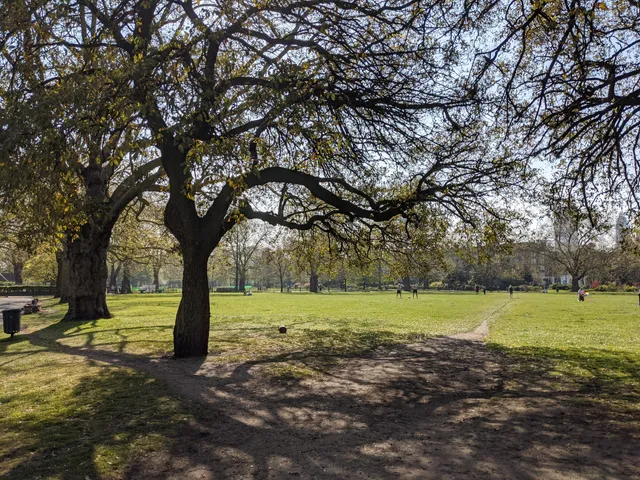
Kennington Park is a public park in Kennington, south London and lies between Kennington Park Road and St. Agnes Place. It was opened in 1854 on the site of what had been Kennington Common, where the Chartists gathered for their biggest "monster rally" on 10 April 1848.
Soon after this demonstration the common was enclosed and, sponsored by the royal family, made into a public park.
Kennington Common was a site of public executions until 1800 as well as being an area for public speaking.
Some of the most illustrious orators to speak here were Methodist founders George Whitefield and John Wesley who is reputed to have attracted a crowd of 30,000.
The common was one of the earliest London cricket venues and is known to have been used for top-class matches in 1724.
Kennington Park hosts the first inner London community cricket ground, sponsored by Surrey County Cricket Club whose home, The Oval, is close to the park.
Casual games of both cricket and football are regularly held in the park.
In the 1970s, the old tradition of mass gatherings returned to the park which was host to the start of many significant marches to Parliament.
Today, a number of commercial and community events are held in the park each year and recently the Flower Garden was restored with a Heritage Lottery grant.
The Friends of Kennington Park, was founded in 2002 and provides a local forum for park issues as well as fundraising for improvements.
1854 Kennington Park opened and maintained by the Crown's Office of Works.
1859 Vauxhall Pleasure Gardens opened for the last time on the night of Monday, 25 July 1859.
1861 Two panelled gardens laid out by John Gibson on the west side to either side the lodge.
1861 A gymnasium erected (which became tennis courts before the children's playground moved there in 2006).
1861 Meeting of the Juvenile Temperance Society allowed in the summer. (PRO work 1/71)
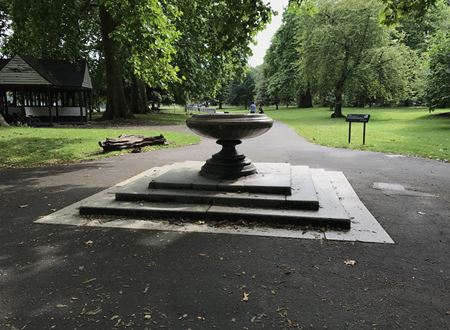
1862 Felix Slade drinking water fountain designed by Charles Henry Driver.
Slade donated this after feeling sorry for the local children who, after playing in the gymnasium, had been taking their refreshment from the cab horse trough.
1869 Sir Henry Doulton donates local artist George Tinworth's 'Fountain of Life'.
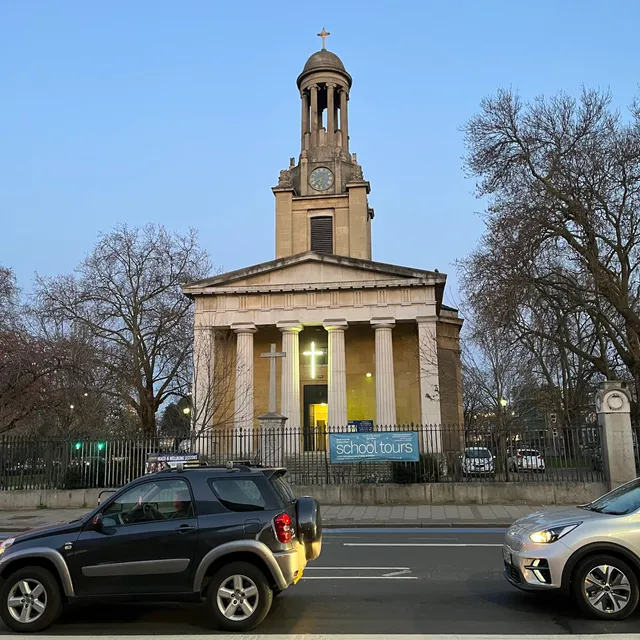
1874 Parish of St Agnes, Kennington Park founded.
1877 Church of St. Agnes, Kennington Park consecrated by the Lord Bishop of London.
1887 Kennington Park maintenance passed over to London's Metropolitan Board of Works.
1889 Kennington Park passed to London County Council that later became the Greater London Council, GLC, in 1965.
1896 A 7-year old Charlie Chaplin spent a day playing in the park after his mother discharged the family from the Lambeth Workhouse in desperation to see her children.
After a day in the park and at a coffee-shop they returned to the workhouse to undergo the shameful admissions process again.
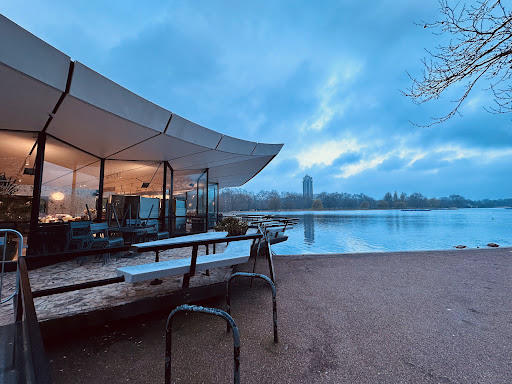
1897 An Arts & Crafts style refreshment house erected which is now a rare survival.
1898 Princess of Wales Theatre, designed by W. G. R. Sprague, opens at the height of the music hall era. (closed c. 1934 and site 'Compulsorily Purchased' for flats in 1949) The theatre had one of earliest air conditioning systems.
1899 The first all-night illuminated footpath through a...
Read moreFarely large swathe of manicured grass with mature trees, separated into two by St Agnes Place. Kennington derived from the Saxon word Kyning-tun = Town of the King. King Harthacnut of England and Denmark (son of King Cnut aka Canute of tidal fame) died here in 1041. Harold Godwinson was crowned here the day after Edward The Confesser died. During the 1230's Henry 3rd held his Court and Parliament here. In 1343 The Black Prince was the 1st Royal Heir to the Throne who was granted Duchy of Cornwall, Vauxhall and Kennington, as well as Prince of Wales. All of which came under his ownership. He resided at Kennington Palace (demolished by James 1st) where his son, the future Richard 2nd was born. The site is now commemorated by Black Prince Rd. The Black Prince used Kennington Common (now Park) to rally his troops, South of the River Thames to attack France. James 1st of England aka James 6th of Scotland gave the land to his eldest son Prince Henry Frederick in 1603 when he inherited the title Prince of Wales and Duchy of Cornwall, Vauxhall and Kennington. It was the main place of public executions for the County of Surrey up until the 19th Century. During the 1740's many Scottish Jacobites were executed here. Much of the common was built upon creating Camberwell New Rd and St Mark's Church in the Georgian 1800's. Surrey County Cricket Club rented the area of the common now known as The Oval Cricket Ground. Whilst the rest of the common was used much like today's Speaker's Corner by religious orators preaching to the masses of fairground goers. In 1854 Queen Victoria changed it's use from a common to a pleasure gardens. Today it continues to be a very pleasant green oasis lung. With playground, fitness circuit, tennis, basketball and netball courts, bring your own table tennis rackets for the ping-pong tables, wee skate park, renovated flower garden, wee pond, changing facilities, cafe and toilets. Fantastic place to let your dogs and children let off steam. In close proximity to The Kennington Monument, St Agnes Church, The Oval Cricket Ground, Imperial War Museum, Harleyford Rd Community Gardens, Bonnington Square Gardens, Vauxhall City Farm, The Albert Embankment, Vauxhall Bridge, Lambeth Palace, The Garden Museum, Lambeth Bridge, and The River Thames. Nearest stations on the Northern Line Kennington and Oval stations. On the Victoria Line and British Rail Vauxhall. Plus Vauxhall...
Read moreMahoosive swathe of manicured grassland and mature trees. Separated into two by St Agnes Place. Kennington derived from the Saxon word kyning-tun meaning town of the King. King Harthacnut of Denmark and England died here in 1041 (son of Cnut The Great aka Canute of tidal fame). Harold Godwinson was crowned here the day after Edward The Confessor died. Henry 3rd held his court and Parliament here during 1230's. In 1343 The Black Prince was the 1st royal heir to the throne to be granted a Duchy (of Cornwall, Vauxhall and Kennington). He was also made Prince of Wales. All of which came under his ownership. He resided at Kennington Palace (demolished by James 1st) where his son the future Richard 2nd was born. The site is commemorated with Black Prince Road. The Black Prince used Kennington Common to rally troops South of The Thames to attack France. James 6th (Scotland) & 1st (England) gave it to his eldest son Prince Henry Frederick in 1603 when he inherited the title of the Duke of Cornwall as heir to the throne. It was the main place of public executions for the County of Surrey up until the 19th century. Not only hangings took place but also disembowelment, after being drawn and quartered. During the 1740's many Scottish Jocobites were executed here. Much of the Common was built on creating Camberwell New Road, St Mark's Church in the Georgian 1800's. And Surrey County Cricket Club rented the area now known as The Oval Cricket Ground.The remaining Common was used during this time much like Speaker's Corner by preachers preaching to the masses of fairground goers. During Victoria's reign in 1854 it changed it's use from a common to a pleasure gardens. The current heir to the throne Prince of Wales, Prince Charles holds ownership of Cornwall, Vauxhall and Kennington. Now a pleasant green oasis lung. With playground, fitness circuit, tennis courts, basketball/netball courts, bring your own bat table tennis, wee skate park, flower garden, wee pond, changing facilities, toilets and café. Excellent place to allow your dogs and children to let off steam. In close proximity to Kennington Monument, St Agnes Church, The Oval Cricket Ground, Bonnington Square Gardens, Harleyford Road Community Garden, Imperial War Museum, Vauxhall City Farm, Vauxhall Bridge, The Albert Embankment, Lambeth Palace, Garden Museum, Lambeth Bridge, and The River Thames. Nearest stations are Kennington, Oval...
Read more