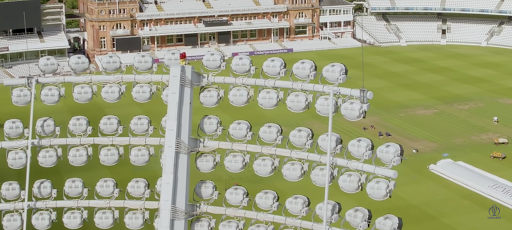
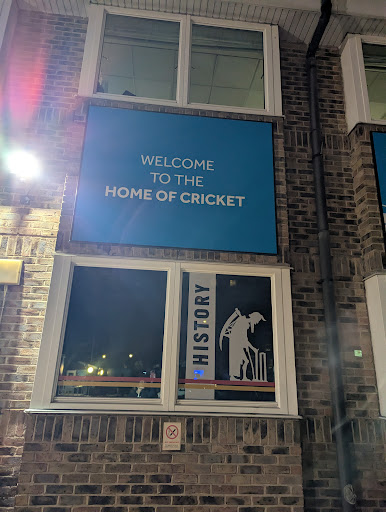
Lord's Cricket Ground known as Lord's, is a cricket venue in St John's Wood, London. Named after its founder, Thomas Lord, it is owned by Marylebone Cricket Club (MCC) and is the home of Middlesex County Cricket Club, the England and Wales Cricket Board (ECB), the European Cricket Council (ECC) and, until August 2005, the International Cricket Council (ICC). Lord's is widely referred to as the Home of Cricket and is home to the world's oldest sporting museum.
Location : St John's Wood, London, England Coordinates : 51.5294°N 0.1727°W Establishment : 1814; 207 years ago Capacity : 31,100 Owner : Marylebone Cricket Club
Lord's today is not on its original site; it is the third of three grounds that Lord established between 1787 and 1814. His first ground, now referred to as Lord's Old Ground, was where Dorset Square now stands. His second ground, Lord's Middle Ground, was used from 1811 to 1813 before being abandoned to make way for the construction through its outfield of the Regent's Canal. The present Lord's ground is about 250 yards (230 m) north-west of the site of the Middle Ground. The ground can hold 30,000 spectators. Proposals are being developed to increase capacity and amenity.As of December 2013, it was proposed to redevelop the ground at a cost of around £200 million over a 14-year period.
The current ground celebrated its two hundredth anniversary in 2014. To mark the occasion, on 5 July an MCC XI captained by Sachin Tendulkar played a Rest of the World XI led by Shane Warne in a 50 overs match.
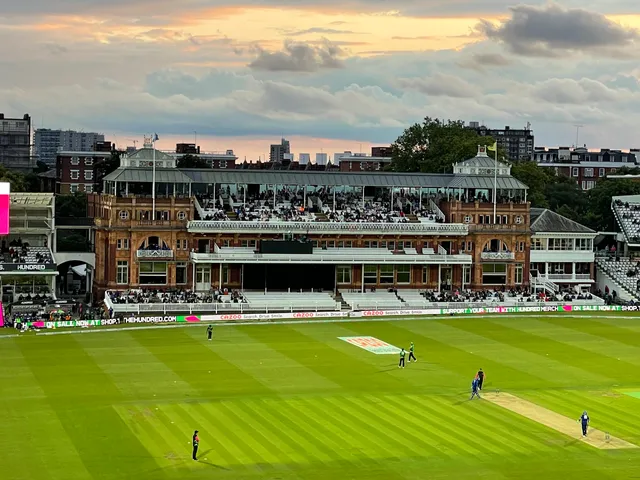
The current pavilion at Lord's is the third pavilion to stand at the ground and is main survivor from the Victorian era, having been built in 1889–90. It has been listed as a Grade II* listed building since September 1982. The pavilion was constructed using brick with ornate terracotta facing, which includes terracotta gargoyles, such as 'The Patriarch' which is thought to represent Lord Harris.The building consists of a long, two storey centre section with covered seating between two end towers which are capped with pyramidal roofs which have ornate wrought and cast iron lanterns.[100] Running the full length of the rear of the second floor is the pavilion roof terrace, which provides views of the entire ground.It underwent an £8 million refurbishment programme in 2004–05. The pavilion is primarily for members of the MCC, who may use its amenities, which include seats for viewing the cricket, the Long Room and its Bar, the Bowlers Bar, and a members' shop. At Middlesex matches the pavilion is open to members of the Middlesex County Cricket Club. The Pavilion also contains the dressing rooms where players change, each of which has a small balcony for players to watch the play.
The Long Room is found on the ground floor of the pavilion and has been described by Lawrence Booth as "the most evocative four walls in world cricket".Players walk through the Long Room on their way from the dressing rooms to the cricket field; this walk is notoriously long and complex at Lord's. On his Test debut in 1975, David Steele got lost on his way out to bat "and ended up in the pavilion's basement toilets".Once a player reaches the Long Room is approximately 30 paces from the swing door at the rear of the room to the steps which lead onto the playing field. The Long Room is decorated with paintings of famous cricketers and administrators from the 18th to the 21st century, predominantly English players. For an overseas player to have their portrait placed in the Long Room is a considerable honour. Amongst overseas players to have a portrait in the Long Room are four Australians: Don Bradman, Keith Miller, Victor Trumper and...
Read moreLord's Cricket Ground was established in 1814 and is named after Thomas Lord, the founder of the ground. It has a rich history and has hosted numerous iconic cricket matches over the years.
The ground is known for its distinctive architecture, including the Victorian-era Pavilion which is a Grade II listed building. The Pavilion is one of the most recognizable features of Lord's and provides seating for members of the Marylebone Cricket Club (MCC).
Lord's has hosted many historic international matches, including Test matches, One Day Internationals (ODIs), and Twenty20 Internationals (T20Is). It has witnessed some of the most memorable moments in cricket history.
The ground is also home to the MCC Museum, which houses a vast collection of cricket memorabilia, including equipment used by legendary players, historic photographs, and trophies.
In addition to cricket matches, Lord's hosts various events, conferences, and weddings. It offers premium hospitality services and facilities for corporate events.
Visitors can take guided tours of Lord's Cricket Ground to explore its history, facilities, and behind-the-scenes areas. These tours provide insight into the rich heritage of the venue.
Over the years, Lord's has undergone several renovations and upgrades to modernize its facilities while preserving its heritage. These efforts ensure that Lord's remains a world-class cricket venue.
Lord's Cricket Ground is situated in St John's Wood, London, NW8 8QN, United Kingdom.
The ground is owned by Marylebone Cricket Club (MCC), which was founded in 1787 and is one of the world's most prestigious cricket clubs. MCC is responsible for the maintenance and operation of Lord's.
Lord's has a seating capacity of around 30,000 spectators. The seating arrangements include the iconic Pavilion, Grandstand, Compton Stand, Edrich Stand, and Warner Stand, among others.
The pitch at Lord's is made of natural turf and is renowned for its quality and consistency. Ground staff meticulously maintain the pitch to ensure it offers a fair contest between bat and ball.
Apart from cricket matches, Lord's hosts various events throughout the year, including charity matches, corporate events, and concerts. The venue is also available for private hire and weddings.
Membership to the Marylebone Cricket Club (MCC) is highly coveted and provides exclusive access to facilities at Lord's, including the Pavilion and Long Room. MCC members have voting rights and play a significant role in the governance of the club.
The Pavilion, built-in 1889, is the most iconic structure at Lord's and features distinctive Victorian architecture. It offers hospitality facilities, members' areas, and media boxes. The Media Centre, designed by Future Systems architects, is a modern addition known for its futuristic design and innovative structure.
Lord's is easily accessible by public transportation, with St John's Wood and Baker Street Underground stations located nearby. Additionally, there are several bus routes that serve the area.
Guided tours of Lord's Cricket Ground are available to visitors, providing them with an opportunity to explore the historic venue, learn about its rich heritage, and visit areas not usually open to the public, such as the players' dressing rooms and the MCC Museum.
The MCC Museum at Lord's houses an extensive collection of cricket memorabilia, including bats, balls, uniforms, and artifacts associated with the history of the sport. It is a must-visit destination for cricket...
Read moreA visit to Lord’s Cricket Ground is not just a visit to a stadium—it's a journey into the very heart of cricket’s rich heritage. Often called the “Home of Cricket,” Lord’s in London holds a unique place in the world of sport. It’s where tradition meets excellence, and where every blade of grass seems to whisper stories of greatness.
From the moment you step through the gates, you feel like you’re entering hallowed ground. The atmosphere is calm yet charged with reverence. Whether it's a packed Test match, a low-key county game, or even an empty stadium tour, Lord’s carries a quiet dignity that’s unlike any other sporting venue in the world.
The historic Pavilion, with its iconic Long Room, polished wood, and strict dress code, feels like a step back in time. Standing on the balcony, where countless captains have watched their teams battle on the field, is an emotional experience for any cricket fan. You can almost see the echoes of legends like Sir Don Bradman, Sachin Tendulkar, and Ben Stokes walking by.
The Media Centre, futuristic in contrast to the classic architecture of the rest of the ground, offers stunning panoramic views and showcases how Lord’s has evolved with the times. The contrast between old and new is tastefully done, preserving history while embracing modernity.
A stadium tour is highly recommended. The guides are knowledgeable, passionate, and full of anecdotes that make cricket history come alive. From seeing the Ashes urn, to stepping into the players’ dressing rooms, to learning about the Honours Boards where only a chosen few have etched their names—it’s an experience that goes beyond fandom and becomes a deep appreciation of the game’s legacy.
Match days at Lord’s are a treat. The crowd is respectful, knowledgeable, and passionate, and the atmosphere is very different from the more raucous stadiums around the world. It’s more refined, yet still full of spirit. You’ll find fans of all ages, dressed in blazers and hats, enjoying every session with thoughtful applause and quiet admiration.
The facilities are top-notch—clean seating areas, excellent food stalls, and helpful staff who keep everything running smoothly. The Lord’s shop is a great stop for souvenirs, and the MCC Museum is a treasure trove for cricket lovers.
In a world where modern stadiums focus on scale and noise, Lord’s stands apart with its elegance, charm, and deep-rooted tradition. It’s not just a ground—it’s a cathedral of cricket, where every visit feels like a...
Read more