I’m…not at all sure what to make of this one.
Perusing the exhibit felt like reading a novel or watching a film with an unreliable narrator, who wants you to believe he is the hero, but gives you as evidence of his heroism what is actually proof he was the villain the whole time.
If anything, in life, Eva Perón underrated herself, at least in public. Far from being a simple woman who owed everything to her husband, the former Maria Eva Duarte was a successful actress and active in the Argentinian actor’s union, rising to become its president—-in which capacity she met Juan Perón. Downplaying her own accomplishments was a necessary evil in a time and place where people were not yet used to women’s seeking or accepting positions of leadership. In 2025 Evita Duarte might have had a bright political career ahead of her—perhaps (who knows?) the Casa Rosada itself—even without marrying an important man (or anyone at all).
Either way, whatever else Evita was, she was a perfect spokeswoman—not to say marketer—of both her own and her husband’s political program. (If you go, don’t miss the short subject—a commercial for a brand of cooking oil—where she plays a newlywed wife whose husband doesn’t like her cooking, and who is too proud to ask her mother-in-law for help.)
Either way, Evita does deserve genuine credit for taking the lead in establishing Argentina’s modern welfare state as well as forcing open the doors to the halls of political power to Argentinian women, who only got the franchise on her and Juan’s watch. The museum building was once a halfway house established under the Peróns for rural Argentinians come to find wirk in Buenos Aires’ industries, where they could get a bed, a decent meal and even clothes fit to be worn by the kids. The Peróns visibly delivered for the Shirtless, and when she died, there’s no reason not to believe that the tears shed for Evita were real.
And yet…
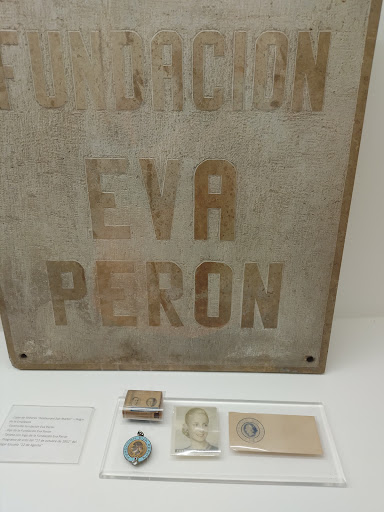
Displayed as well, either without comment or presented as proof of how amazing Evita was. are pieces of evidence of how the Argentine state promoted the Peróns’ personality cult to a degree rare in liberal democratic nations even at the time. A children’s reader expects grade-schoolers to be grateful to Eva personally that ordinary people can now have nice things. A public information film in newsreel form, ostensibly encouraging women to exercise their new franchise, actually reveals the pressure women faced to vote Peronist; Evita’s smiling face is everywhere.
And the purpose of the museum is to defend Evita’s legacy, setting the record straight for those who know little about her beyond what they could gather from the musical (itself full of distortions which the movie version could only tone down so much).
This could be a great museum. All it needs is some attention from a curator more inclined to take a more neutral view of Evita’s life and career, placing her more clearly in its historical context—and blessed with a bit of awareness of how odd her personality cult now looks and how transparent Peronist propaganda now appears to visitors in 2025, especially from outside Argentina.
(If you go, don’t buy the English translation of Evita’s Reason For My Life offered in the gift shop. However effective it must have been in its time as propaganda aimed at average Shirtless Argentinians in its time, as autobiography (much less as literature) its value is minimal, not least because Evita reveals almost nothing about her life before Juan. Spare a thought for the Argentinian children once forced to read it as a required school text.)
To be fair, at least in Argentina, there may as yet be too little demand for a historical Evita, less even than there is demand for the historical Jesus at the Buenos Aires Metropolitan Cathedral. She is adored and hated, in equal measure, far too much for that.
Either way, for now, you’ll have to look elsewhere for the “real” story of Eva...
Read moreThis was a disappointing experience. The front counter staff were indifferent to the needs of paying tourists/customers. There is some translations but all specific items are not translated. Wifi was down which was a shame because I could have used it to translate some of the text, and the staff didn't care. When I called them out on the wifi being down like it was last week (I learned from a previous review) the girl retorted "you were here?". I told her they shouldn't even offer it, to take down the wifi sign. It's redundant. They just don't care. Instead of sitting there gas bagging maybe the staff could make translation signs themselves, if the museum director doesn't see fit to do it. There isn't even an audio guide in English, which they could make $ from. Anything. Just lazy.
The collection is ok. It's not really a celebration of Evita's life or work. Her wardrobe and costume which is all part of the 'legend' could be amped up. More images of the clothes from when she wore them, etc. Even from a fashion point of view there is a lot to be said about her dress and the use of fashion in politics. There are interesting elements and I think I understood that they showcase her charity work and impact for women, children & the elderly.
Gift shop was kind of junky. Again not many English translated books. And they only accept cash...staff on gift shop are pleasant and helpful at least.
It's a shame, despite the still obvious debates re Evita's importance in contemporary Argentinian life and politics, you would think they would really honour her legacy more thoughtfully and with vigour, the way Mexico has with Frida Kahlo. Consider, Eva Peron was acting politically and socially unlike women of her generation and that in itself, for better or worse (re politics) was extraordinary. She deserves better than what this museum...
Read moreThe place is instructive as it explains two crucial words in Argentinian politics...namely justicialismo and peronismo. Éva Péron appears as a benevolent Marie Antoinette and Juan Péron as some kind of knight off center left with an égérie faithfull to him and elogious about a set of social values whose roots seem to justify today's Kirchnerismo and the operatic Puccini-Verdi like harmonies of the daily episodes of Saga Queen Dama Christina still unjailable... The exhibits presented therefore hypnotises and makes one wonder if democratic virtues are not a giant fantasma at the border of "ensoñanciones" (rêveries) and/ or fantasmas of Rousseauists proportions or dogmas about a sacro saint " Pueblo" through which God Himself expresses his Will for mankind's happiness. As for the visit itself it is poisoned by a few female guards of the lesser kind who harass and intimidate the visitors about quite unclear and insipid rules forbiding pictures of the very old Pierre Balmain style of Haute Couture...not Chanel, not Dior, not Saint Laurent...and it's very disturbing to have agressive, insulting, impolite, vulgar unelegant alledged "security" interventions about such un-original silk fabrics or broideries once worn as night atours or ceremonious ostentatious tape-à-l'oeil "creations" made to fill up the public eye with awe or puzzlement. You are either leftist or not but "security" is out of place there where NOT ONE single object has any value in worth or foremost beauty. Much more real valuable stuff at the Museo de los Artes decorativos. Entrance price...
Read more