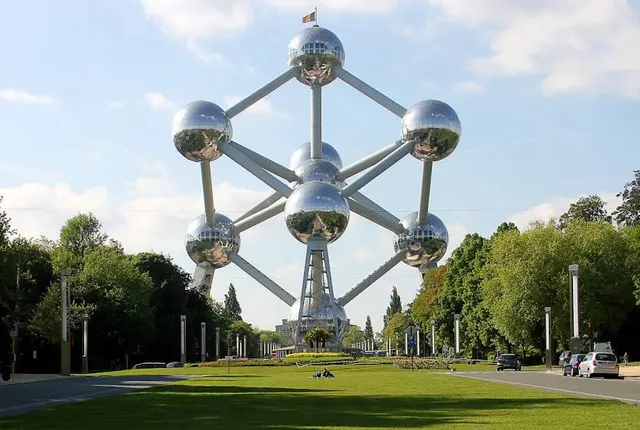
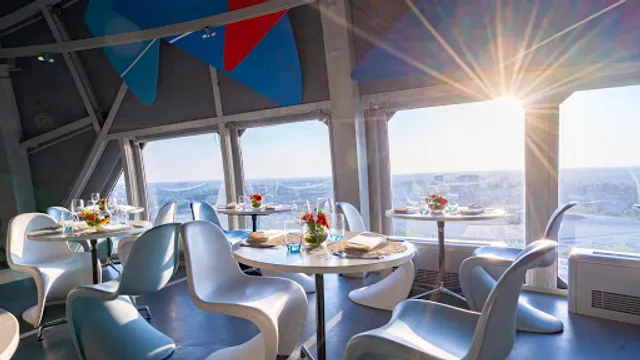
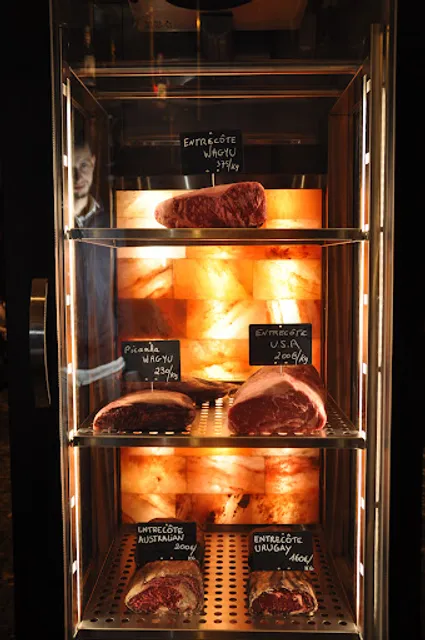
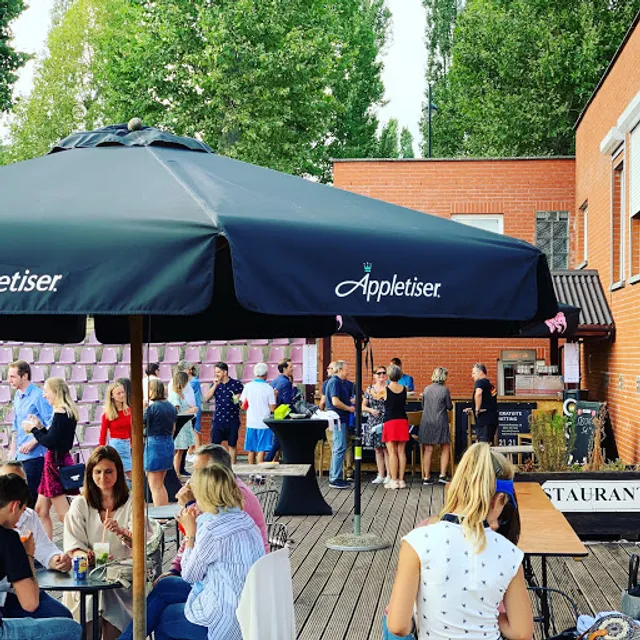
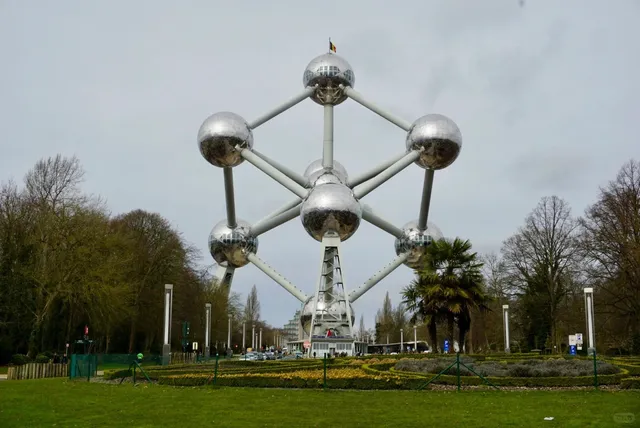
An impressive construction that blends in very well with the surroundings - a great subject for photos! It is definitely worth visiting the Atomium (EUR 16,- for adults) - the construction and the view are impressive. The exhibition on the history of atomium (construction, etc.) is a bit old - here a fresh set-up would do wonders. In some areas there was an artistic light installation installed - it seems something like "we didn't know what else to do with the room, so we'll put some colorful lights in". This is my only criticism - here one could have either accommodated an interesting travelling exhibition or extended the topic "atomic age" to the decades following the year of construction of the Atomium (1958) (technical developments, problems, future, etc.). I recommend a visit to the restaurant (at the top) - you can have a drink there with wonderful views (high price - but cheaper than some touri cafes in the city center). You read here again and again about problems with parking (expensive, unsafe): there is actually a large parking lot in the immediate vicinity - but in the morning you get a parking lot on the street without any problems (with parking machine - I mean it was 5 EUR for 2 hours). Even independent of parking, it is better to start in the morning (the Atomium opens at 10) - the tour starts with an elevator ride up; here you quickly get to a longer queue. The elevator takes you all the way up - from there you go down again with the elevator and then start the tour through the rest of the area. The Atomium is quite unique and can be seen from some trains as you approach Brussels. It is a bit over 300 feet tall and clad in aluminum, so it is hard to miss. It was built in 1958 in conjunction with some World's Fair, from a similar timeframe as the Space Needle in Seattle. The design is supposed to be super-enlarged representation of an iron crystal, I think. It has 9 large spheres attached together with tubes. We rode the subway out to the Heysel station for less than 3 Euros apiece. From there, it is a less than 10-minute walk to the Atomium. I had purchased tickets online in advance (I could not buy them too far in advance, but when I checked back about 4 - 6 weeks ahead I was able to get them). The tickets are just good for a given day - no time slot involved. We went on a Friday and it appeared we could have just gotten tickets when we walked up. Weekends may be busier, though. When you first arrive, they insist on taking your photo (to try to sell you a copy later).This practice usually makes me feel a bit of a cheesy tourist vibe. You then ascend an elevator in the central column up to the top sphere. There, you can do a circuit and take in the views. There is a restaurant there on an upper floor, but we did not check it out. You next descend back via the same elevator to the ground floor again, where you are free to use the escalators and stairs to ascend a couple of levels up. The exhibits about the 1958 World’s Fair were somewhat intersting. You can get an impression of what the original fair's layout was like, and still see some pavilions that got converted to other uses in the distance. As you continue up, the areas with the artistic light shows were less interesting. One seemed like you were inside a giant toaster. From there, you descend stairs back down to the ground level again and exit through the gift shop. This is worth seeing once, but I'd categorize it more as a 'see it if you have...
Read moreWe visited the Atomium Restaurant at the very top of the Atomium. Before that, we had to queue for quite a while just to buy tickets to enter the Atomium. Then we explored the inside exhibition, which took about 1.5 hours. During that time, we finished the entire bottle of water we had brought with us.
Then we headed to the very top. The line was at least an hour long, and there was no place inside to buy water while waiting. The signs said there was a restaurant at the top, so we figured we could get water there.
When we finally arrived, we were met with another equally long line of people waiting to go back down. The view was nice, but not worth all the waiting – we could have spent that time elsewhere.
We decided to at least get a drink before joining the line down. There was no water dispenser anywhere, so we went into the restaurant. If you don’t order food, they won’t let you sit by the window even if you ask, though you still get a view from other tables.
We were thirsty, so we checked the menu. Water was more expensive than Coke or beer – a bit disappointing. Half a liter was €6, and a liter €10. Coke was €4.20, rum €12. In the end, we ordered Cuba Libres instead – if we were going to pay that much, we might as well drink something stronger.
Honestly, they really need a water vending machine up there.
On the positive side, our waiter was incredibly friendly – he elevated the experience and softened our disappointment. For that, we are truly grateful.
Then we joined the queue again, eager to get out as quickly as possible.
The exit, of course, is through the souvenir shop – as is usual for attractions like this. Prices were steep: €3 for a coin, €4 for a magnet, €55 for a miniature Atomium magnet, and even an Atomium pencil sharpener for €12–14. Some items were pricier than in the Natural History Museum in London. I ended up buying an Atomium magnet for €7.60. Prices felt more like Iceland than Belgium.
Our recommendation: set aside enough time for queues and bring at least 0.75–1 liter of...
Read moreThe Atomium, located in Brussels, Belgium, is a stunning architectural marvel and a symbol of modernism and innovation. Designed by engineer André Waterkeyn for the 1958 Brussels World's Fair (Expo 58), the Atomium is a representation of an iron crystal magnified 165 billion times. Its beauty lies in both its futuristic design and its symbolic significance.
Key Aspects of Its Beauty: Futuristic Design:
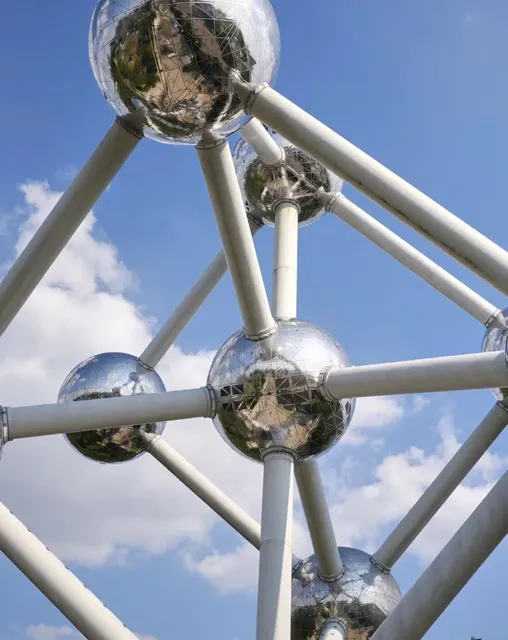
The Atomium is composed of nine interconnected spheres, each 18 meters in diameter, forming the vertices of a cube. The spheres are connected by tubes containing escalators and stairs, creating a visually striking, futuristic structure. The structure’s stainless steel cladding gives it a sleek, reflective appearance, making it gleam in sunlight and glow when illuminated at night. Innovative Engineering:
The design of the Atomium was a remarkable feat of engineering in its time. The combination of geometry and structural integrity is a testament to the innovation of the 1950s. Its construction involved complex calculations to ensure the stability of the spheres and the tubes, which adds to its technical beauty. Symbolism:
The Atomium represents the atomic age and the dawning of the space age, reflecting the optimism and forward-looking spirit of the post-war era. It also symbolizes the scientific progress of the time and the belief in technology as a force for positive change in society. Panoramic Views:
Visitors can ascend the structure and enjoy panoramic views of Brussels from the top sphere, enhancing the beauty of the experience. The design allows for a unique interplay between interior spaces and the surrounding landscape. Cultural Icon:
Over the years, the Atomium has become an iconic symbol of Brussels and Belgium, much like the Eiffel Tower is for Paris. Its distinctive design and historical significance make it a beloved landmark. The Atomium's beauty lies in its blend of artistic vision, scientific inspiration, and cultural symbolism, making it a masterpiece of 20th-century...
Read more